

Cars Tried External Combustion Engines And There Are Good Reasons It Didn't Stick
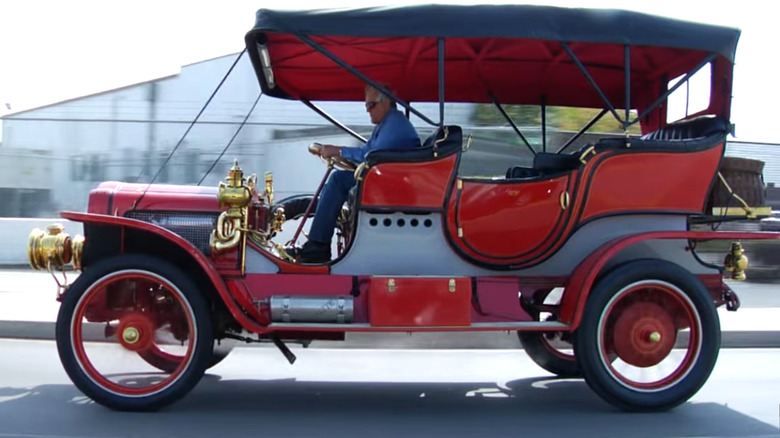
We're not going to get into the whole "who made the first car" argument today. But there's not much doubt that the overall history of self-propelled vehicles goes back well beyond the Mercedes Patent Motor Car of 1885. And it goes back well beyond the development of the internal combustion engine.
Most folks point to Nicolas-Joseph Cugnot's 1769 tractor, meant for pulling artillery pieces, as the first vehicle to be able to move under its own power. That power came from a steam boiler — a means of external combustion where the action takes place outside of the engine proper. With internal combustion engines, the fuel and air burn inside the engine block itself, in the engine cylinders. It took another 100 years before Amedee Bollee Sr. produced what we would think of a modern steam-powered car in 1873, but by the turn of the 20th century, the best-selling cars in America were external combustion steam cars from the Stanley brothers.
Even though no external combustion engines were able to meet the needs of modern drivers much after that, they certainly had their moment in the sun. They also weren't alone, as other external-combustion technologies, such as hot-air Stirling engines, were tried out in cars over time. Unfortunately, one particular issue eventually sunk all these choices: Internal combustion engines tend to deliver usable power much quicker than external combustion motors. They could be pretty dangerous, too, as Jay Leno discovered while working on his 115-year-old steam car.
Steam-car popularity stalled when the Model T was introduced
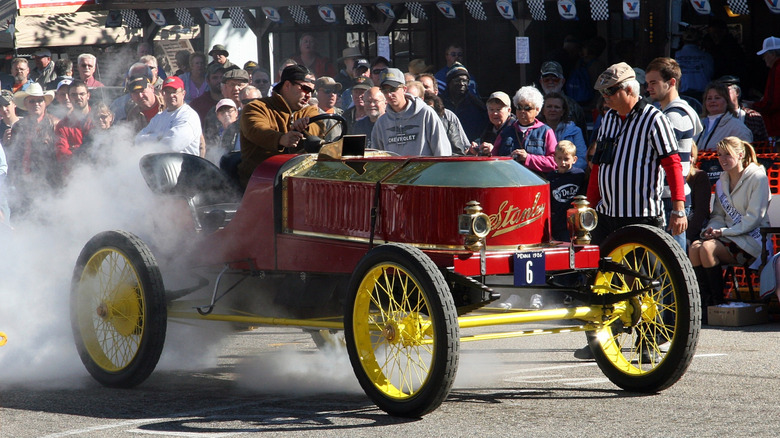
There are a number of reasons as to why steam cars ultimately failed, starting with the fact that they ran on steam produced in a large and heavy boiler tank filled with water and fuel. Just like when you're making tea or whatnot, it takes a certain amount of time for the water's temperature to rise to the boiling point. That could mean a wait of up toa half hour for a steam car, which wasn't ideal compared to a gas-engined car that's ready to roll as soon as you crank it up — and once the electric starter was invented, in 1912, cranking wasn't even necessary. (The starter motor may have been the No. 1 aftermarket part in the 1910s.) It's also worth noting that steam evaporates into the atmosphere as it cools, so you'd have to refill your car with it.
Consider the 1903 Stanley Type C which had a 20-gallon water tank that boiled off one gallon per mile. For some context here, the 1909 Ford Model T only had a 10-gallon gas tank, but due to the higher energy density of gasoline, it could get 13-21 mpg. While the Steamer had to stop at least once every 20 miles for water, the Model T had a low-end range of about 130 miles before you had to refill.
A lot of folks also point out what seems like an inherent danger of steam boilers. But this risk was a bit overblown — at least in Steamers. The unique design of the Stanley boiler meant there wasn't a single documented report of a boiler explosion with their cars.
Stirling engines never became the gold standard
As mentioned, steam engines weren't the only external combustion motors proposed as alternatives for cars. There was also the Stirling engine, an advanced type of heat engine. The most basic examples include a closed system containing pistons and an unchanging amount of hydrogen or helium gas. A separate heater, which can be fueled by a number of sources, changes the temperature of the gas, causing it to expand or contract, in turn forcing the pistons to move. The setup was patented by Robert Stirling in 1816 to work pumping water in mining operations, likely as a safer alternative to potentially explosive non-Stanley steam engines.
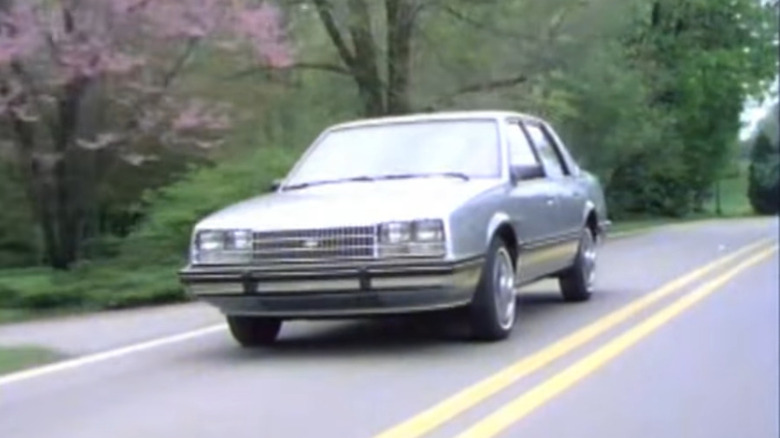
Stirling engines had their uses, mostly as water pumps and cooling fans, but gas and electric motors were soon improved to the point at which they were more efficient than early Stirling engines. Stirling's also power plants had trouble operating at high temperatures, too, and were more expensive to build. Yet none of this stopped the U.S. government from launching the Automotive Stirling Engine Development Program in 1978, backed by funding from the Department of Energy and overseen by NASA. By 1985, the project had evolved so far that a Stirling-powered 1985 Chevrolet Celebrity was going through real-world testing.
Results did include improved fuel-economy and performance compared to the gas-powered Celebrity, but the Stirling version remained too heavy and expensive for practical use. According to NASA's math, getting 150 horses out of a Stirling engine would still require a motor weighing over 800 pounds and priced at $2,250 (nearly $7,000 today). Besides, fuel-efficiency standards are dead now, anyway, so automakers don't have much incentive to experiment with these designs again.