

What's The Purpose Of A Carburetor Vacuum Line?
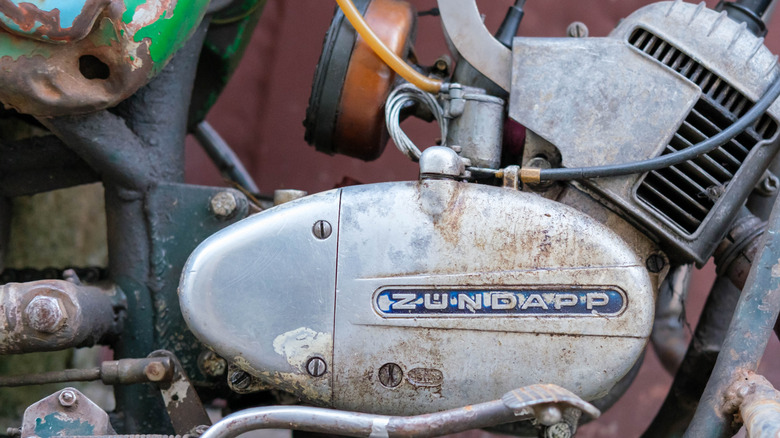
A carburetor is a simplistic and old-school way of delivering air and fuel to an internal combustion engine. In its most basic form, no electronics are required. All you need is a throttle cable, some adjustment screws, and — well, that's pretty much it. The air-fuel mixture travels into a two- or four-stroke engine, where it is combusted to spin the crankshaft and propel the vehicle down the road.
Vacuum is produced by gasoline-powered engines and utilized for a variety of different jobs. On a moped, motorcycle, or other smaller displacement engine vehicle with a gravity-fed fuel tank, the purpose of a carburetor vacuum line is to send engine vacuum to a petcock that allows fuel to flow into the engine's carburetor. When vacuum isn't present, the petcock closes, cutting off the flow of fuel.
However, to fully understand the concept, we can't end it there. It's important to know what vacuum is, and why its application doesn't just end at opening the flow of fuel.
What services does a carburetor vacuum line perform?
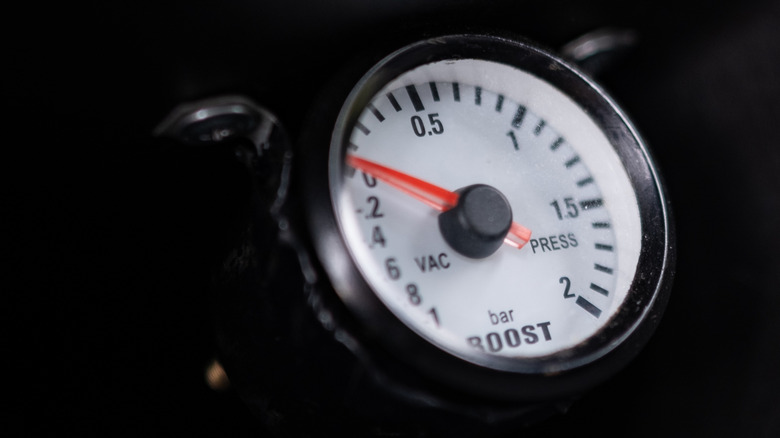
A vacuum is the result of an imbalance in air pressure — as is created repeatedly during the standard operation of an internal combustion engine — and is relied on for many different tasks in most cars on the road.
In its most basic definition, vacuum is the difference in air pressure inside the intake manifold and the outside of it. In an engine, vacuum is created when the piston travels downwards during the intake stroke while the intake valve is open, the exhaust valve is shut, and the throttle blades are closed or only barely open.
Vacuum that is routed through a carburetor is commonly used for a variety of tasks, not just pulling down on motorcycle petcocks. When a vacuum line is hooked up to the carburetor in a passenger car, it transports vacuum to provide pulling power to the brake booster, which pushes on the master cylinder to actuate the brakes. It's also commonly used to automatically actuate the distributor's timing advance. Additionally, its force opens the exhaust gas recirculation (EGR) valve to re-burn some of the exhaust gases, helping clean up the vehicle's emissions.
Vacuum is a fascinating force of nature with many applications in engines
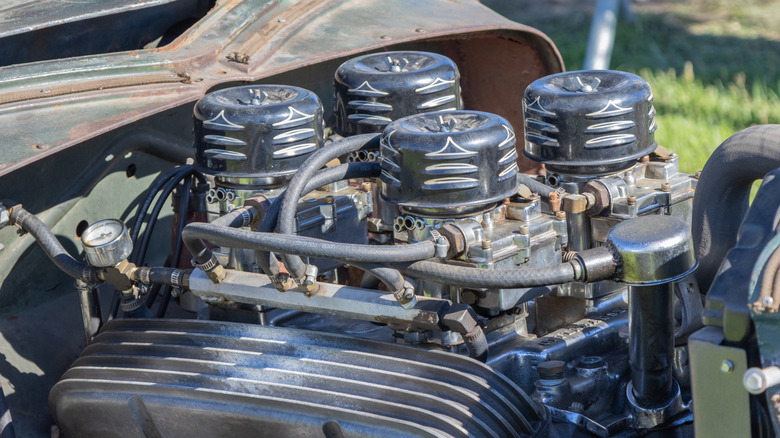
To drive the whole concept home, let's dig a little deeper into how carburetors work.
Carburetors are basically tubes, but with a few crucial components mixed in. At the beginning of a carb's functioning equipment is the choke, which restricts air flow in order to create a richer (meaning, more fuel than air) air/fuel ratio at startup. Then, inlet air reaches a narrowing in the tube where it experiences the Venturi effect. This means a low pressure area is created, which pulls the fuel out of where it's dispensed. Finally, this air/fuel mixture gets to the throttle valve, where, depending on the amount actuated by the driver's input via the gas pedal (or handlebar's throttle), it's let into the intake manifold.
When the piston pulls the air/fuel mixture into the cylinder via the intake manifold, with the throttle either closed or slightly open, the vacuum that's being created helps feed the fuel in on a gravity-fed small-displacement engine. It's quite nifty that somebody came up with the concept of utilizing a byproduct — vacuum — to perform such a crucial task. That same byproduct can be tapped into to perform a wide variety of crucial tasks to provide safer, more efficient, and cleaner operation in carburetor-equipped vehicles.
Is vacuum still utilized in passenger cars even though carburetors haven't been bolted up to them for a few decades? It sure is — vacuum is tapped into via the intake manifold and utilized for additional tasks like operating turbo wastegates, actuating climate control systems, and even providing power to older automatic door locking systems.