

The Smallest Diesel Engine In The World Fits In The Palm Of Your Hand
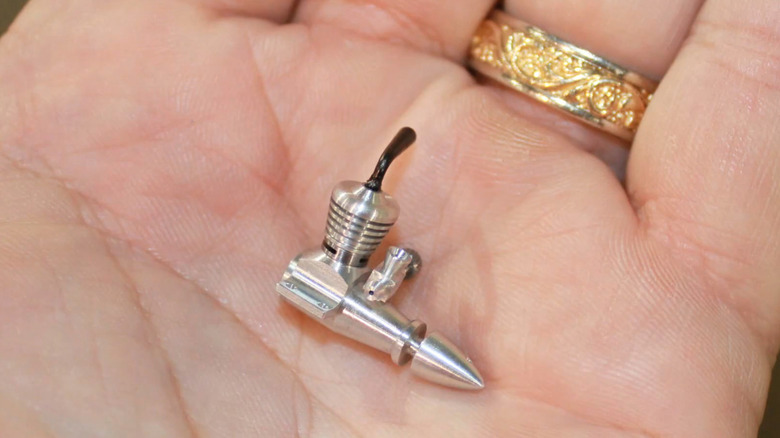
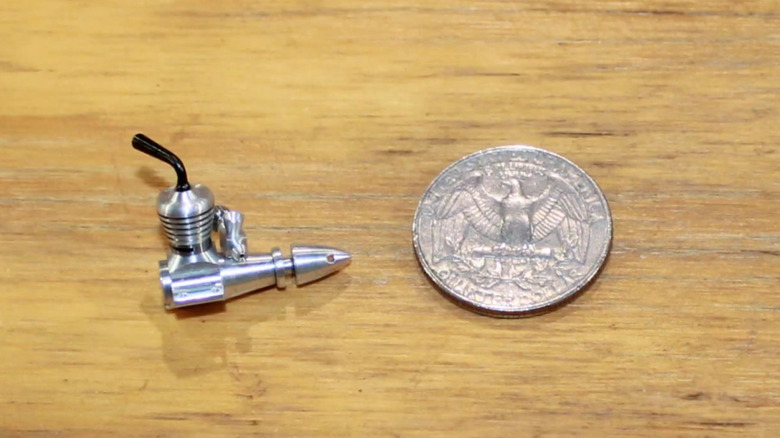
Holy smokes, this diesel engine is small. It's like holding the power of a reliable Cummins diesel engine in the palm of our hand. Okay, maybe that's a bit of an exaggeration, and sounds a bit too much like something Doc Ock would say. But engineer and Gainesville, Florida resident Ronald Valentine created fully functioning diesel engines that are smaller than a quarter but still powerful enough to to spin the propeller of a remote controlled plane. While bite-sized diesel engines are nothing new, Valentine's are exceptionally small and, at the time of its creation, this one was considered the smallest in the world.
It's called the Nano Bee and it's the smallest of Valentine's surprising collection of tiny diesel engines. Admittedly, once it's hooked up with a fuel source, hose, and propeller, it's a bit bigger than a quarter, but it could still fit in the palm of your hand. Many enthusiasts of small remote-controlled (RC) airplanes use tiny engines like Valentine's to carry their winged passion projects into the sky. Since Valentine didn't respond to questions we posed via Facebook message, it's unclear what kind of plane the Nano Bee can power. A paper airplane, maybe?
Why build a diesel engine the size of a quarter?
Why would Valentine go through the painstaking engineering required to develop an engine smaller than a quarter? The better question probably is: Why not? It's just awesome. But more practically, piston engines like Valentine's are popular among RC plane enthusiasts because they're small and light enough to fit in the front of the plane, but also typically have longer runtimes and easier refuels than electric planes. While there's debate among enthusiasts about which fuel type is better — diesel, gasoline, or nitro (nitromethane/oil mix) — piston engines in general are popular.
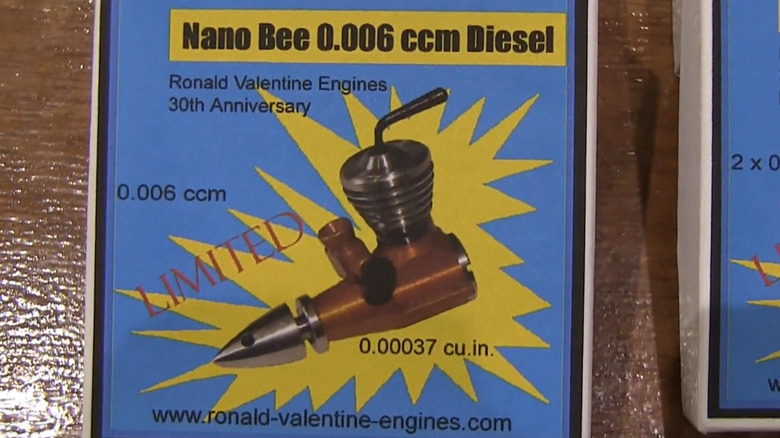
Valentine's Nano Bee is both his smallest and most famous engine, and it's the one that's garnered the most attention at trade shows and swap meets since he created it in 2011. With its 0.006-cubic-centimeter displacement, single cylinder, and tolerances as low as one-ten-thousandth of an inch, it isn't hard to see why it's so popular. And if you're into RC planes, the little Nano Bee can spin a 1¼-inch-diameter propeller at 12,800 rpm, potentially making it a very useful engine for some enthusiasts.
It's unclear how much power it makes and what sort of plane it can fly. Valentine doesn't have much of a presence on the internet anymore, as his website is no longer active. However, most of the enthusiasts who own his engines seem to keep them as novelties, rather than actually use them. Valentine's engines don't seem to be cheap, with poster ukanduit saying on Cox Engine Forum that they paid $500 for a Nano Bee. We wonder about reliability, given such tight tolerances and small parts.
How does someone make such a small engine?
Valentine is an engineer who studied at the University of Stuttgart, in Germany, and wanted to see how small he could make an internal combustion engine. He's been building tiny engines since the '80s, and most of his engines were hand-machined by him and his brother Chris. No Computer Numerical Control machining, no mass production. Just hand-built, low-volume engines made from steel, aluminum, and brass. And despite their absurdly small size, they're all fully functioning piston-pushers.
One of his original works was an air-cooled, five-cylinder, four-stroke radial engine that ran on methanol with glow ignition. He even custom designed and fabricated custom glow plugs for it. According to the Miniature Engine Craftsmanship Museum, which owns many Valentine engines, the pistons and cylinders are lapped to such tight tolerances that his engines don't even need piston rings.
In 2007, Valentine created one of his more modern designs, which could be one of the smallest diesel radials in the world, certainly smaller than the already small radial engines fitting to the reborn Meyers Manx. It's a five-cylinder engine with a 0.49cc displacement, a three-piece crankshaft, and two intake and exhaust ports for each cylinder. It only weighs 2½ ounces and spins a prop at 9,300 rpm.
Valentine is far from the only builder of tiny engines, but his are among the smallest and most impressive. But his Nano Bee, with its bafflingly small displacement, is the smallest functioning diesel engine known in the world.