

Why Hudson Stuck With A Straight-6 Engine When It Already Had An 8
America's automotive history is dominated by the V8. It's what we're most famous for. You can probably hear Jeremy Clarkson saying "V8 motor," with his less-than-kind American accent imitation. In terms of motorsport, America is most famous for NASCAR, despite IndyCar — goofy cooling-system tubes and all — being the fastest circuit racing on this continent. However, it might come as a surprise that one of the most dominant racing engines in NASCAR history, and American automotive history in general, wasn't actually a V8. It was Hudson's massive inline-6.
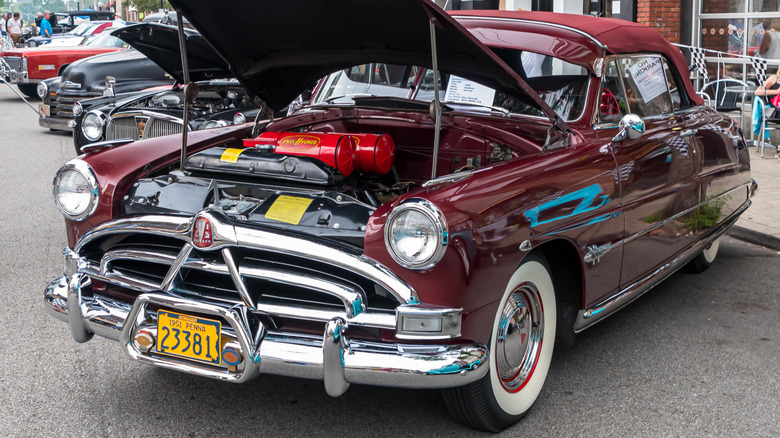
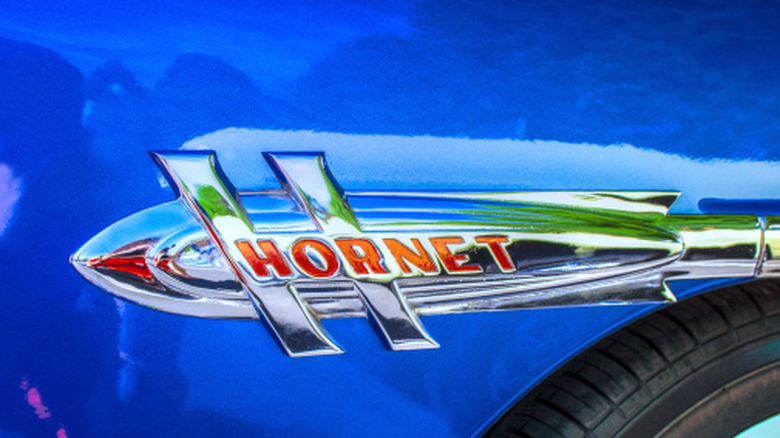
In the 1950s, when NASCAR was starting to gain popularity in America, many of its automakers were running V8s, like the Studebaker and Oldsmobile. However, despite having a V8 in its lineup, Hudson stuck with its enormous 308-cubic-inch (5.0-liter) flathead straight-6 in the Hornet. Why stick with an old-school (even by 1950s-standards) flathead design and fewer cylinders? It was that good an engine, that's why. Despite its smaller displacement and fewer cylinders, Hudson's inline engine made more power, which helped it eventually dominate its rivals in NASCAR.
Why stick with the straight-6 when it already had a straight-8?
Hudson's flathead straight-8, used in cars like the Commodore, started its life in 1932. So when Hudson eventually dropped it in 1952, it was already quite old. However, Hudson was a small company and didn't have the money or resources to invest in a new V8 with newfangled overhead-valve technology. What it did have was tons of flathead inline-6 knowhow and the ability to massively upgrade its successful "Super-Six" engine. So that's what it did.
Flathead, or "L-head," engines were old-fashioned even in the 1950s. In a flathead engine, the valve train is inside the block, which lets the cylinder head be, well, flat. Due to that design, valves and combustion chamber were off to the side of the cylinder, rather than directly above it. While flathead engines could have decent low-end torque, they weren't efficient, nor did they have the power potential of an overhead-valve engine. But they were durable and cheaper to make. So it made sense for Hudson to just build the best flathead it could, rather than invest in newer technology.
Despite the aging engine design, Hudson managed to squeeze out more power from its massive six-cylinder than some competitors could from V8s. The 308-cubic-inch, single two-barrel carbureted straight-6 made 145 horsepower at 4,000 rpm and 257 pound-feet of torque at just 1,600 rpm. For comparison, the Oldsmobile "Rocket" 303 cubic-inch V8 made just 135 hp and 253 lb-ft at the time.
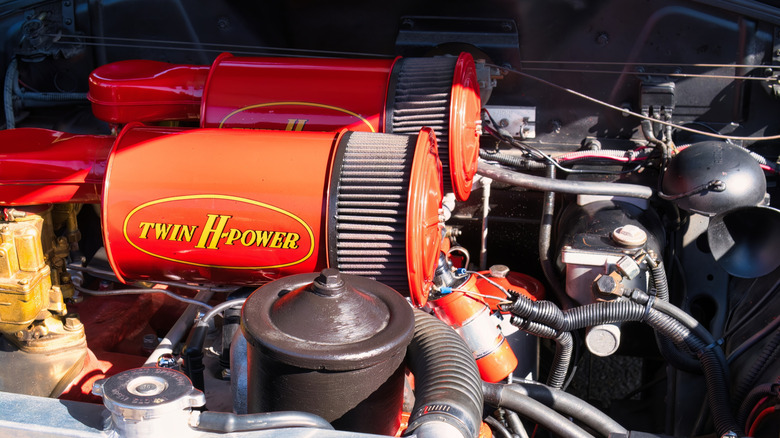
It got even better, though. In 1951, Hudson created the "Twin-H" dual carburetor package, which started out as a dealership add-on but was offered from the factory in 1952. The Twin-H package came with two Carter WA-1 single-barrel carbs that bumped power to 160 horses, while torque remained the same.
How did Hudson end up using its old-school engine in NASCAR?
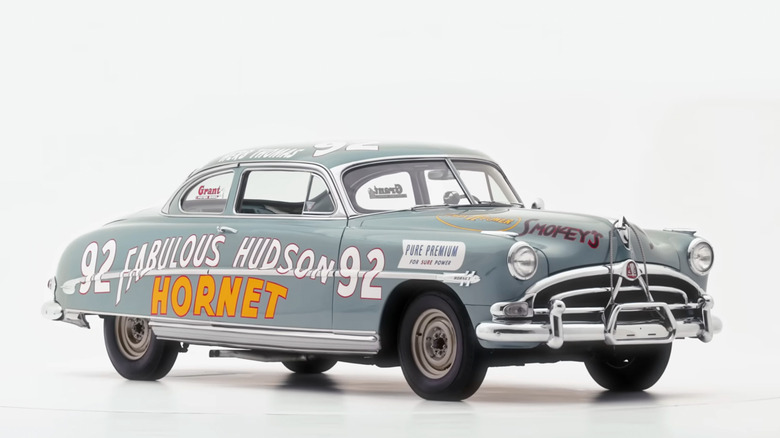
NASCAR racer Marshall Teague saw racing potential in the Hornet after winning a beach race in Daytona in 1951. Hudson welded the floor pan to the underside of the frame rails, which improved handling and performance by lowering the center of gravity, and allowing a lower, more sweeping roofline without sacrificing headroom. The Hornet impressed Teague enough that he visited Hudson in Detroit and talked its executives into backing him in NASCAR, which led it to become the first automaker to dedicate factory resources to the racing series.
Hudson didn't just slap a racing livery on the Hornet and send Teauge packing, though. Teague and Hudson engineer Vince Piggins helped develop a special version of the flathead six-cylinder for NASCAR, internally known as the "7X" engine. It had a bigger bore and valves, as well as polished combustion chambers, a higher compression head, and an upgraded camshaft, among other improvements. There's some debate as to how much power the 7X engine made, as Hudson never released official figures. However, it's estimated to have made between 220 and 270 hp.
The parts that made the 7X so much more powerful were sold as dealer-installed add-ons, under the "Severe Usage" rule that let automakers sell special parts for certain applications, such as cop cars. Since dealers sold those parts, NASCAR had to allow them in racing Hornets. Since NASCAR was still a genuine stock car racing series at the time, Hudson needed to sell the 7X engine to customers in order to race with it. So the 7X was offered as a dealer-installed add-on, available locally rather than from the factory.
Hudson's NASCAR career was short but legendary
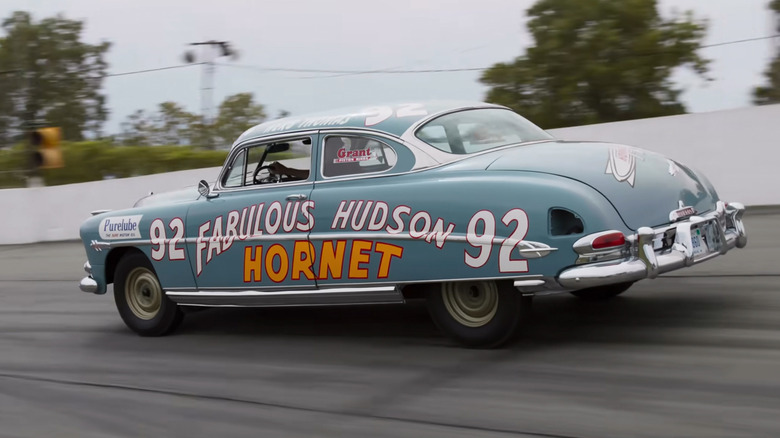
Hudson only raced in NASCAR from 1951 to 1955. However, during that short run, its hard-charging Hornets managed to rack up a whopping 79 race wins and three Manufacturers' Championships. Those three straight championships, from 1952 to 1954, tie it for third most in NASCAR history to this day, sharing the title with Toyota and Oldsmobile. Chevy's 39 titles and Ford's 17 might make Hudson's seem small. But to win three championships in only five seasons racing is a remarkable achievement, even so. And doing so in three consecutive seasons of racing makes it even more impressive.
It's hard to overstate just how dominant Hornets were in NASCAR during that brief period. In 1952, there were 34 races. Hudson won 27 of them, which is an astonishing 79%. The following year, it won 22 of 37 races, which is still an impressive 59%.
Did Hudson eventually ditch its killer 6 for a V8?
Nothing is long for this cruel world, even a V8-slaying straight-6. Even though Hudson found so much success on the race track, it found less in the sales sheets. All of Hudson's innovative chassis and engine designs actually ended up hurting it, as it was too expensive to create cheaper variations for customers, like The Big Three (GM, Ford, and Chrysler) could. So sales halved in 1952. In 1954, in order to stay alive, Hudson merged with Nash to form the American Motors Coporation (AMC).
The merger ultimately killed off all of Hudson's original models by 1955. Instead, AMC had Hudson build rebadged Nash models. And while the Hudson Hornet and Wasp still existed, they were simply Nash models with mildly modified bodies. Ironically, the shift finally gave Hudson a new eight-cylinder engine — but it wasn't its own.
AMC made a deal to buy Packard 320-cubic-inch V8s for Hudson and Nash cars. In 1956, Hudson and Nash models got 352-cubic-inch V8s with two-barrel carbs. However, even though the V8s made more power than any Hudson flathead I6 (with the potential exception of the NASCAR-special 7X), it's the humble six-cylinder that remains beloved.
The Hudson Hornet even continues to live on in pop culture, in the Pixar movie "Cars." Delightfully played by Paul Newman, the appropriately named character Doc Hudson is designed to resemble a Hudson Hornet. So even if casual car enthusiasts don't remember Hudson or its brilliant straight-6, the legend still lives on.