

What Exactly Are You Doing When You Jump Start An EV?

You may or may not know that an EV, in addition to its massive battery pack, has a smaller 12V system to power the auxiliaries. Just like what you'd find in an internal combustion vehicle, the 12V is there to facilitate your EV's lights, alarms, door locks, and sophisticated computer brains. The 12V also steps in to prevent voltage swings and protect the electrical systems whenever the main battery starts to act weird. It's even responsible for disconnecting the high-voltage system during a crash.
Understand that while it's entirely possible to jump an EV's 12V battery, you can't jump the main battery (and you should never attempt that). Regardless, the process of jump starting is very similar to what you've practiced in the past — at least for the vast majority of EVs. But to be certain, double-check the owner's manual, just in case. If you're confused or haven't jump started a car before, a quick and easy way to remember the process is an old saying: "Red from the dead to red on the good, and black from the good to under the hood."
Before you jump start, however, there are a few EV-specific things to take note of here. Don't use another EV to jump the dead one, as the 12V battery is not designed to assist another jump start. Second, unplug your EV from its charger before jumping the 12V. And, of course, don't mix up the jumper cable colors; the internet already has a vast library of the calamities that might occur when you do.
Jumpstarting an EV 101
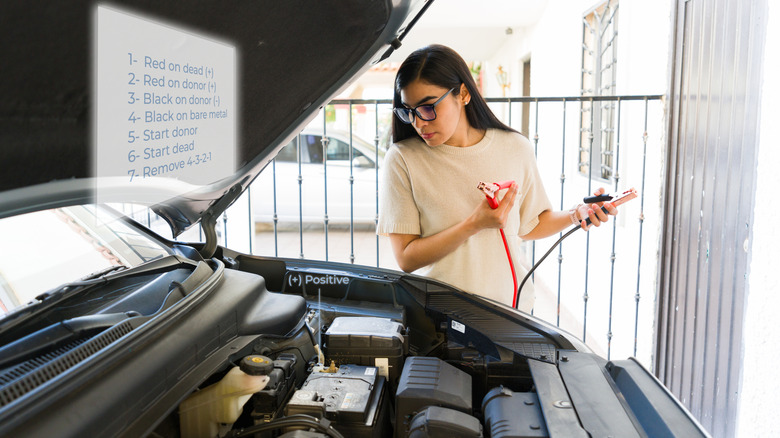
To jump start an EV, start by positioning both cars (or the portable jump starter, if you're using one) so that you have enough clearance and the jumper cables are within reach. Next, make sure that both cars are in park and turned off. Connect one end of the red jumper cable to the dead battery's positive terminal, which typically features a red cover or marking. Connect the other end of that cable to the positive terminal of the good battery. Then, use one end of the black jumper cable and clamp it on the negative terminal of the donor battery, and connect the other end to a grounding point on the EV, such as an unpainted metal surface or a dedicated grounding stud. Before proceeding with the start, check everything and inspect the clamps for loose contact.
From there, start the donor car (the one with the good battery) and let it run. Once the donor car has been on for a while, get in the EV and try starting it. If it's not starting right away, cycle the power button a few times and keep the EV on for at least 20 minutes. When you're done, disconnect everything in reverse, starting with the ground.
Interestingly, the 12V inside an electric car is of a "deep cycle" variety, so it isn't always a one-to-one copy of the battery in your regular car or truck. Unlike internal combustion vehicles, electric cars don't have an alternator; they use trickle charging (via a DC-to-DC converter) to keep the 12V topped up. Also, when you plug in your EV, the computers use some of the available power to charge the 12V battery as well.