

When Did US Automakers Switch To Metric Bolts?
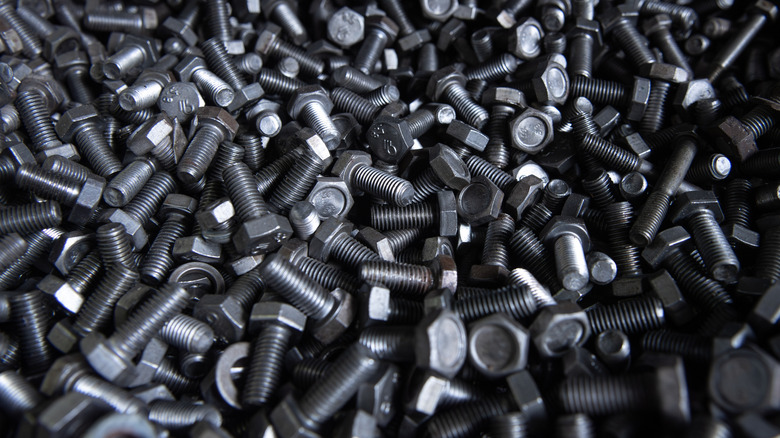
The 1970s were a turbulent time for the American auto industry. Not long after the decade's kick-off, the dense fog of the Malaise Era set in, giving us numerous love-it-or-hate-it models, many of which sported an iconic Bustleback design. Emissions standards were implemented, leading to the widescale adoption of catalytic converters (which was definitely a good idea) and brutally low engine outputs. However, there was one gleam of light that made life easier for professional mechanics and DIYers alike: it was when U.S. automakers began switching to metric bolts.
The keyword here is began, because metric bolts didn't fully replace standard, otherwise known as Imperial, English, or SAE fasteners, for many years. Popular internet forums have no shortage of discussion revolving around this topic, but in terms of when America's big three automakers first committed, that would be the early '70s. Though, conversion was slow — to the point that some vehicles came equipped with both standard and metric fasteners.
The beginning
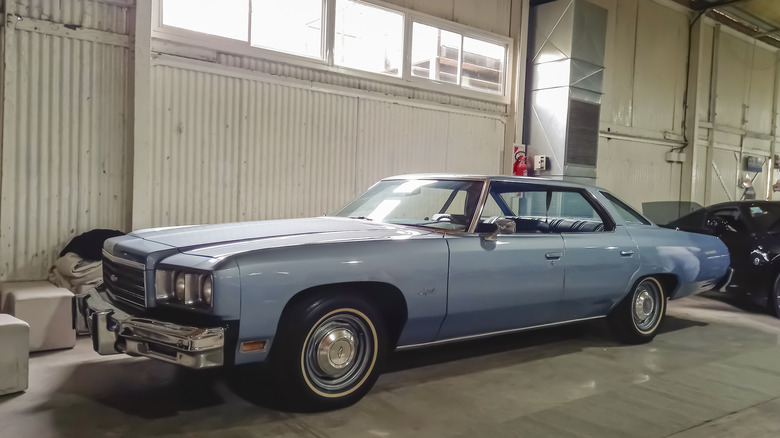
Replacing standard with metric wasn't a cottage industry movement. According to an article by the New York Times from December 1975, it was General Motors that first took the dive. "When General Motors decided to go metric in 1973, letters announcing the move were sent to its 47,000 suppliers," wrote Rita Reif during the era. "Six months later the manufacturer held a meeting for 600 of its suppliers of nuts and bolts to explain the thread system it had adopted. The mostly metric Chevette was the result."
The Chevy Chevette is an excellent example. Coded internally by GM as the T-car, this platform and badge sold in markets all over the world, known as the Vauxhall Chevette in Europe and the Opel K180 in Argentina. But it wasn't a direct import — GM brought the plans to the U.S., where they were reworked for the American consumer in just 18 months. One of the carryover features from its international DNA was offering two engines, a 1.4-liter and a 1.6-liter four-cylinder — while engine sizes are measured in liters these days, cubic inches were the reigning measurement at the time of the Chevelle, making it unique in more ways than one.
Above all else, switching to metric was a manufacturing industry move intended to save money. The Times went on to report, "What's more, metric opposition is crumbling now that early predictions of astronomical conversion costs have been revised. Reduced estimates have been reported both by industrial giants that are already predominantly metric..."
Today, most of the world uses metric fasteners. However, according to a handy quiz by Napa, Myanmar (written as Burma in the quiz) and Liberia are keeping it old school living the standard life.
Adopting metric was rocky
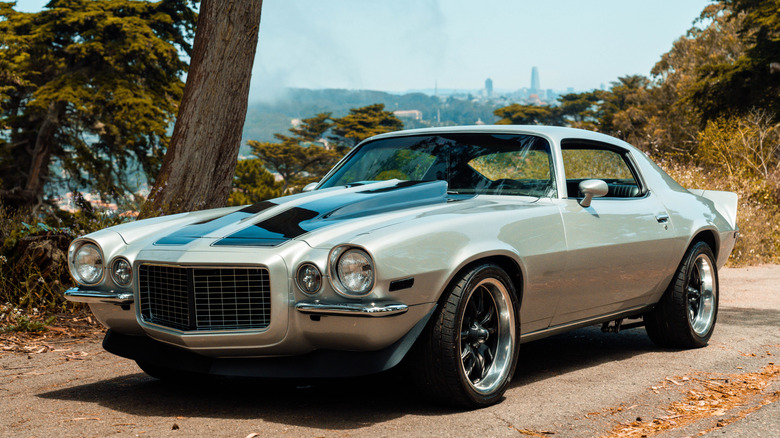
There wasn't a particular date that signified all bolts would be metric. As Hot Rod Magazine pointed out in March, 1985, "Older engines and chassis may have a combination of both standard (English) and metric fasteners. Correct identification of these new fasteners is vital in order to replace damaged parts with correct and safe new parts."
Hot Rod Magazine also clarified that, not only can American metric bolts differ from their European and Japanese counterparts, but also, "most U.S. metric bolts and screws (as well as many nuts) have numbers embossed on their heads ... they identify its tensile strength properties. Thus, a bolt marked '8.8' has been heat-treated to DIN Grade 8.8 strength properties." Tensile strength between metric and standard bolts do not correspond. Interestingly, it wasn't until the early 2010s that American automakers started converting to metric wiring standards.
These days, metric is the uniting bolt measurement among automakers of the United 50. The 1970s were the tipping point, and, with its introduction, a whole new level of knowledge became necessary if you're ever in a position of comparing standard and metric hardware sizes, tensile strengths, and so on.