

Single Vs. Dual Exhaust: Sometimes Size Matters And Two Isn't Always Better Than One
Turns out, running a dual exhaust system isn't always better for power, at least when compared to a single-exit setup. There are nuances to this, of course, but the power difference is real, as demonstrated in season 5 of Engine Masters. The guys ran multiple setups, with varying pipe diameters, muffler design, and merge/collector combinations, all on the same 351-cubic-inch V8.
The first run combined the engine with two 2.5-inch pipes and a restrictive turbo muffler, followed by the same dual pipe setup with a straight-through muffler. Runs three, four, and five were all done using a 3-inch single exit pipe, with a 90-degree merge and turbo muffler, a Y-merge and turbo muffler, and a Y-merge with straight-through muffler, respectively. Although both the 2.5-inch setups performed as expected, as did runs three and four, run number five left the guys in awe. Contrary to traditional wisdom, the single exit Y-merge and straight-through combo made the most amount of power and torque. But how?
Enter exhaust scavenging and back pressure. You might have heard that some back pressure is good for the engine, when in fact, the truth is, any kind of resistance robs the engine of its performance potential. Out of all the combinations, setup number five had the best scavenging and back pressure characteristics. It provided the least amount of resistance for the exhaust gases to pass through. In other words, the engine didn't have to put in the extra work to send those gases out.
But shouldn't the engine be able to breathe better when there are two exhaust pipes instead of just one? Not necessarily, at least when the system is separate and not connected through an X or Y-pipe. Allow us to explain.
The plot thickens
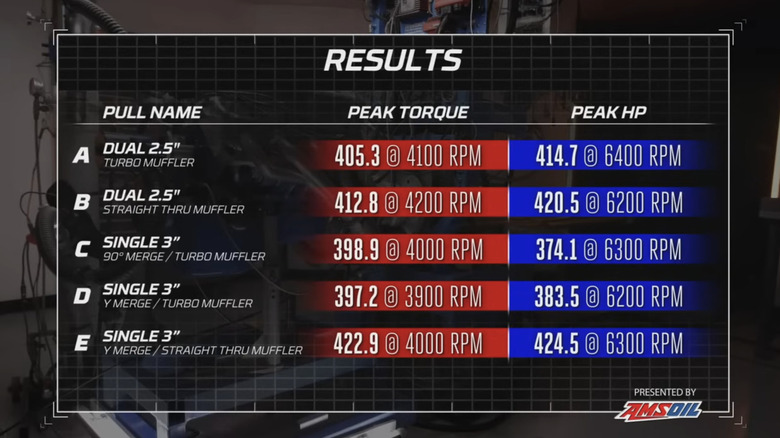
Pictured above are the results from the dyno test. As you can see, just by de-restricting the single-exit muffler, the engine was able to unlock roughly 40 horsepower. Comparing the dual exhaust setups, the difference, although present, isn't all that substantial. It's also worth pointing out that installing a Y-pipe made a slight difference in the single-exit system. Although, to be fair, the 90-degree bend was not doing the exhaust any favors.
The dual-exit system alone (without crossover) won't be better at scavenging than a single-exit setup because, as you may know, a V8 pulsates between banks. When connected, the pulses from one bank are helping the other bank scavenge better, as opposed to just being straight-piped, which has its fair share of pros and cons. By connecting the two sides of an engine (using an H-pipe or X-pipe), you're unlocking more performance, as shown in season 2 of Engine Masters.
But how does this impact the single versus dual exhaust debate, you ask? The X-pipe that you'd use in a dual exhaust is effectively a slightly worse Y-pipe with a leak in it, as there's more turbulence, resulting in reduced velocity. This explains why the 90-degree bend choked the engine, and the Y-pipe made it breathe better.
Something else of note is the area inside those pipes. A single 3-inch pipe has a lot less area for the air to stick to (yes, it does have that habit) than two 2.5-inch pipes combined, so less friction equals better air velocity. Had the guys tinkered a bit more and Y-merged those 2.5-inch head pipes to a de-restricted muffler, things would've been a lot more interesting.