

Why Suzuki Took Consumer Reports To Court Over Its Testing

The results Consumer Reports comes to can sometimes be quite damning. The publication is famously unbiased, and that can lead to negative press. For instance, we covered 67 used models you shouldn't buy according to Consumer Reports.
Now, automakers have to expect some bad press; after all, not everyone is going to like everything you churn out. Whether it be finicky infotainment systems, or controversial styling, they need to take the rough with the smooth. However, when Consumer Reports claimed that the then-new Suzuki Samurai was prone to toppling over, the Japanese firm just wasn't having it.
This was back in the late 1980s, when the model was new to American audiences, and as a smaller Japanese automaker trying to wrestle in among the bigger players, Suzuki felt it had to fight back. Sales had initially been strong, with Suzuki reportedly selling two Samurais for every Jeep Wrangler in 1987, but when Consumer Reports declared the following year that the Samurai was easily toppled, sales plummeted.
A closer look at the lawsuit
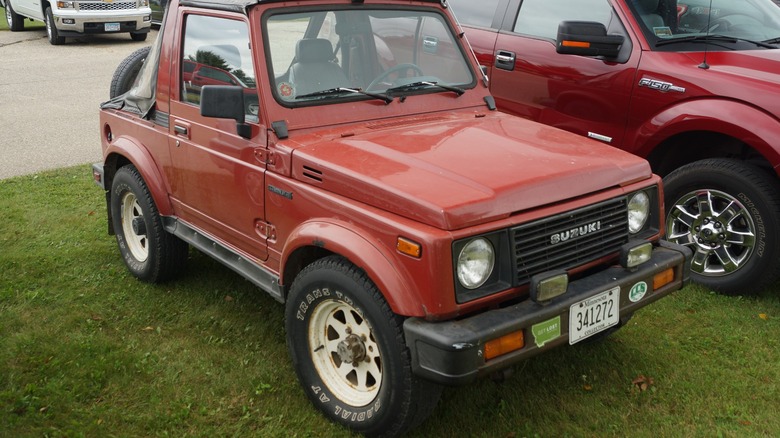
Suzuki responded by taking Consumer Reports to court, and over the years, evidence came out to suggest that the testing conducted by Consumer Reports was unfair. The Samurai proved difficult to topple, even at higher speeds, and Suzuki argued that the publication's driver turned more aggressively at speed than any normal driver would in order to induce a roll.
The same was said of the Isuzu Trooper at the time, and sales fell by the wayside there, too. In fact, Isuzu pulled out of the U.S. altogether in 2008, due to a lack of sales and profitability. Was Consumer Reports partially to blame for this? It's unclear, but the reports of rollovers certainly didn't help Isuzu or Suzuki.
In the end, Suzuki and Consumers Union agreed to dismiss the lawsuit, and to mutually respect each other's position. Suzuki agreed to acknowledge that Consumers Union commits itself to objective and unbiased reporting, while Consumers Union recognized Suzuki's commitment to designing, manufacturing, and marketing safe vehicles.
Issues were highlighted with how Consumer Reports tests and reports on rollovers

Suzuki wasn't the only party upset by the Consumer Reports rollover testing. The National Highway Traffic Safety Administration (NHSTA) had stated in the past that how Consumer Reports conducted its tests was flawed. The NHSTA uses robots to test a vehicle's rollover tendencies, whereas Consumer Reports uses a driver — which allows for far more variation in the test, such as how hard they yank the wheel.
Suzuki also took issue with how Consumer Reports phrased its findings, saying that the Samurai could "easily" roll over in turns. The use of "easily" implied that the Samurai might topple under normal driving conditions, which both parties agreed wasn't what Consumer Reports intended.
While the report ended up being removed from the Consumer Reports site, the damage was already done, and Suzuki felt sales suffered as a consequence. Neither really won here. Instead, Suzuki lost out on sales from a formerly high-performing model, and Consumer Reports had its integrity as a publication questioned. Ultimately, the Samurai ended up as one of the discontinued off-roaders that deserve a modern revival.