

The Last Production Car With A Hand Crank Was Still On Sale New In 1997

The first automobiles lacked several of today's modern conveniences, including electric starters. It wasn't until 1912, when Charles F. Kettering invented one for Cadillac, that there was even an option besides manually hand-cranking a start. However, rather than become a footnote in early automobile history, the hand crank persisted on some vehicle models until the late 1990s.
Hand cranks haven't been the primary method of starting cars since the 1930s, so why did they persist? The crank served as a backup to the electric starter. For instance, the Russian Lada Niva, a rugged SUV, didn't have the best track record in terms of reliability, so the hand-crank option remained well into the '90s. (This wasn't the only unusual model to come out of that part of the world — Soviet Russia produced an off-road sedan way before AMC or Subaru.) YouTuber gogmorgoaway uploaded a video showing the process of hand-crank starting his 1996 Lada Niva.
Car enthusiast bearmtnmartin recalled on Classic Motorsports: "[There was a] 1997 Lada Niva which a forestry company I worked for bought. It came with a hand crank so we all had fun with it." But the car "was gone six months later as parts were unobtanium and it had already started falling apart."
Hemmings says the front bumper opening where the hand crank is inserted is visible as late as 1998 in Lada Nivas, though its appearance doesn't automatically mean the engine supported a hand crank. Today, as the Lada Niva pushes toward five decades in production, it doesn't feature a hand crank anymore — but it still offers a delightfully odd mishmash of stylings, with the interior of a new Lada being one of the weirdest things you'll see all day.
The long-running Citroën 2CV also famously kept its hand-crank option
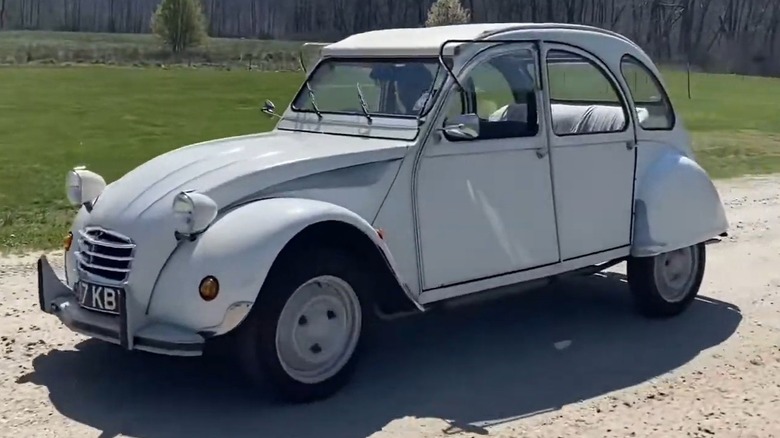
The Citroën 2CV never removed the option to manually hand-crank-start the engine over the course of its lengthy production. With a more than 40-year production life, the oddball French economy car finally retired following the 1990 model.
Unlike the Lada Niva with its electronics of questionable quality, the Citroën 2CV was designed to be basic, dependable, and minimalistic. The hand crank was an example of its utilitarian build, allowing drivers to get moving if the battery or starter became inoperable.
However, in terms of power and speed, it wasn't going to thrill anyone. The 1990 model featured a two-cylinder engine outputting just 29 horsepower. Put the gas pedal down from a stop and you could reach 62 mph in 35 seconds. Still, there may be more life in the old nameplate: the Citroën 2CV is the latest retro icon getting an EV rebirth.
They may look fun, but hand cranks weren't always easy to use
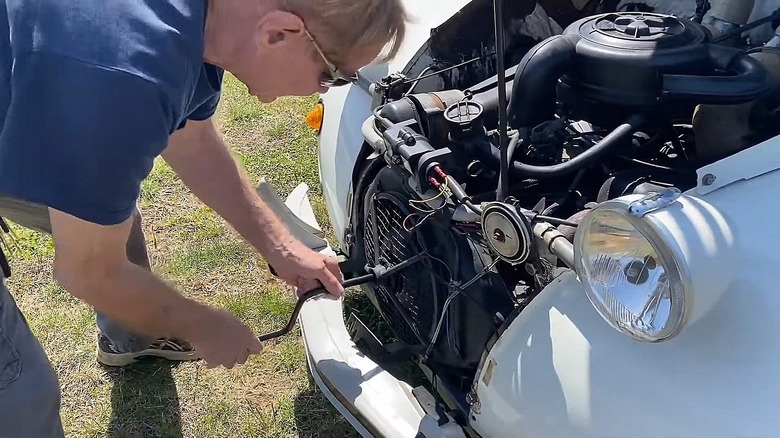
A hand crank works by connecting to the engine's crankshaft through an opening on the front of the vehicle. Turning the handle clockwise, you get the pistons moving, helping to facilitate combustion.
Getting an engine going by hand crank required two things: strength and proper technique. Not only would you get an arm workout, but there was always the dreaded possibility of a backfire. With Ford's Model T, for instance, it was recommended to use your left arm for cranking, because there was less chance it could be broken should the crank arm spin back on you.
A backfire would result in the direction of the metal crank handle suddenly jolting counterclockwise. Many suffered injuries to their hands, or worse, if the recommended grip wasn't used. Fortunately, in the case of the Lada Niva, its '97 model came equipped with a 1.7-liter engine, smaller than the Model T's, making it potentially easier to manually start.