

Why GM's Beautiful 1950s Aerotrain Was A Nightmare For Passengers
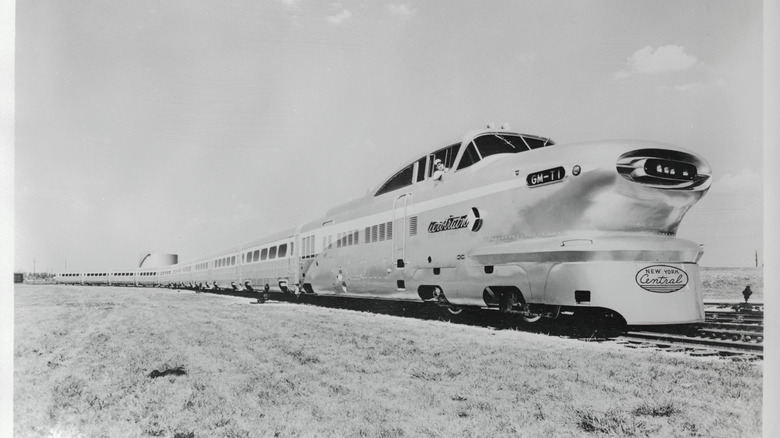
While it was poised to usher in a new era of passenger train travel, the Aerotrain was unfortunately a disappointment — not only for the railroad companies, but for riders as well. Passengers complained of issues like excessive noise and an unpleasant ride. In fact, when running at speeds greater than 60 mph (it was originally made to travel above 100 mph), the suspension system had a tendency to fail, leading to a downright brutal series of severe vibrations during travel. In addition, the Aerotrain's coaches featured smaller interiors with reduced headroom compared to typical locomotives, which was a noticeable downgrade for passengers accustomed to rail travel.
Despite its flaws, the Aerotrain still made its attempt to rewrite the rules of how locomotives were built, as well as what role they would play in the country's future. The 1950s and '60s provided some novel ideas of the next evolution of rail travel, not just with GM's Aerotrain, but also examples like France's plane/train hybrid. Fortunately, visitors of the National Museum of Transportation and National Railroad Museum can still see what's left of the two preserved Aerotrains today.
Why was the ride so rough for passengers?
The 1950s saw a drop in railway travel as automobiles and airlines were dominating. GM, a heavy player in the bus and locomotive market at the time, sought to combine its knowledge of both areas into a new type of train. Take the body of a bus, modify it in a few places, and transform it into a train coach. Each coach was made from the altered shell of a public transit bus, and yet this design was much lighter than a typical locomotive coach.
But the typical trains of that era relied on a few factors to help even out the ride for passengers. First, their heaviness was used as a positive, helping to save fuel and prevent any bumps or jolts from being too noticeable. Secondly, they utilize heavy springs to further absorb the unforgiving ride of steel wheels on a steel track. Conversely, the Aerotrain was significantly lighter than a typical train and opted for an air suspension system.
The problem is that road travel and railroad tracks require vastly different suspension setups. While rubber tires can help cushion the vibration over uneven pavement on the road, Aerotrain passengers had to deal with a ride that was potentially dangerous. Also, since it's bound to a track, a train must be able to counteract lateral movement, unlike a car, where suspension is focused on vertical movement. The air suspension wasn't up to the task, and the higher the speed, the worse the ride. To make matters worse, the bellows (air springs) would rupture, and need to be replaced.
Aerotrain did operate until 1966, but not as it was originally intended

A few of the railways experimented with the Aerotrain, but they decided to go back to previous models in less than two years. Still, GM's locomotive did end up serving commuters in Chicago, with Rock Island Railroad finding a use for them up until 1966. The original lofty goals of triple-digit speeds were abandoned, though, as it was only permitted a top speed of 60 mph. Today, America's deadliest train is speed limited, although it has still caused the deaths of many pedestrians and cyclists. But in the case of the Aerotrain, the speed limit seems to have also stemmed from the inadequate suspension system that made travel miserable at higher speeds.
The goal of Aerotrain was to make this form of travel less expensive by repurposing already existing parts and reducing the overall weight, but it struggled in areas that weren't a problem for other trains. The U.S. isn't short on mountainous regions, and trains navigate them regularly — although aging infrastructure has become an issue, as Amtrak's new trains can't hit full speed on its ancient track. However, alongside shaving hundreds of thousands of pounds off the Aerotrain, GM downsized the engine, too. This proved extremely problematic on rail lines that included inclines, forcing the Aerotrain to accept help from another locomotive. Even in its earlier days, passengers weren't given much reason to be confident in the Aerotrain's capabilities.