

No, European Cars Can't Use American Car Oil: Here's Why
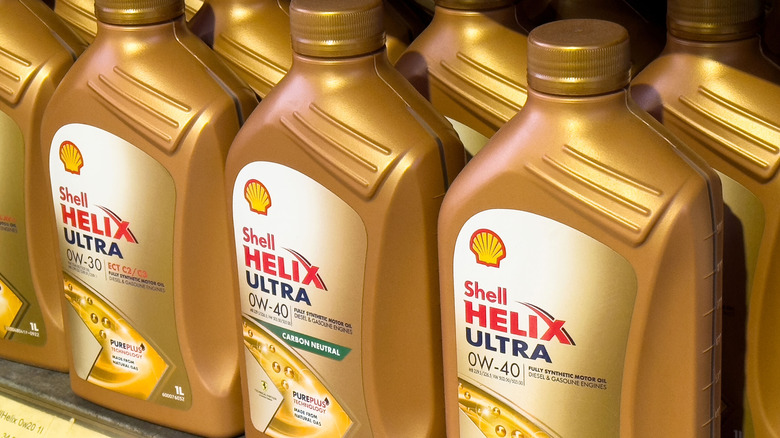
There are a multitude of factors that separate European- and American-spec engine oils, but if we were to pick one, it'd be emissions. Both the European Automobile Manufacturers' Association (ACEA) and American Petroleum Institute (API) set engine oil standards that align with their respective markets. Perhaps the biggest difference between them is that the ACEA focuses more on gas mileage and emissions, while the API standards place greater emphasis on oil residue and wear protection.
Additionally, European OEMs are more pedantic when it comes to oil specs, going as far as developing unique engine oil tests that better suit their specific engine and turbocharger designs. Mercedes-Benz, Porsche, BMW, and Volkswagen all have their own takes on engine oil specification. Ford and General Motors have also joined the bandwagon, apparently.
To meet their specific requirements, engine oils often have a cocktail of additives like friction modifiers, antioxidants, and advanced detergents. As Amsoil puts it, one OEM may require an oil spec that's better at resisting oxidation, while another may demand something that keeps the oil relatively stable in terms of viscosity changes.
Speaking of which, European engine oils, whether synthetic or semi-synthetic, typically feature a wider viscosity range. As you may know, it's not uncommon for European OEMs to recommend using 0W-40 or 5W-40 for their engines, which are much rarer recommendations as far as domestic automakers are concerned.
That's not all. American automakers typically recommend changing the engine oil between 3000 and 5,000 miles. In contrast, many European makes have oil change intervals between 10 and 15,000 miles. To compensate for the longer drain intervals, European cars require special oil formulations that are more capable of resisting wear and protecting against sludge and other unwanted residues.
Emission standards dictate the game
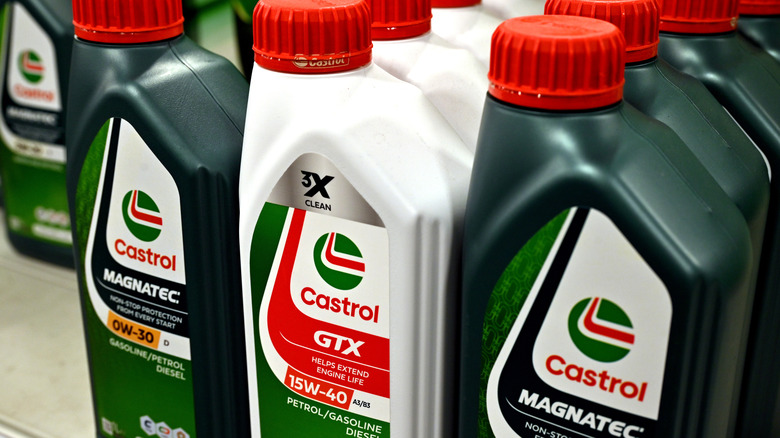
Let's address the elephant in the room — emissions. Since Europe is stricter than the United States when it comes to carbon dioxide (CO2) and carbon monoxide (CO) levels, European cars and their emissions hardware are much more sensitive toward sulfated ash, phosphorus, and sulfur content (or SAPS for short).
Understand that the SAPS formulation is different across manufacturers. Some engines perform better when there's more phosphorus in the oil, while others do well with more sulfated ash in the blend. Most European engines (whether gasoline or light-duty diesel) demand mid-SAPS oil even when it's for the American API-approved market.
Interestingly, API oil specifications are broader and a lot less specific than what the ACEA prescribes. API's SN grade is for gasoline engines between 2010 and 2020, while API-SP is the recommendation for engines after 2020, as it offers better protection from low-speed pre-ignition.
ACEA is really specific about the oil type and which sort of engine it goes into. For instance, the ACEA A/B oils range from low-friction, low-viscosity oils to specific formulations for GDI (gasoline direct-injection) engines and high-performance diesels. ACEA C-spec oils focus on diesels with exhaust after-treatment systems like DPF (diesel particulate filters) and DEF (diesel exhaust fluid), whereas ACEA E-spec is designed for heavy-duty diesel engines. The list is far more comprehensive than API's, shall we say.
In short, just like putting in the wrong type of oil in your engine, using American oils in European engines can lead to several problems. It applies the other way around as well. So stick to what the manufacturer recommends and pay close attention to the details.