

2026 Indian Chief Vintage Isn't Compensating For Anything
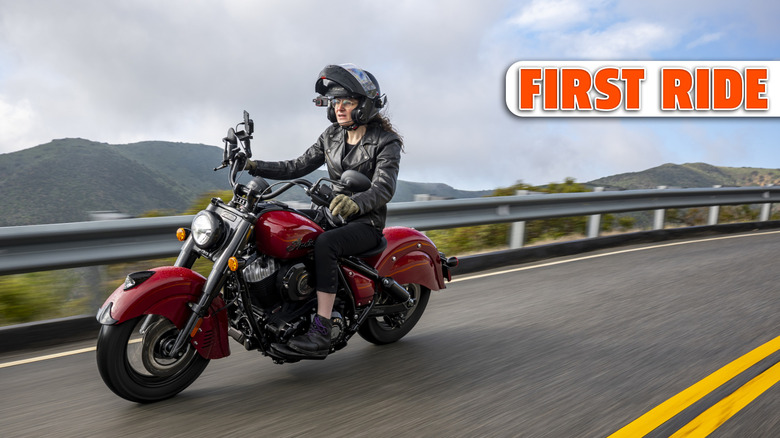
They say that hard times make strong men. Strong men make good times, which in turn beget weak men that make hard times. Plenty of modern men will bemoan how soft we've all gotten, how weak modern masculinity is, and they'll point to nebulous times Before — often during or immediately following World War II, but before all that complicated civil rights stuff — as times when the strong men of Traditional Masculinity reigned and created the good times we all now enjoy.
It would follow that the Indian Chief Vintage — a variant of the Chief platform that harkens back to the company's post-World War II era — would be a bike for stronger men than, say, the unabashedly modern Sport Chief RT variant I rode last year. It would be rough-and-tumble, it would require a man's man to manhandle it into submission and cooperation. So why, then, is the Chief Vintage a more approachable, comfortable, and confident bike?
Full Disclosure: Indian shipped me out to Los Angeles to ride the Chief Vintage at the bike's launch event, which also included a celebratory party at the Petersen Automotive Museum where high-profile dealer owners and, for some reason, supposedly even William H. Macy were in attendance. The company paid for my airfare, lodging, and fuel, and I repaid the kind folks at Indian by throwing up in the Uber they bought to get me from LAX to the hotel. Sorry if that incurred a cleaning fee. That's also why I'm wearing pants that don't fit in the pictures, they're just what I could grab at a random Ross Dress for Less in LA.
Looking backward
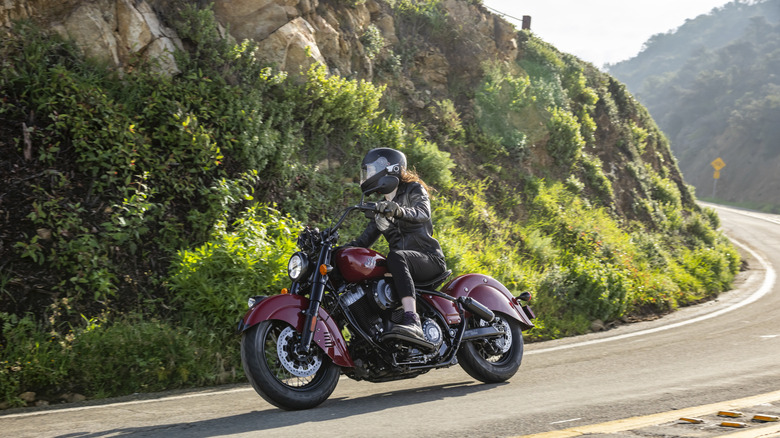
The Chief Vintage is, aesthetically, a callback to the Chief of 1947 and 1948. The new model shares its stamped-metal valence fenders, floating seat, and front "illuminated headdress" with those years, and like the older bike it's not a hardtail — the '40s bike had some rudimentary rear suspension, and the Chief Vintage sits on dual rear shocks with three inches of travel.
Its engine is neither blacked-out nor all-chrome like other Chiefs in the lineup, but a mix of black and raw-metal parts that truly nails the vintage look. Credit also goes to the spoked wheels, which wear a narrower 150-section rear tire to evoke the skinny tires of old. I've long been a fan of these skirt-fendered old bikes, and Indian really nailed the look here — except, of course, for the black seat. Give me a brown leather option to go with the red paint, Indian.
That vintage look extends into the feel of the bike, at least as it concerns the rider triangle. The seat is more comfortable than one might expect, after a bit of an adjustment period for a skinny rider like myself, and the bars and floorboards are easily within reach. I'm not stretched out to fit the bike like I was on the Sport Chief RT, though bringing the controls to the rider does come with a cost. As the burn that's still red on my leg can attest, the floorboards may be a little too close to the exhaust.
But not too far backward
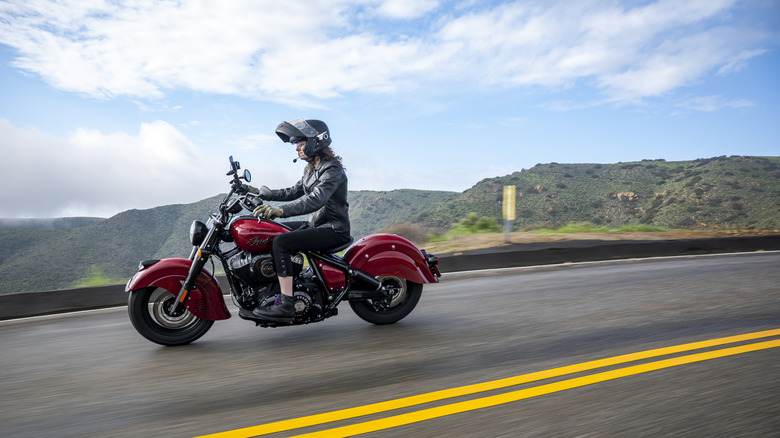
Despite the approachably vintage ergonomics, the Chief Vintage doesn't really feel all that vintage. Its digital gauge cluster sports a four-inch screen with GPS, Bluetooth, and Apple Carplay; its fuel-injected 116-cubic-inch V-twin provides its 120 pound-feet of torque reliably whenever asked. It may be air-cooled, but it lacks some of the quirks of a vintage bike. With that seating position and that look, I found myself expecting the engine to run for another couple revolutions after being shut off like a Ural or an old carbureted bike — and found myself a little disappointed when the electric killswitch did its job.
The one aspect of the Chief Vintage that really does feel appreciably vintage is the last one you'd want: The brakes. The 11.7-inch front rotor hides its caliper beautifully beneath the front fender, but the package is almost scarily slow to stop in normal riding. It's the same size as the rear rotor, which ends up getting far more use than it would on other bikes. There comes a curb weight and a price where dual front discs are no longer a sporty option or a luxury, but a safety necessity, and at 721 pounds wet and at $19,999 to start the Chief Vintage sits well above both.
A nice easy ride
Besides the stress of trying to slow the bike down, the rest of the riding experience is just generally pleasant. The 27-inch seat height makes it simple for folks of all heights to ride, and the engine is happy to offer up torque anywhere and everywhere along the tachometer (just don't expect to get much from wringing the engine out to its 5,400 rpm redline). The spoked wheels mean it's not the nimblest cruiser, but it's still more than capable of splitting through California highway lanes, and the low center of gravity makes it hard to drop even when backing it down a dirt hill with the engine off. Not that I recommend that, but I can speak from experience on it.
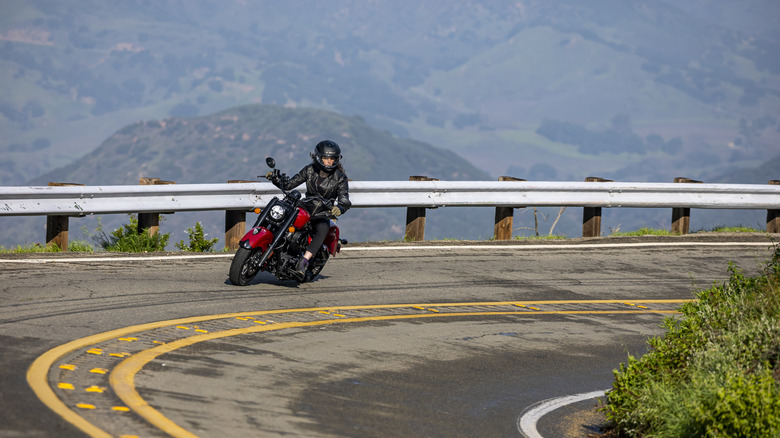
The lack of wind protection makes the Chief Vintage a bit of a pain for long highway hauls, though Indian does offer some appropriately vintage-styled accessory windscreens. Get the bike into some twistier fare, though, and you'll find that it's certainly capable of leaning over. It's not the fastest to change direction, again thanks to those spoked wheels, but I've never heard so many scraping floorboards on a press ride before.
A different age of man
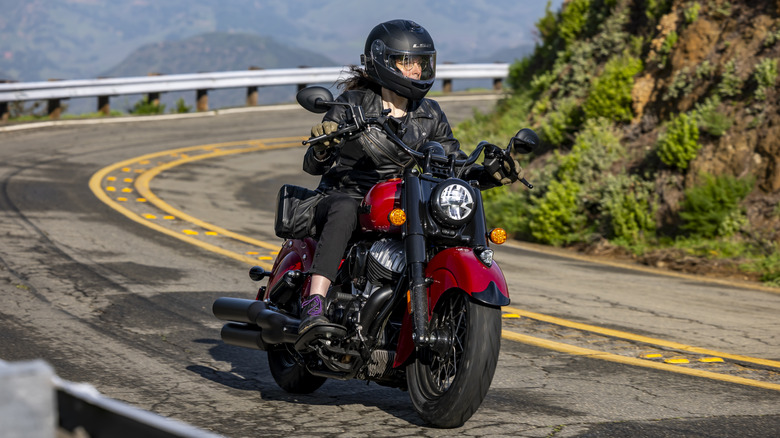
When I rode the Sport Chief RT, I was struck by how much it molds its rider into a singular expression of masculinity. It's a bike for Jax Tellers and their wannabes, for men whose definition of manhood relies on being big and loud and taking up as much space as they can. So when Indian told me it was adapting that Chief platform to make a bike to echo the company's post-World War II era, I expected something similar — a bike built to reassure fragile men that they are in fact as big and strong and powerful as they want to imagine.
But, in echoing the aesthetics of that bygone era, Indian necessarily echoed the ergonomics of 80-year-old bikes. Those ergonomics speak to a different era of men, a generation with quiet confidence instead of all-caps compensating. Where the Sport Chief wrenches your body into aggressive hypermasculinity, the Chief Vintage knows that it — and the rider on it — is good enough as it is.
If the saying goes that good times create weak men, then the Sport Chief RT is for men desperately afraid that they are, in fact, weak. Men who need to prove that they're the strong ones, and whose only language for doing so is aggression. But the strong men they think they need to live up to, who stormed Normandy and gave the Nazis what for, rode bikes like this: Comfortable, approachable, and altogether unconcerned with the image they gave off to others. The Chief Vintage doesn't posture, it doesn't compensate, it's simply a very good motorcycle.