

Mazdaspeed3 Vs Ford Focus ST: How These Affordable Hot Hatches Measure Up?
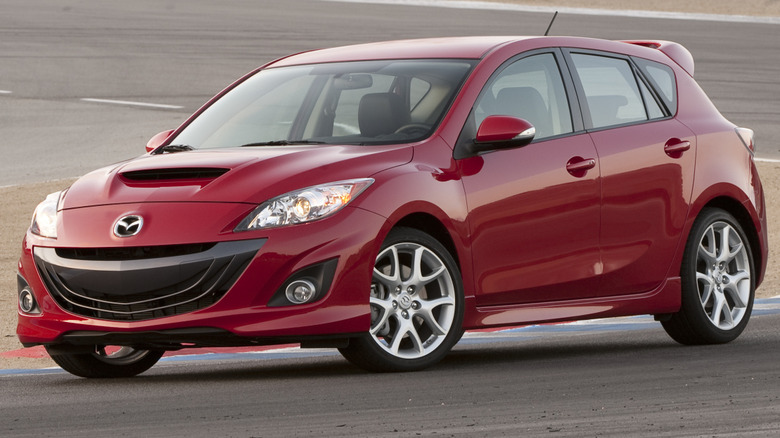
Ever stricter emissions rules have meant that affordable gas-powered hot hatches are now a dying breed. Thankfully, the used car market still delivers plenty of choice and affordability for buyers seeking out bargains, with the Mazdaspeed3 and Ford Focus ST among the most recognizable names you can find. The Mazdaspeed3 sold in the U.S. between 2007 and 2013 as a performance version of the Mazda3, while the Ford Focus ST was offered Stateside for the 2013 through 2018 model years – European production continued until 2025.
That means the Focus ST is much newer. But it still gets cross-shopped with the Mazdaspeed3, as they share some similarities and speak to the same community of those who are big on a combination of value, power, handling, and practicality. Both are attractively finished hatchbacks with turbo-four mills that make over 250 horsepower. They both also use a front-wheel drive system and are notorious for torque steer, due to the superabundant torque going to the front wheels. However, they're also quite different in many areas, so we put together this piece to help you decide which is right for you.
Engine and performance
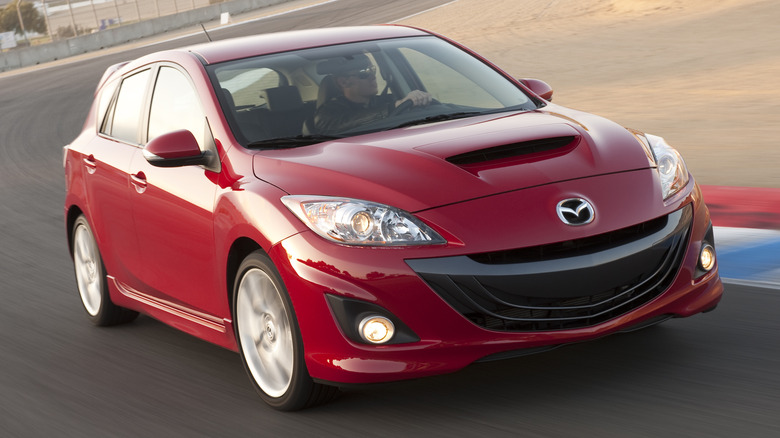
The Mazdaspeed3 and Ford Focus ST each came with a single powertrain. In the case of the Mazdaspeed3, the unit is a 2.3-liter turbocharged four-cylinder, sending 263 horsepower and 280 pound-feet of torque to the front wheels via a six-speed manual transmission and a standard limited-slip differential. For context, that's 63 hp and 88 pound-feet of torque more than the 2025 Honda Civic Si delivers, allowing the Mazdaspeed3 to go from 0 to 60 mph in under 6 seconds on its way to an electronically limited top speed of 155 mph. All that interplay is mediated by 225/40 high-performance tires (first-gen models came with P215/45s) wrapped around 18-inch alloy wheels. The base curb weight for the first-gen Mazdaspeed3 stands at 3,153 pounds, while second-gen models weigh in at 3,281 pounds.
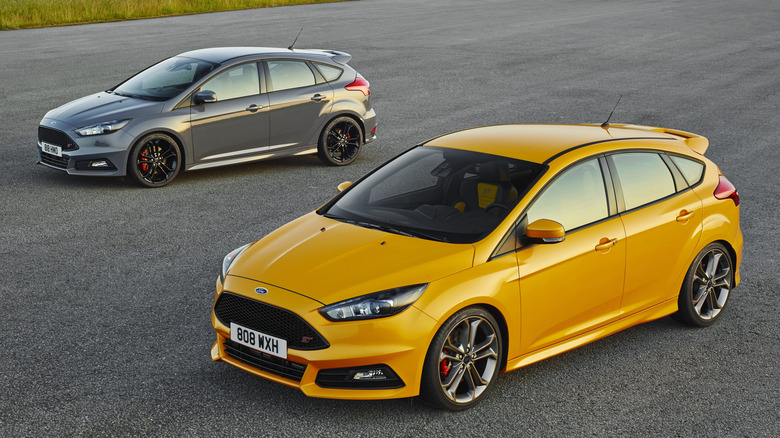
In comparison, the Focus ST's turbo-four displaces 2.0 liters and produces 252 hp and 270 pound-feet of torque. As with the Mazdaspeed3, the ST gets a six-speed manual transmission that funnels power to the front wheels, with that output ensuring that 60 mph is reached in under 6 seconds, while top speed is quoted at 154 mph. The ST's wheels were also 18 inches as standard, but they were shod with 235/40 Goodyear Eagle F1 Asymmetric tires.
The Focus ST offers an EPA-estimated combined fuel economy of 25 mpg, which beats the Mazdaspeed3's average return by 4 mpg. Regarding curb weight, though, the base-spec ST is sandwiched between the first- and second-gen Mazdaspeed3 models, with its weight coming in at 3,223 pounds.
Price and practicality
As we've stated, the Mazdaspeed3 and Focus ST are no longer in production, so your only option is to buy used. Depending on its mileage and condition, the Mazdaspeed3 is priced from around $8,000 on many used vehicle marketplaces, like CarGurus, with the most expensive models having a typical listing price of around $15,000.
This means a used Ford Focus ST is a lot more expensive. A quick check of prices on Carvana shows a clean, low-mileage example can cost up to $22,000. It shouldn't come as a great surprise, considering the ST is newer. Besides, it's a price that those prioritizing a blend of refined drive and daily drivability will be willing to pay, as the Ford Focus ST reputedly lends itself to a smoother driving experience than the Mazdaspeed3, which delivers power more aggressively and feels more explosive.
A great deal of effort also went into making the ST a decent load-hauling machine. There's 23.8 cubic feet of space with all five seats upright and a very attractive 44.8 cubic feet with the back row folded down. The Mazdaspeed3, in comparison, delivers 17.0 cubic feet of space with all seats in use. Fold the rear seats down, and you'll get 42.8 cubic feet. In fact, the ST's cargo-carrying capacity remains impressive, even when stacked against contemporary hot hatches like the 2025 Volkswagen Golf GTI and Golf R. Those German machines each come with 19.9 cubic feet behind the rear seats and 34.5 cubic feet behind the front seats.