

Rock Sliders Vs. Running Boards: How Are They Different?
We may receive a commission on purchases made from links.
There are plenty of great vehicles to tackle the backcountry, including the best off-roaders of all time, according to you. But even among the most capable choices for rugged terrain, some aftermarket accessories can really enhance the experience and help protect your ride along the way.
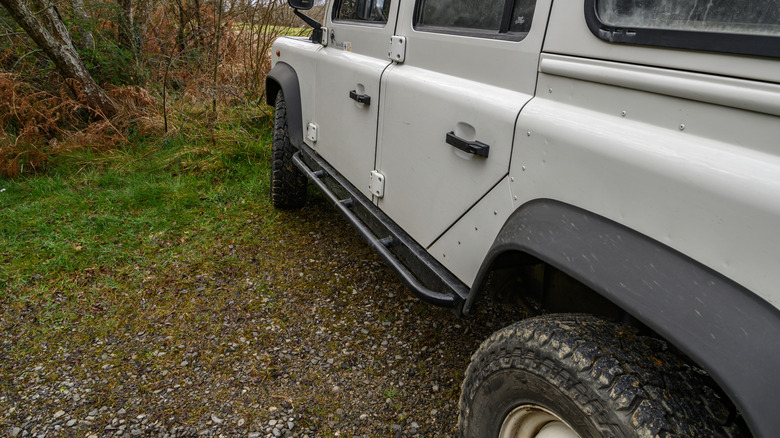
This is where rock sliders come into play, and among serious off-road enthusiasts, they just might be a requirement. While a 2026 Jeep Wrangler, for example, offers 11.1 inches of ground clearance, a rougher-than-average trail could have you navigating over boulders, fallen tree logs, or extremely uneven terrain. This could put sections of your vehicle's body at risk, as rocks or other debris could cause damage. If the area beneath the doors becomes a pivot point over an especially stubborn obstacle, you'll want something like a rock slider to help shoulder the weight. Often comprised of durable steel, a rock slider features bars running across the length of the body between the front and rear wheels.
Conversely, running boards have nothing to do with off-roading. In fact, adding them can be a detriment to trail performance. The qualities that make a vehicle capable in rugged conditions, like increased ground clearance, larger tires, and lift kits, also make it difficult to actually enter and exit your ride. A running board simply acts like a step, installed below the doors low enough to help offer assistance to both drivers and passengers. However, ground clearance can be compromised by some running boards, so it's important to understand how high it goes.
The best of both worlds: rock sliders with a secondary function as running boards
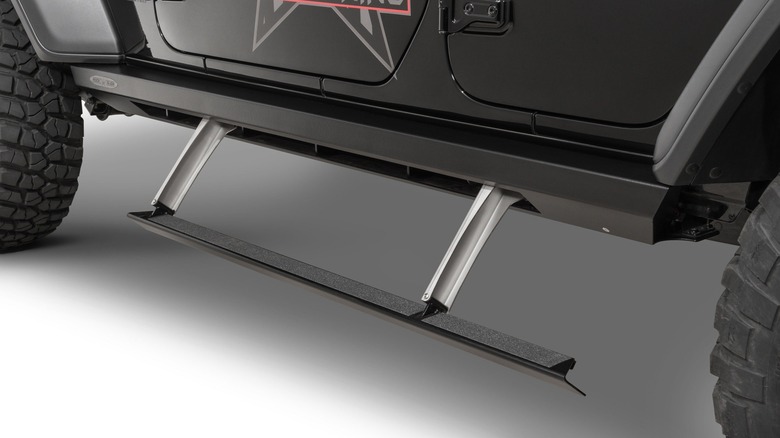
In terms of traditional rock sliders, there's not much room to place a boot to step up, as their purpose is purely to protect the rocker panels. There are some options that attempt to combine the advantages of a rock slider with a running board. However, simply adding a metal step jutting out wouldn't allow the vehicle to slide over an obstacle, and may actually get caught up on things.
One solution to this problem is something like Quadratec's Gen III Step Sliders. Most of the time, this accessory functions as a rock slider, but it conceals a hidden step that retracts once you open the door. Once inside the Wrangler, the step moves back into position, sitting flush with the rest of the rock slider assembly.
Unfortunately, aftermarket products like these come with a wallet-damaging price tag that can run over $2,300. Meanwhile, you can find fixed rock sliders for under $240 or running boards for less than $180. Of course, pricing and availability depend on the vehicle's model and year, but getting a powered product that combines the functionality of a rock slider and running board will be markedly more expensive. Sill, it's tough to put a monetary value on quality-of-life that enhances the fun you get from tearing up trails in your favorite off-road experiences.
What if you want the convenience of running boards but don't want to compromise ground clearance?
Some new trucks come with fixed running boards at higher trims. For instance, the 2025 F-150 Platinum comes with the accessory, although that trim starts at $74,905. Meanwhile, basic aftermarket running boards for a newer F-150 Super Crew can run as little $139. That being said, these products often sit below the undercarriage, affecting clearance. Even if you aren't ripping down highly technical trails, you may not want to reduce ground clearance with a bolted-on step.
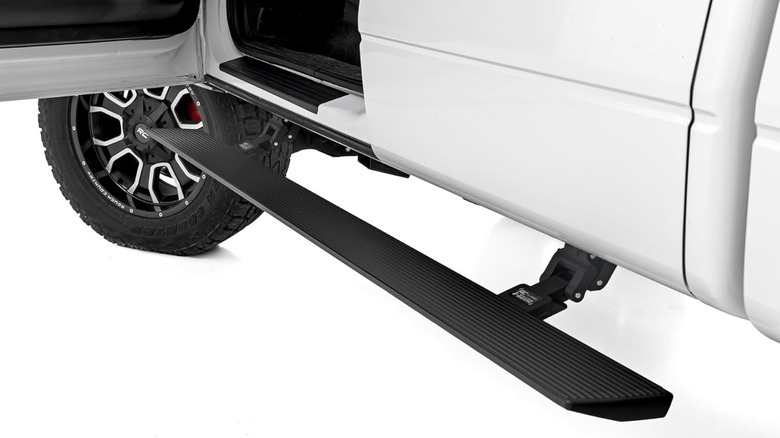
Fortunately, you can opt for powered running boards. These tuck up and out of the way when not needed, and they aren't nearly as pricey as the powered rock slider and running board combos. Still, these electric steps will still start at around $979 and go up from there, so they aren't cheap, either.
You can find powered running boards included on some of the highest-end truck trims, including the Ford F-150 King Ranch. That still puts you at a starting price of just around $75,000, though. Before you decide on getting one for yourself, it's important to weigh the pros and cons of power running boards for trucks, as their larger price isn't the only downside.