

Why Your Heated Steering Wheel Is Probably Not Heated All The Way Around
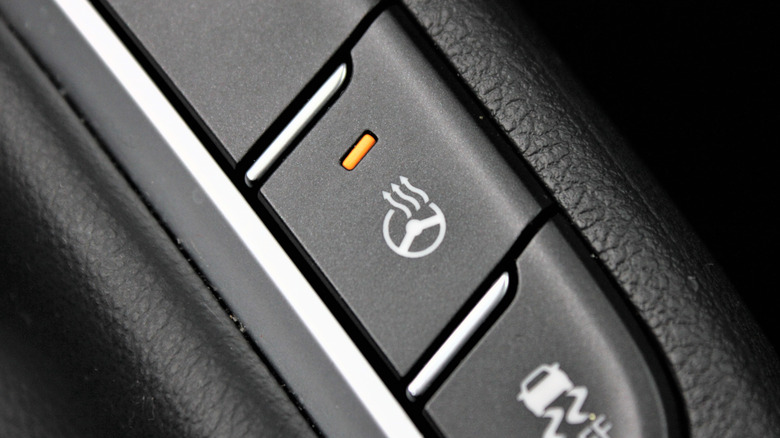
Comfort features have come a long way in the automotive industry. In vehicles of all sorts of shapes and sizes, there are features like tri-zone climate control, 18-way power adjustable seats with lumbar control, and even utilitarian vehicles like the big, tough Toyota Tundra can give you a massage at the push of a button. Another one of these nice features that's becoming more common (especially on upper trims) is the heated steering wheel, which makes cold commutes much more bearable.
Some drivers are noticing that their heated steering wheel isn't adding warmth all the way around, though. For instance, ywlke on an XC40 forum posted, "It seems that the 7pm position on the steering wheel either isn't heating or heats slower or less than the rest of the wheel. Is this normal?" John Covello, a Toyota Tundra owner, explained this phenomenon on Facebook, stating, "My finger tips freeze while the palm of my hand cooks." He even shared a few images from a thermal camera, showing a wide range of temperatures between 35 and 114 degrees Fahrenheit, with lots of differing temperatures across different parts of the steering wheel.
According to many forum responses, this isn't a case of the feature being broken, but rather a deliberate design choice by some automakers. Heating elements are fitted inside only the sections most drivers use, or the sections they are supposed to use: The 10- and 2-o'clock positions on the steering wheel. In our research, we can't find instances of automakers admitting this strategy publicly, but it passes a basic logic test. It's also possible that auto manufacturers opt not to cover the entire circumference of the steering wheel with heat elements to save money.
Partial or full heated steering? It depends on the model
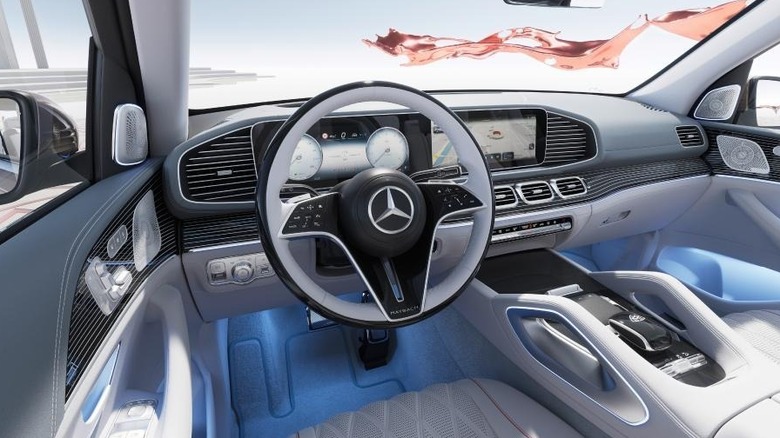
While drivers have come forward with plenty of examples like the Toyota Tundra, GMC Sierra, and Subaru Crosstrek, which only heat certain sections of the steering wheel, there are some luxury brands and models that heat the entire wheel. For example, a few Mercedes-Benz dealers claim their system radiates warmth uniformly throughout the entire wheel. Unfortunately for Mercedes-Benz, the automaker failed to place on a list of your favorite factory steering wheel designs, even with even heating. More direct evidence of full heating from luxury brands can be found on a YouTube channel, powerfulukltd, where a Range Rover steering wheel is taken apart, revealing small heating elements along the full circumference of the wheel.
Luxury automakers aren't immune to issues with their heated steering wheels, though, as some drivers are happy to proclaim online. For instance, benzbell on MBWorld explained, "On my GLE, the heated steering wheel seems finicky and I can't figure out any particular pattern. Sometimes it goes off within minutes, and other times it doesn't." Some quirks of the system could explain this, such as the fact that the C-Class models have both the heating functions in the seats and the steering wheel connected by default. In addition, some automakers limit the use of heat on the steering wheel if the ambient temperature of the car is above a certain threshold. For example, a 2018 Ford Escape won't engage the heating function unless the interior is below around 68 degrees Fahrenheit.
Heated steering wheels have a lengthy history

You may have assumed that an option to heat your vehicle's steering wheel is a modern high-tech enhancement. Something born out of the '90's, perhaps, having only been available for the last 30 years or so. However, this feature goes all the way back to the early 20th century, well before many of today's ergonomic interior niceties were developed. The heated steering wheel is much like heated seats, which GM introduced decades ago – both are features that took a long time to catch on.
Charles Berg, a New York inventor, patented a heated steering wheel design in 1907. The patent filing described the use of exhaust gas to heat the wheel. This would have been an extremely dangerous idea in practice, as vehicles produce harmful gases such as carbon monoxide and nitrogen oxides, to name a few. A year later, he patented an idea for an electronically-heated steering wheel, too. And the heated steering wheel was an idea engineers would continue to pursue. Examples like aftermarket "Steer Warms" and a 6-volt Electric Steering Wheel Heater announced in 1917 would eventually lead to what drivers have today.