

Greg Biffle's Plane Suffered Instrument Failure Prior To Crash, NTSB Preliminary Report Claims
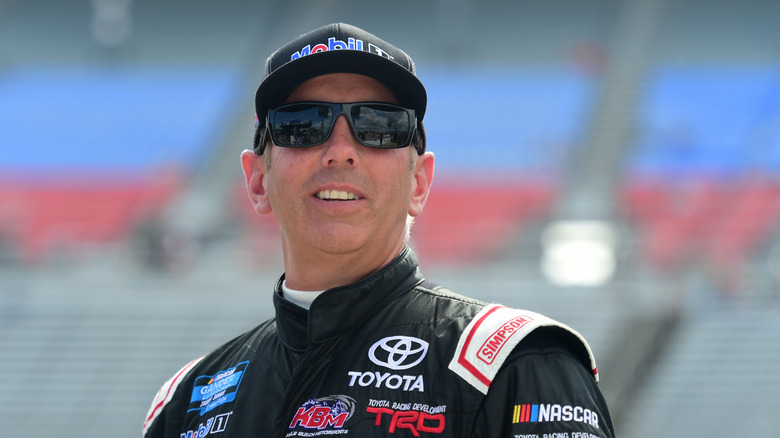
Modern NASCAR legend Greg Biffle tragically died in a small plane crash in North Carolina on December 18, along with six others, including his wife and two children. No one on board the plane survived the crash. But while we already knew what happened, we didn't know why it happened. New information revealed in the National Transportation Safety Board's preliminary report, however, sheds a little more light on what may have caused the crash, and sadly, it doesn't make Biffle or his friend Dennis Dutton look great.
According to the preliminary report, Dutton piloted the plane with the assistance of his adult son Jack. Dutton was an Air Force veteran who later spent decades flying for Delta Air Lines, so he wasn't exactly an inexperienced pilot, but his son Jack definitely was. Per his April 29, 2025, first-class medical application, Dutton had reportedly logged 17,000 total hours of flight time and 400 hours in the last six months, while Jack's logbook showed he only had 175.3 hours of experience in single-engine aircraft prior to the crash.
Additionally, the Cessna 550 they were flying requires two qualified pilots, and while Dutton was already rated to fly the A-320, A-330, A-350, B-737, B-757, B-767, CE-500, and DC-10, his CE-500 type rating still carried the "CE-500 Second in Command Required" limitation. According to the report, "the right seat passenger was not qualified to perform second in command duties per Title 14 CFR part 61.55."
A long list of problems
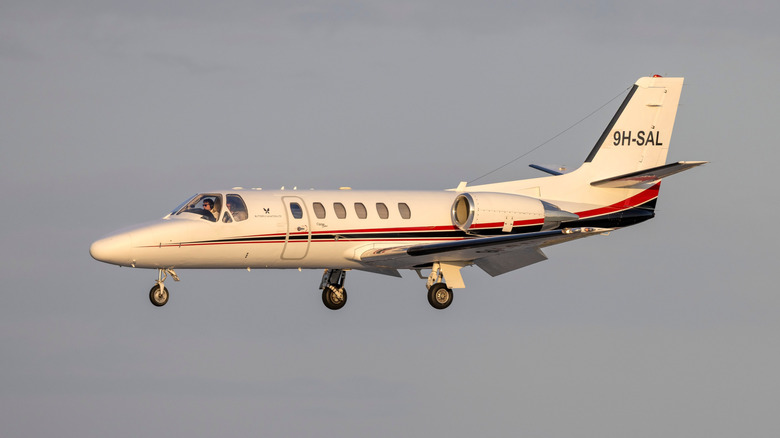
According to the report, "[e]ngine start was initiated using onboard battery power and, following an initial unsuccessful start of the left (no. 1) engine, both engines were started about 0953." While the plane was still on the runway, "the pilot and the two pilot-rated passengers discussed that a
thrust reverser indicator light(s) for an unspecified engine was inoperative, but that the thrust
reverser for the affected engine was working properly." Instead of aborting the flight, they took off "under visual flight rules," although they reportedly "intended to activate an instrument flight rules (IFR) flight plan... once airborne."
During takeoff, Biffle reportedly noted "that the left engine was producing more power than the right and indicated there may have been a faulty gauge. The pilot continued the takeoff." Jack then "attempted to contact ZTL ATC and activate the flight's IFR flight plan three times between 1008 and 1010 but was unsuccessful due to the controller's workload and associated radio communications." A few minutes later, Biffle "noted a difference between the left and right engine interstage turbine
temperature (ITT) indications."
Shortly after that, Dutton noted the altitude indicator on his side of the plane wasn't working correctly, and the plane's autopilot cut off. The NTSB's report also seems to suggest that other instrument systems failed. The Garmin navigation system on board stopped recording, as well, and the report noted the Cockpit Voice Recorder's audio quality dropped significantly. Dutton then appears to have handed control of the plane over to his son Jack while they attempted to fix what was wrong with the plane.
The NTSB believes Dutton soon took back control of the plane and "requested the flaps be extended at 1013:03, made a right turn to a westerly heading, and requested the landing gear be extended at 1013:22," while Jack "transmitted on the SVH common traffic advisory frequency (CTAF) in part '...we're having some issues here.'"
Disaster strikes
A minute later, Biffle, who had at least 3,500 hours of total flight experience, was recorded asking if the alternator was on, although he most likely meant "generator," since the NTSB report noted the Cessna 550 doesn't have an alternator. Turning the generator on appears to have fixed the instrument issues they were having, but they also began to turn again.
The recording confirmed they had eyes on the runway prior to the crash, but about a quarter-mile away from the runway, the plane made contact with the lightbulbs mounted on a light pole, only to hit a second light pole before colliding with some trees. From there, "[a] post impact fire consumed a majority of the fuselage and heat damaged both wings, empennage, and both engines."
Since this is just the NTSB's preliminary report, it doesn't speculate on why the plane crashed. For that, we'll have to wait for the full report, which will likely take much longer to be released. That said, the report found that "[b]oth engines remained attached to the pylon structures and both thrust reversers were found in the stowed position. There was no evidence of uncontained engine failure with either engine."
If everything had worked correctly, and the weather had cooperated, the decision to let Jack serve as his father's second in command could have just been reckless and illegal, but with all the added complications, choosing to fly without a second qualified pilot appears, at least for now, to have ended in a disaster that left multiple families devastated.