

9 Of The World's Fastest Superyachts And Their Top Speeds
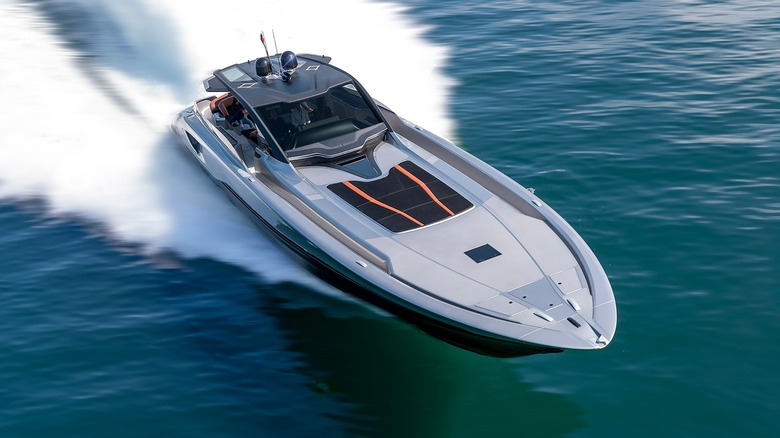
Being fast on the water is conditional, and published top speed is usually a best-case number. Fast boats are light and clean, but they still need cooperative water and a committed operator. Speeds can also change over time as yachts age, gain weight, or swap hardware.
That's why the goal of this article isn't to pretend like there's one eternal number carved into stone for each yacht, or just to look at some of the fastest boats ever made. Instead, we'll round up some of the fastest superyachts that have ever sailed to see what makes each one feel like its own unique character.
The really fast yachts tend to be relatively short and aggressive, because weight and drag punish you on the water. The propulsion packages often look like they were borrowed from racing boats, ferries, and defense hardware, using waterjets, gas turbines, combined diesel-and-gas setups, and horsepower figures that make car people start doing mental conversions.
Jet Ruban Bleu: 60 knots

The Jet Ruban Bleu is a 60-knot yacht that feels like it was built by someone who wanted a speed award more than a luxury vessel. It's about 25 meters long, which makes its speed already ridiculous, but the setup is what makes it charming. Instead of a maze of turbines and multi-engine complexity, it has a single motor-and-turbine-union (MTU) setup rated at 3,500 horsepower. It's a simple-yet-purposeful approach that feels more like a racing build than a traditional luxury project.
This yacht is credited with a 3,000 nautical mile range at 40 knots, which makes for exceptional speed over a very long distance in any vehicle category. That's fast enough to change how long-distance travel feels on water. All of the yachts on this list are engineering masterpieces, but handling the Jet Ruban Bleu is less like helming a large yacht and more like driving an absurd hot rod on water.
Oci Ciornie: 60 knots
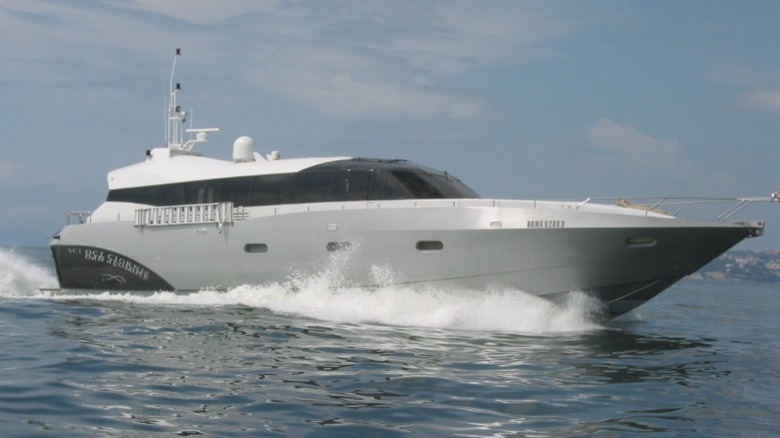
A top speed of 60 knots is common for these large fast yachts. However, each yacht in that speed range is built with different goals in mind. The Oci Ciornie, representing the Jamaican flag, is a 60-knot yacht that uses a combined diesel and gas (CODAG) setup with twin MTU diesels plus an Avco Lycoming gas turbine, all paired with Arneson surface drives. In plain terms, it can cruise on diesel before calling in turbine power when it's needed.
While it won't measure up to something like the largest yacht in the world, the Oci Ciornie has accommodations for up to eight guests with three available cabins. There are also quarters available for two crew members. All of this makes the whole thing quite unique in design — after all, it's one thing to build a turbine-assisted rocket, but it's another to build one that can host dinner after.
Azimut Atlantic Challenger: 60 knots
Among our 60-knot yachts so far, we've seen a hot rod and a luxury behemoth. Here, we have something in the middle.
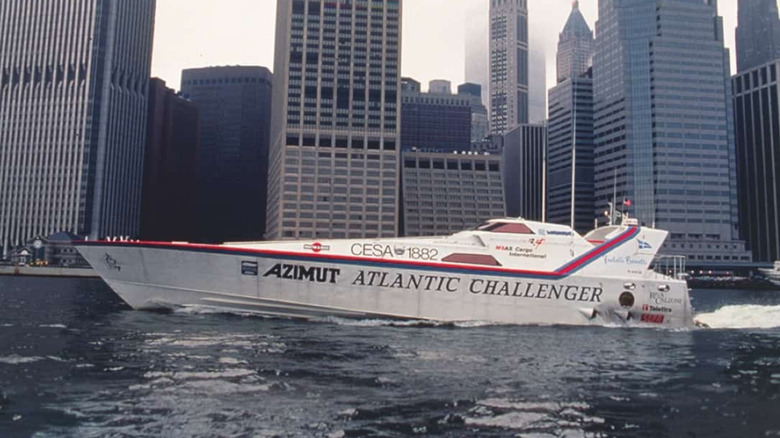
The Azimut Atlantic Challenger was engineered around the idea of going after a transatlantic speed record to collect the Blue Riband award. It's an aluminum monohull around 27 meters long, styled by Pininfarina, and it has a 60-knot top speed. While a beefy car engine like the Ford 6.7 Power Stroke produces 390 horsepower, this boat boasts four CRM diesel engines producing 7,400 horsepower. At a regular cruising speed of 40 knots, this yacht has a range of 3,000 nautical miles.
Azimut describes it as an ambitious project aimed at a transatlantic crossing without refueling. Even the navigation tech nods to its era with the use of a Fiat-based system. While the attempt didn't land the trophy outcome the project aimed for, the Azimut Atlantic Challenger still made a spectacular attempt at it.
Brave Challenger: 60 knots
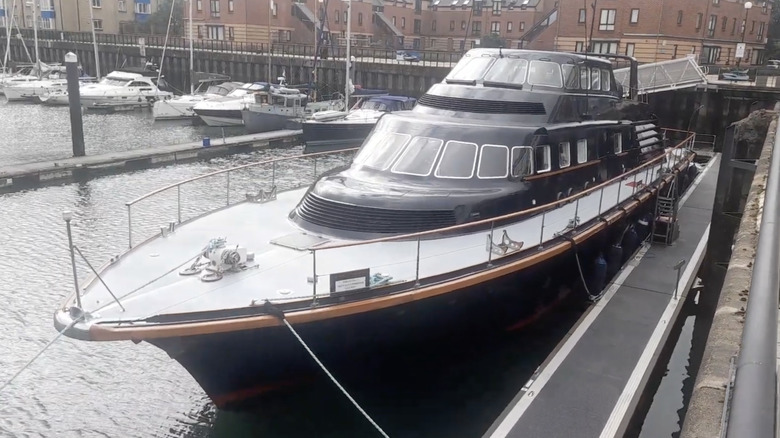
The last yacht in our 60-knot category is the Brave Challenger. It's larger and heavier than others, but it keeps pace with the group thanks to a CODAG propulsion system with three Rolls-Royce engines at the center. It has had its performance officially recorded under supervised conditions on a measured course with an emphasis on repeatability, which proves this yacht is a machine with credible capabilities.
This boat was originally delivered in 1960. Today, a preservation-minded effort has given it substantial refit work and a dedicated support location stocked with spare parts for its propulsion system. The Brave Challenger stands out in the 60-knot group because it's the oldest vessel in the group, which makes it feel a bit like a floating artifact.
Although plenty of yachts can be fast, fewer can be fast in a way that still feels repeatable and real — especially when they come from a former time.
Kereon: 62.3 knots
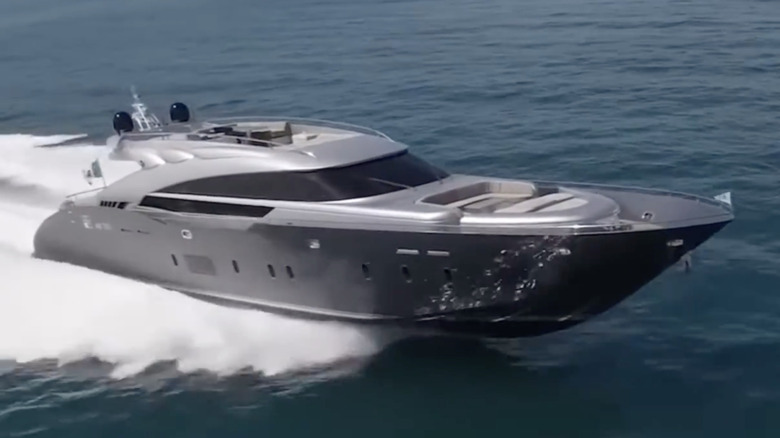
The Kereon has a top speed of 62.3 knots, which is just enough to put it beyond the 60-knot bar of previous yachts.
It boasts classic speed-yacht logic with a fast planing hull, 6,300 horsepower from 3 CRM engines, and an overall package that prioritizes acceleration and pace over floating-palace theatrics. It's roughly 27 meters long and designed as a compact, performance-first yacht, with accommodations for six guests along with room for two crew members. With a cruising speed of 50 knots, it also has a range of 900 nautical miles that implies it wasn't built solely for short sprints.
What makes Kereon distinct from the turbine-heavy boats is that it doesn't need a jet engine, as it is instead driven by diesel. It all makes for the kind of yacht that feels like it's applying supercar philosophy to water — if some of the yachts here read like ambitious one-offs, the Kereon feels more like a focused performance product.
Galeocerdo (WallyPower 118): 65 knots
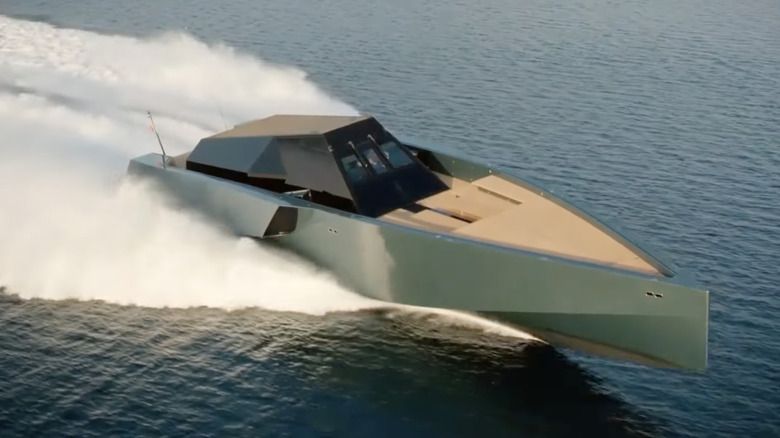
The Galeocerdo – also known as the WallyPower 118 — is a modern engineering marvel that looks like it was designed in a wind tunnel, because, well, it was. It has a 65-knot top speed, but what makes it feel different is the philosophy behind it. The design brief wasn't simply to go fast — it was designed to stay fast, and its development included formal tank testing and wind tunnel work.
This superyacht uses gas turbine power feeding waterjets, plus specialized exhaust work designed to handle turbine heat while keeping weight under control. That's essentially the high-speed boat version of thermal management and packaging.
While it has enough guest space to qualify as a yacht and enough crew space to make it operable, the rest of the design is focused on minimizing drag and maximizing control. The Galeocerdo is a yacht that feels like a research project with a bar — if you're looking for the superyacht that most resembles a prototype, this is it.
World Is Not Enough: 67 knots
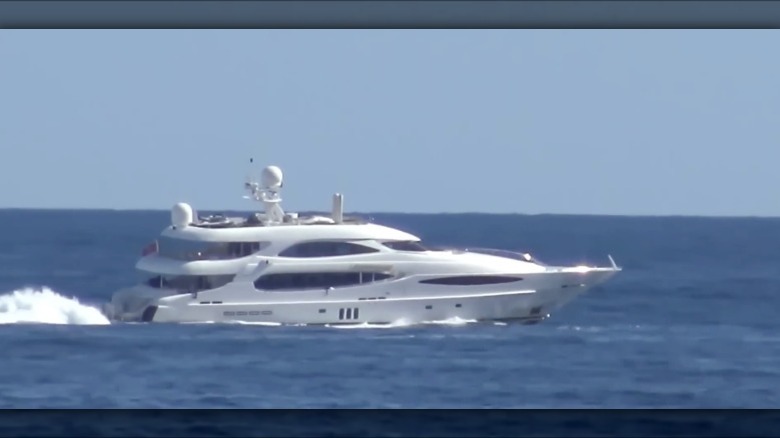
A yacht with the name like World Is Not Enough certainly isn't making much of an effort to be subtle. It can reach speeds of 67 knots using two Paxman engines with propulsion provided by a mix of fuel styles, as it uses diesel engines running alongside gas turbines. These produce a horsepower total of over 20,000, which explains how a yacht of this size gets into territory most boats never even glimpse.
In the context of this list, the impressive top speed of World Is Not Enough places in our top three. Rather than being a minimalist missile or a concept-record craft, it's a full-size superyacht that decided it should also be able to outrun your expectations. It's also credited with 3,800 nautical miles of cruising range at low speed, which is a nice reminder that even the fastest yachts still live out in the open ocean.
Foners: 70.1 knots
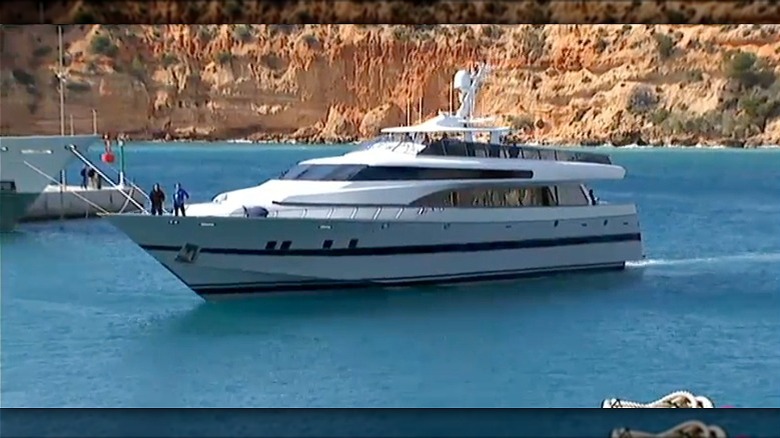
The Foners is the second-fastest yacht on our list, with a top speed of 70.1 knots. Even more importantly, it held the status as the one to beat for more than two decades. That kind of longevity is rare, and it gets there running two 1,280 horsepower MAN engines alongside three Rolls Royce gas turbines providing 6,700 horsepower.
Its original name was Fortuna, prior to its current owner, and its story is surreal. It was built as a royal yacht for the King of Spain, which likely explains why it's lined with bulletproof aramid fiber. That gives the yacht a personality of performance alongside a hint of paranoia and prestige.
Even the basic numbers sound unreal. A 41.5-meter yacht with a top speed that sits firmly in record lore is a sight to see. In this lineup, the Foners is the elder statesman. It spent decades as the fastest superyacht on the ocean and when it was finally surpassed it felt like a changing of the guard.
Bolide 80: 73 knots
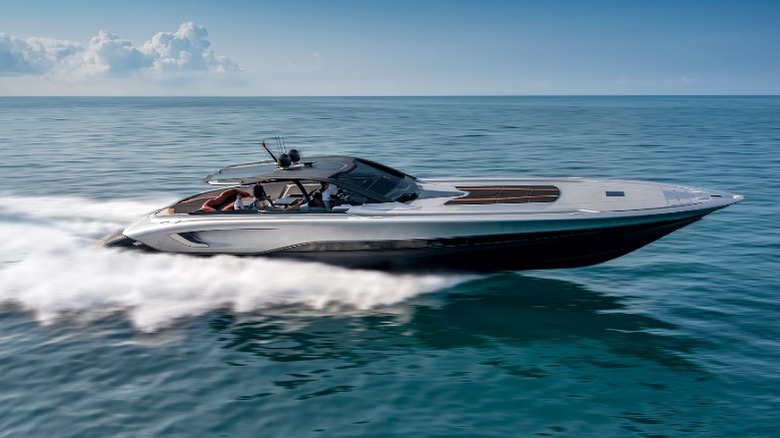
At the top of our list is the Bolide 80, which showed up in 2023 to reset the leaderboard. Its top speed is 73 knots, and it achieves this with triple 2,000 horsepower 12V MAN diesel engines, a number that lands with the energy of a hypercar debut.
The concept of the Bolide 80 is tied to an experienced owner who wanted the thrill and pace of small, fast boats, but without the usual trade-offs they make in comfort and safety. That can be a relatable problem, but it carries a budget that isn't for the masses. This superyacht justifies that budget with its construction. On top of being under 25 meters, the boat was built with carbon fiber and uses a multi-stepped planing hull designed to make the yacht as fast as it can be.
The Bolide 80 has a defined cruising speed of 55 knots and a 345 nautical mile range that shows the limits of extreme performance when fuel becomes the real governor. It's not only the quickest yacht on this list — it's also the most contemporary in spirit. If the Foners is the legendary champion, the Bolide 80 is the new kid on the block whose computer-aided design makes it truly feels like the yacht of the future.