

When Did Chevy Start Factory Racing With A Corvette?
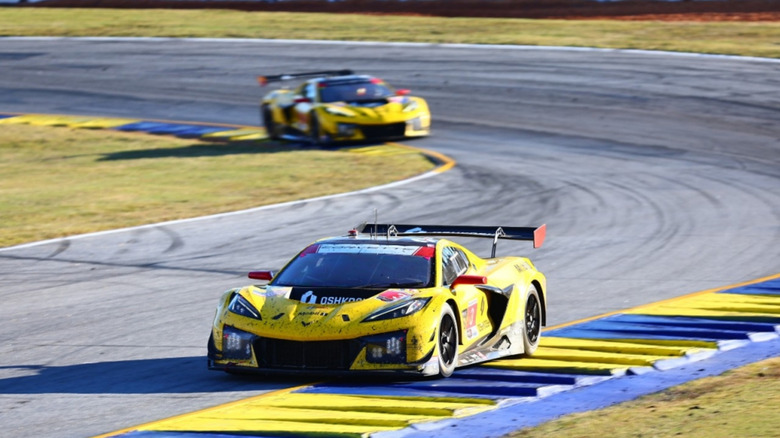
The Chevrolet Corvette wasn't actually much of a sports car when it was introduced in 1953, and GM nearly shut down the program in its early stages. But the 'Vette got its first V8 in 1955, and by 1960, thanks to fuel injection, the motor was able to deliver both 315 horses and the kind of smile-inducing thrills folks would begin to expect from the Corvette name.
The same year also saw the car's first trip to Le Mans, when a team of three Corvettes under the direction of Zora Arkus-Duntov, Chevy's director of high performance, made its debut at the iconic 24-hour endurance contest — earning a class win. Yet the team didn't have official support from Chevrolet, despite Arkus-Duntov's presence, and the event didn't turn into a springboard for Corvette's factory-backed racing. That wouldn't happen for another four decades or so, when, in 1999, Chevrolet formed the first factory racing team for the Chevrolet Corvette.
Why the delay? Part of it was due to the terrible tragedy at the 1955 running of Le Mans: Mercedes-Benz driver Pierre Levegh's car crashed into a slower-moving entry and left the track, exploding in flames as it reached the crowd and killing 83 people. Mercedes outright quit racing, and other automakers, including Chevrolet, pulled back their motorsports efforts as well. Another result of the disaster, closer to home, was that the Automobile Manufacturers Association effectively halted U.S. automakers' official motorsports support in 1957.
The birth of Corvette Racing
Of course, that didn't slow down backdoor factory support for racing, whether it was Arkus-Duntov lending his expertise to Briggs Cunningham's Le Mans Corvette or, in the mid-1990s, Doug Ripple looking to GM for help with bringing his own privately run Corvette racer to the competition. One constant with many of these programs, though, was GM's Doug Fehan, a former race car driver who helped convince GM executives to approve a fully fledged factory-backed Corvette team in 1996.
The crux of the matter was that GM's involvement in multiple motorsports efforts — official or otherwise — spread the automaker's resources too thin. Fehan believed that by focusing on a single program, such as bringing the Corvette to the American Le Mans Series, singular success would be in reach as well. And Fehan meant what he said about pulling together all of GM's resources. His dream team would be supported not only by GM engineering, but also every GM department with a stake in its success, which included getting buy-in from the marketing team for maximum "win on Sunday, sell on Monday" action.
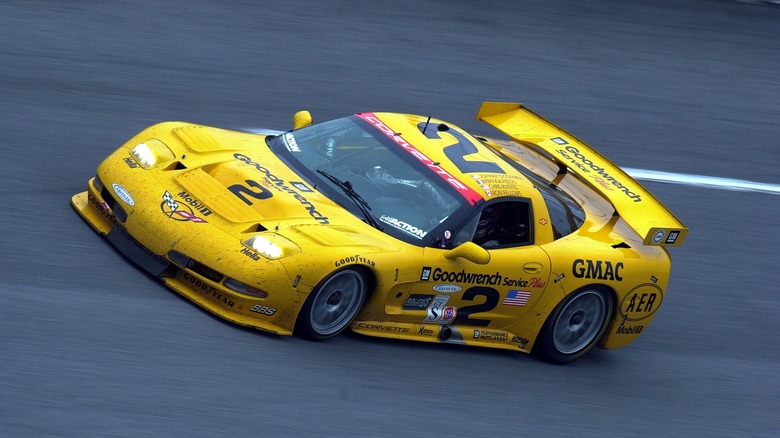
Fehan even claims credit for choosing Corvette's attention-getting yellow liveries. The original look was a silver-and-black design that was, in fact, used during the team's first race, the 1999 Rolex 24 at Daytona — where the No. 2 Corvette driven by Ron Fellows, Chris Kneifel, and John Paul Jr. scored a third-in-class finish. Corvette Racing would go on to win its class in 2001, 2015, 2016, and 2021, A privately entered Corvette won its class there in 2025, too.
The days of domination
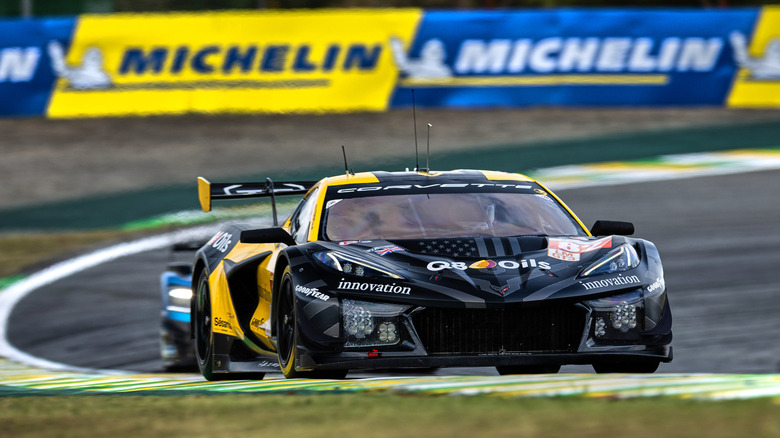
Showing exactly how fast Corvette Racing got up to speed, its third year of competition, 2001, saw the team add to its Daytona honors by winning a class championship in the American Le Mans Series, the first of eight consecutive manufacturers' titles that included runs of 12 straight race wins from 2005 to 2006 — then another, separate string of 25 consecutive victories from 2007 through 2009. At Le Mans itself, factory-backed Corvettes have taken the checkered flag for their class nine times.
More recently, Corvette Racing has competed for the World Endurance Championship, taking a class title in 2023, and the International Motor Sports Association's WeatherTech SportsCar Championship series, in which — for the 2025 season — the team was part of a triple play: Corvette Racing won the team championship for its class, Chevrolet won the manufacturer's title, and the No. 3 car's Antonio Garcia and Alexander Sims shared the driver's honors.
Interested in joining the team yourself? You can get your own example of one of those IMSA championship winners — Chevrolet's first Corvette GT3 racer, the Z06 GT3.R — for amateur racing. (It's the first Chevy race car ever sold to both professional and amateur racers, according to the brand.) That said, not just anyone will qualify for ownership, as Corvette Racing notes that Chevy will only sell them "to racing teams who are uniquely equipped to showcase the car on track in competition use." Also necessary: About $735,000.