

CVT Vs. Automatic Transmission Fluid: What's The Difference
There are seven core fluids — eight, including differential, which isn't always on the list — that keep most gasoline engine cars running smoothly: fuel, coolant, power steering fluid, windshield wiper juice, brake fluid, motor oil, and transmission fluid. In certain cars, some fluids may see double-duty where similar properties are required, like brakes and clutches using a common reservoir. Generally, though, it's best to assume that different fluids are not interchangeable and shouldn't be mixed; for example, pouring oil into your wiper fluid reservoir is a terrible idea.
Pouring automatic transmission fluid (ATF) into a continuously variable transmission (CVT) is also a terrible idea, but it happens. That's understandable, because CVTs and automatics both shift gears on your behalf, and for many people, that's where the story ends. There are several cars you probably didn't even know came with a CVT. Yes, they're automatic, but they're not the same as the usual automatics.
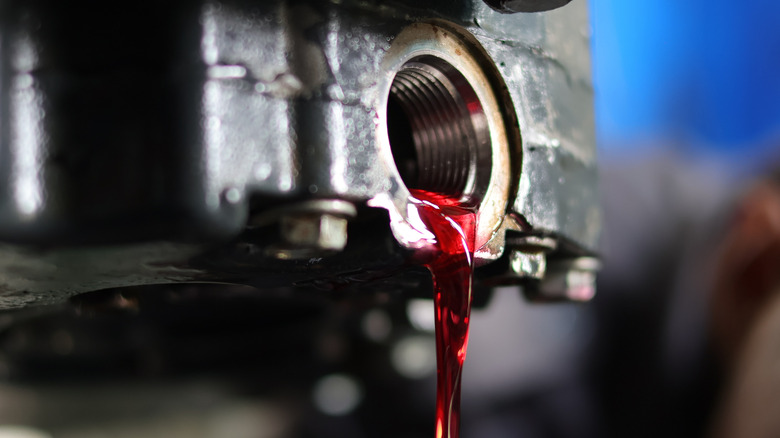
ATF is typically dyed red to set it apart. CVT fluids can be green or yellow. But the material difference between ATF and CVT fluid lies in how each transmission goes about its business, and the related forces involved — particularly friction. Automatics don't like it, but CVTs need some to function properly. If you're not sure which fluid to use, or whether your car has a CVT or automatic, check the manufacturer specs for your car. It's the easiest way to avoid potential transmission failure.
Automatic transmission fluid is cool under pressure
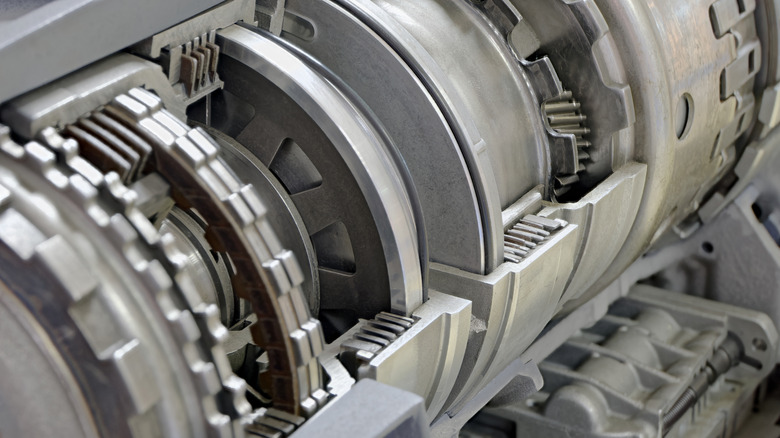
Unchecked heat and rust aren't kind to transmission guts. CVT and automatic transmission fluid both have to withstand high-temperature environments to keep things running smoothly, and they may contain additives to shield against oxidation. Things diverge from here as we get into fluid coupling, which is when liquid (in this case, ATF) is used to supply torque in place of a mechanical connection. We recently covered how your automatic transmission knows when to change gears in depth. At a high level, traditional automatic gear boxes feature a fixed sequence of planetary gears that can't operate without automatic transmission fluid, which doubles as a hydraulic medium that engages gears and a lubricant that keeps them gliding freely. The less friction here, the better.
Automatic transmission fluid flows through a torque converter. The converter pressurizes an oil pump, routing that slippery ATF through a series of valves, which actuates clutches and bands that select gears based on how much pressure is in the system. Some torque converters will lock up, which means it connects directly to the engine output shaft to bypass fluid coupling and lower heat.
As temperatures rise, the automatic transmission fluid increases in volume, and volume affects flow. That volume increase comes with a decrease in density, which causes the compression characteristics of the fluid to change. As a hydraulic medium, ATF has to be the right viscosity to compress just enough to flow properly and pressurize the system without breaking down.
Continuous variability presents constantly tense conditions
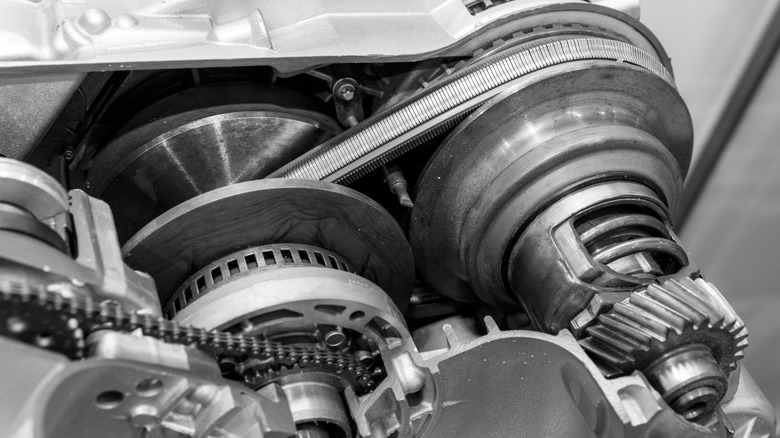
Torque converters also see part-time operation in many cars with CVTs — like some Subarus – but there are no gears in a traditional CVT, and therefore no hydraulic gear changes for CVT fluid to pressurize or cope with. Typically, they use a belt or chain tensioned around two pulleys (a drive pulley and a driven pulley) to simulate gear ratios. It's easier to visualize how CVTs work using LEGO, but the gist is that the belt is squeezed between two conical faces on each pulley. As the faces compress, the belt pushes up to the edges of the cones; when they expand, the belt slides down to the center. The variance between the pulleys is what determines how fast the belt spins.
The belt itself never changes size, but it's doing three things at once that CVT fluid has to help manage: gripping the face of the pulley, sliding up and down the pulley, and bearing shear force from the ever-changing tension of those pulleys. CVT fluid's higher viscosity allows it to handle those tasks. In a nutshell, each fluid is engineered for opposite results. Put automatic transmission fluid in a CVT, and you won't have enough friction for its belt and pulleys to grip one another. Add CVT fluid to an automatic transmission, and your gears won't glide, but drag.