

7 Underrated AMC Cars That Time Forgot (But We Didn't)
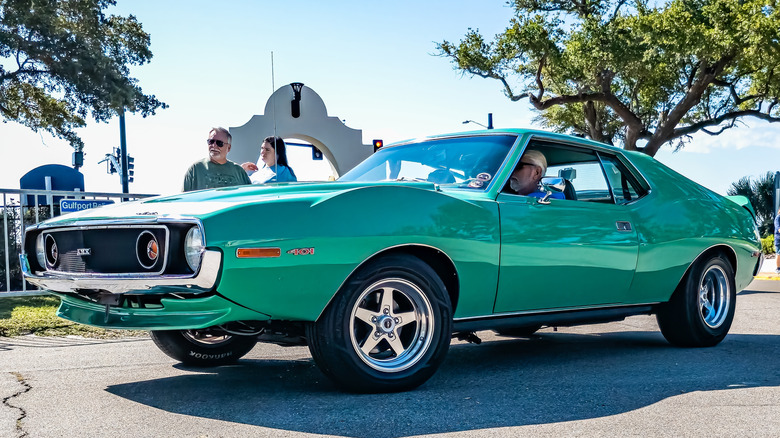
AMC = not cool. At least that's what enthusiasts who follow any of the Big Three brands would like you to believe. Remember the Gremlin? Yeah, these people like to make fun of that poor thing. But come on, we also shouldn't forget about the disastrous Ford Pinto. Or the notoriously unreliable Chevrolet Vega. How about the Dodge Aspen, which rusted right from the dealership?
The point is: American automakers weren't very good at making economy cars during the 1960s and '70s. And in hindsight, the American Motors Corporation might've been the most successful. As goofy as they look, the Gremlin and Pacer weren't much worse than their rivals; in fact, with V8 power, they offered something different. In some cases, AMC outsmarted the era's rapid increase in insurance costs with V8-powered performance beasts that could outrun their rivals at lower costs.
Think we're blowing smoke? We have just the right list of underrated AMC cars to prove you wrong. These models might not carry the cachet of Mustangs and Camaros, but they're quirky, well-engineered, and, crucially, fast. These AMC cars deserve more attention than they get.
1970 AMC AMX/3
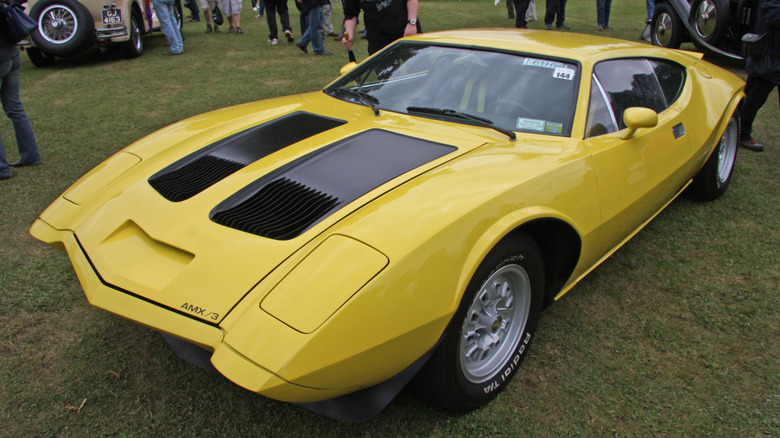
The AMC AMX/3 is perhaps the American auto industry's ultimate almost. A car that caused a stir among European exotic carmakers, with a design that could go hand in hand with the stunning Lamborghini Miura. The fact that this mid-engine masterpiece came from an economy car brand made the AMX/3 that much more impressive. Yes, it never reached production, but it was so close that we had to include it here. Just. Look. At. It!
Once you see the superstar cast that developed AMC's supercar, though, it all starts to click. Dick Teague, legendary AMC design chief, penned the aggressive body, winning over Giorgetto Giugiaro's design in a competition organized by the company. For the chassis, AMC chose engineer superstar Giotto Bizzarrini, the man who designed the legendary Ferrari 250 GTO (you can watch what it takes to restore one); Giugiaro's newly established Italdesign company was tasked with testing the body. As for the engine, AMC chose its own 340-hp, 390-cubic-inch (6.4-liter) V8 from the Rebel Machine.
Throughout development, the star-studded team needed to overcome chassis stiffness and overheating. By the sixth prototype, AMC reportedly had solved most issues. Still, the last (sixth) prototype had AMC's smaller 360-cubic-inch (5.9-liter) V8, as the larger engine wasn't in production anymore.
So why did it never reach dealerships? Well, according to some sources, the DeTomaso Pantera forced AMC leadership to change its mind. Launched at the same 1970 New York Auto Show as the AMX/3, the Pantera undercut its rival on price, causing AMC's leadership to rethink the whole project.
1971 AMC Hornet SC/360
1971 wasn't the best year for launching a high-performance vehicle. Insurance companies started charging a 25% surcharge on cars with a weight-to-horsepower ratio lower than 11-to-1 and displacement-to-horsepower ratio of 8-to-1. Meanwhile, emissions regulators started pressuring automakers to make more efficient, cleaner engines.
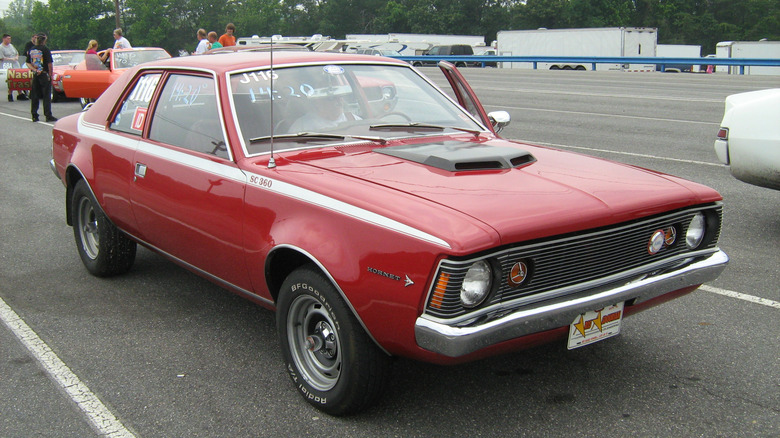
Always the whiz kid among American automakers, AMC had the genius solution to install its 360-cubic-inch (5.9-liter) V8 in its Hornet compact car. The small-block V8 produced 245 hp, or 285 hp and punchy 390 pound-feet of torque with the optional Go package. Even with the higher tune, the Hornet SC/360 was just under the insurance requirements, so it avoided the 25% penalty. Even so, the Hornet SC/360 flew under the radar. Not that this should surprise you, as Ford dominated 1971 with the Mustang Mach 1 and Boss 351 beasts. The Dodge Charger Super Bee Hemi and Chevy Chevelle SS were also making noise that year.
But we'd argue the Hornet SC/360 has as much merit as those legends. It's smaller and lighter, so it handles better, particularly with the Go package that included handling improvements plus four-barrel carbs, dual exhausts, and ram-air hood scoop. Buyers could even opt for a four-speed Hurst manual and a Twin-Grip differential with 3.90:1 or 3.54:1 ratio. The result? A swift machine that could hit 60 in 5.6 seconds and the quarter mile in 14.3 seconds. Confused? Don't be; the Horner SC/360 weighed just 3,108 pounds, making it one of the lightest muscle cars from its era.
1972 to 1974 AMC Gremlin Randall 401XR
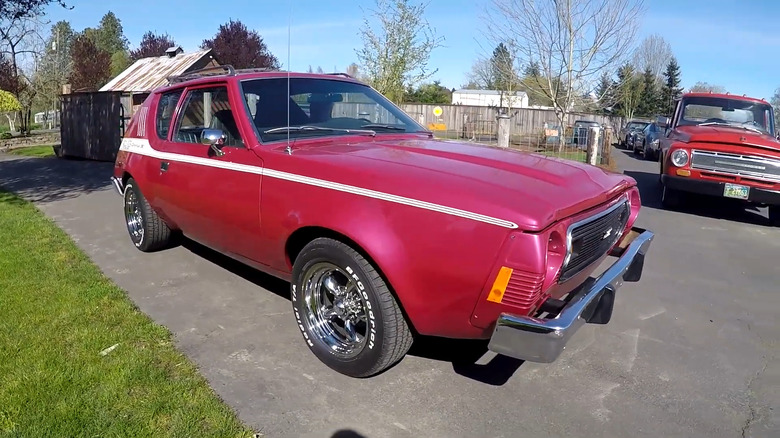
Volkswagen changed the game when it launched the Golf GTI Mk1 at the 1975 Frankfurt Motor Show. With a 1.6-liter, 109-hp four-cylinder engine and low 1,786-pound curb weight, the Golf GTI gave birth to a whole new category of automobile — the hot hatch. But we might as well give that accolade to the 1972 AMC Gremlin Randall 401XR — the hatch that could beat 454 Corvettes through the quarter mile.
How so? Of course, with V8 power. Crazy amounts of V8 power. But this wasn't AMC's idea — the upgrade was only offered through the Randall AMC dealership in Mesa, Arizona. These guys were insane enough to put the firm's 401-cubic-inch (6.6-liter) V8 in the featherweight, 2,600-pound Gremlin 304. With 255 hp and 345 lb-ft of torque, the 401XR's engine made the Golf GTI look like a child's toy.
Right from the dealer, the rear-wheel-drive Gremlin Randall 401XR ran the quarter mile in just 13 seconds. But the Randall AMC dealership also offered the usual upgrades that AMC used in other performance cars, like headers, TwinGrip differential, and a four-speed manual transmission. With all these upgrades, Car and Driver covered the quarter mile in an unbelievable 12.22 seconds!
How come almost nobody knows about this muscle hatch lunacy? Well, only 21 examples were produced. And it's not because of the price — Randall's dealership asked just $2,995 for the 401XR, which equates to $23,223 today. It was probably because the Gremlin was viewed as an econobox, so not many muscle-car lovers signed up. Such. A. Shame.
1965 to 1967 AMC Rambler Marlin
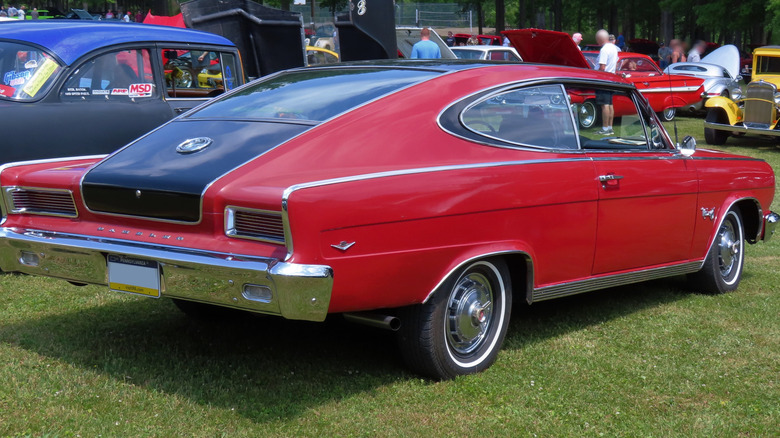
During the first decade of its existence, AMC, led by George Romney, did everything it could to avoid competing directly with Detroit's Big Three. Once Roy Abernethy took the helm of the company, however, things changed. AMC was no longer interested in playing the underdog — it wanted to compete with style and performance. So, for the 1965 model year, it launched the Marlin — a handsome fastback aimed directly at the current muscle-car offerings.
AMC already teased a similar body style with the 1964 Tarpon concept. With a 106-inch wheelbase and 2+2 seating, the Tarpon should've been the brand's entry-level sports car offering. Still, Abernethy wanted something bigger with 3+3 seating, so for 1965, AMC launched the Marlin. Based on the Rambler Classic, the Marlin boasted a longer 112-inch wheelbase, but the same cool-looking fastback body as the Tarpon. The design was so influential that Dodge borrowed the same formula for its first-gen Charger.
And the Marlin wasn't all bark and no bite. AMC offered two V8 options — a 287-cubic-inch (4.7-liter) unit with 198 hp and a 327-cubic-inch (5.4-liter) engine with 270 hp. Buyers could opt for performance features, such as sportier suspension and a Twin-Grip rear differential, while power disc brakes were standard.
The Marlin was luxurious inside, too, with a roomy cabin and individually reclining seats. It got even better in 1967, when AMC moved the Marlin to the bigger Ambassador chassis. Longer and wider, the Marlin was arguably even more handsome than the Tarpon concept. Regardless of the model year, the futuristic, sweeping-roofline styling makes the Marlin a prize catch today.
1971 AMC Javelin AMX 401
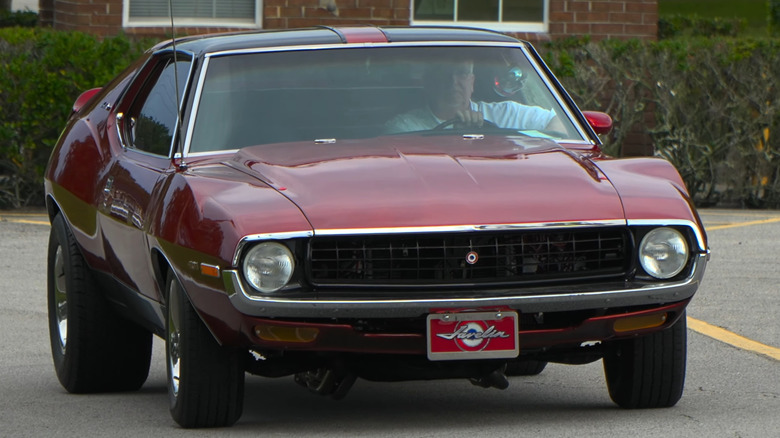
AMC took its time delivering its Mustang killer, but it was worth the wait. The 1968 Javelin brought style and performance to the brand's showrooms. The attractive, sporty design, penned by Dick Teague, and 390-cubic-inch (6.4-liter) V8 engine option made the Javelin one of the more interesting pony-car options.
Still, the second-gen, 1971 Javelin AMX 401 easily is the most formidable of the bunch. It certainly looks the part, with massive wheel arches, sleeker front end, and a decklid-spoiler-enhanced rear. But the aggressive design wasn't just for show. The tall, wide wheel arches let AMC fit wider tires while lowering the ride height. The goal: to win the Trans-Am title.
AMC succeeded, winning the 1971 and 1972 titles with the Javelin. More importantly, it offered customers a taste of its success with the 1971 Javelin AMX. The high-performance model came as standard with a 360-cubic-inch (5.9-liter) V8, good for 245 hp. Then, there was the 401-cubic-inch V8 option, which bumped the output to 330 hp and brawny 430 lb-ft of torque. That's impressive for a pony car, particularly one that weighed just 3,244 pounds. A three-speed automatic came standard in the 401, while a four-speed manual was optional.
With the Go package, buyers could turn the Javelin AMX 401 into a corner-carving sports car. It added the customary Twin-Grip differential, alongside stiffer springs and stiffer anti-roll bars for sharper handling, while also bringing improvements to engine cooling. Unfortunately, AMC produced just 745 Javelin AMXs with the larger engine, so it's a rare, but relatively affordable beast.
1974 AMC Matador X Coupé
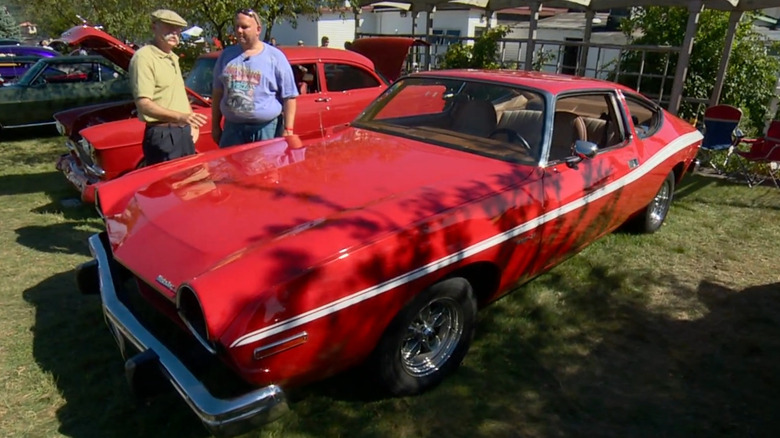
In an era when most American performance cars featured an aggressive, muscular stance, AMC went with sleekness and elegance. It worked. Apart from the frog-eyed front end, the Matador Coupé is perhaps the best-looking 1970s coupé. Dick Teague's team once again surpassed itself, creating the graceful, aerodynamic, long-on-style Matador X.
The aero-efficient body also helped AMC win five NASCAR races. Crucially, AMC once again gave buyers a shot of NASCAR glory by offering its 401-cubic-inch V8 as an option in the Matador X Coupé. It produced 235 hp and 335 lb-ft of torque. And, yes, that's a lower power figure than on the Javelin AMX 401, but post-1972, automakers started using the Society of Automotive Engineers' new net horsepower measurement. With the standard three-speed automatic, the V8 was potent enough to bring the large coupé to 60 in 8.3 seconds, according to Car and Driver. Yes, that's far from impressive. Car and Track's Bud Lindemann roasted the Matador X's driving dynamics, pointing out its excessive body lean and bad stability under braking, though Car and Driver's views are more positive.
Still, the Matador X was never designed to be a sports car. Instead, it was a large, luxurious coupé with a roomy interior and powerful enough engines for cruising boulevards and highways. To that end, AMC even collaborated with star fashion designer Oleg Cassini, who designed a unique, modern-looking interior for AMC's elegant coupé. So the Matador X is more a forgotten style icon rather than a street brawler, but that doesn't make it any less special in our eyes.
1981 to 1983 AMC Eagle SX/4 Sport
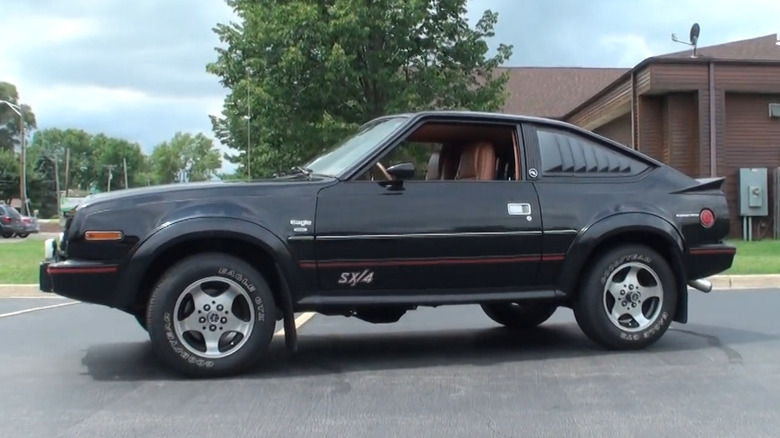
The regular AMC Eagle is already a legend as the first American crossover SUV. What many people forget is that AMC also launched a rally-inspired, high-riding hatchback in the 1980s under the same moniker. The AMC Eagle SX/4 Sport arrived a year after Audi announced its tectonic Quattro all-wheel-drive rally homologation special, and although better in many ways, it remained hidden in history books.
Perhaps the biggest reason is the SX/4's underpowered power train. AMC's 4.2-liter inline-6 produced just 100 hp at comically low 3,400 rpm, enough for a 0-60 time of glacial 15.6 seconds, according to Car and Driver. Top speed: 92 mph. Oh, it also came with a three-speed automatic. Had AMC equipped this futuristic, high-riding hatch with a more potent engine, it might've had a winner on its hands. But here's the thing — the Eagle SX/4 Sport was also better than the Quattro. Like, it had a real, usable 6.9-inch ground clearance for off-roading. The selectable four-wheel-drive system also helped when things got slippery.
Meanwhile, on the road, the Eagle SX/4 handled better than most SUVs of the time, thanks to its independent, coil-sprung suspension. So, AMC rightfully said, per Silodrome, that it's "The Sports Car That Doesn't Always Need A Road." And in its review, Car and Driver said it's fun to drive.
Don't tell anyone, but you can also V8-swap this thing. Oh, and let's not forget about the looks. Based on the Spirit sports car, but enhanced with the rugged-looking Sport package, it looks infinitely cool. Heck, you can snatch an Eagle SX/4 for basically lunch money today!