

These Chevy Nameplates Made Comebacks As Completely Different Cars
Badge engineering is a strategy in which automakers use different brand and product names as tools to release cars with lower development costs and in less time than usual. Chevrolet stands out for how creatively it has used that strategy: It has taken cars from partner companies under license to release as its own, participated in General Motors' global projects to sell the same car under multiple brands, and — our focus here — reused old nameplates on highly different vehicles.
Most automakers use a given name on a single car model, such as the Land Rover Range Rover or the Volkswagen Golf. Any updates they get, like all-new generations, follow a strict visual identity; those cars, along with their nameplates, become brands themselves. Chevrolet, on the other hand, has no objection to using the same nameplate for multiple cars even if they differ in size, type, or region.
When it comes to nameplates Chevrolet has reused on completely different cars around the world, one can mention the Blazer, Captiva, Cobalt, Cruze, Monza, Spark, and Tracker. From their first generation to the next ones, they became different in so many ways that they ended up getting a whole other target audience.
These cars had in-house designs, but strikingly different ones
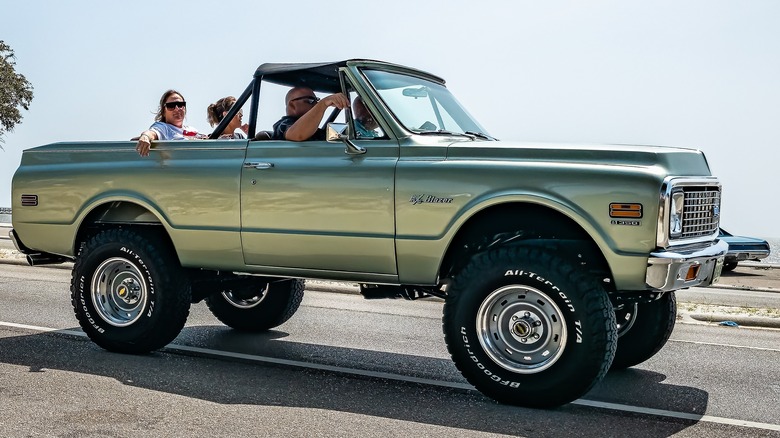
A recent example is the Chevrolet Blazer. While its current generation includes an electric SUV with sophisticated underpinnings (it uses electric motors on both axles to offer front, rear, and all-wheel drive!), the original body-on-frame SUV from 1969 was so no-frills that at first, even the front passenger's seat was optional. In between were a family SUV offered until Chevy retired the Blazer name in 2005, and a sportier unibody SUV released when the name was revived in 2019.
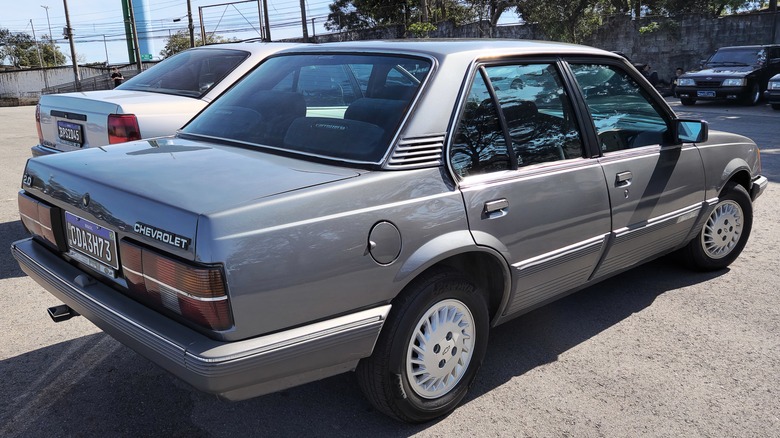
The Chevrolet Monza name was first used on a family offered in North America from 1974 to 1980: it had coupé, hatchback, and station wagon bodies and could even get V8 engines. However, it also started a midsize lineup in Brazil in 1982 as the local application of the J platform (remember that even Cadillac used it?). That Monza had hatchback and sedan bodies and became famous for becoming Brazil's bestseller for three years, staying in production until 1996. Chevrolet used the nameplate again on a Chinese compact sedan beginning in 2019.
The Chevrolet Cobalt was first released in North America in 2004 with sedan and coupé bodies. It was meant to replace the Cavalier and compete with the likes of Honda Civic and Toyota Corolla and had its 15 minutes of fame thanks to the performance-oriented Cobalt SS versions that had both a supercharged and a turbocharged option. After the name was phased out in 2010, it reappeared in Latin America the next year, this time on a family sedan that would fight the Nissan Versa and Renault Logan. Besides being smaller, this Cobalt traded the sporty image for a comfortable, quiet ride and lots of interior room.
With these cars, sky's the limit to badge engineering
The Chevrolet Cruze's first generation was a rebadged version of the Suzuki Ignis. It was a tiny four-door SUV sold exclusively in Japan from 2001 to 2008. That name was reused in the U.S. in 2008 on a family of midsize cars with hatchback, sedan and station wagon from 2008 to 2023.
The Tracker, a small SUV based on the Suzuki Vitara, appeared in North America in 1989 as a Geo. It had a boxy design, truck-like platform, optional all-wheel drive, and even a convertible version. It became a Chevrolet in 1998, but was discontinued in 2008. It had its drastic change in 2013, developed by GM itself and sold in South America and Russia, still an SUV but with car-like design, only four doors and front-wheel drive. The current generation was released in 2019.
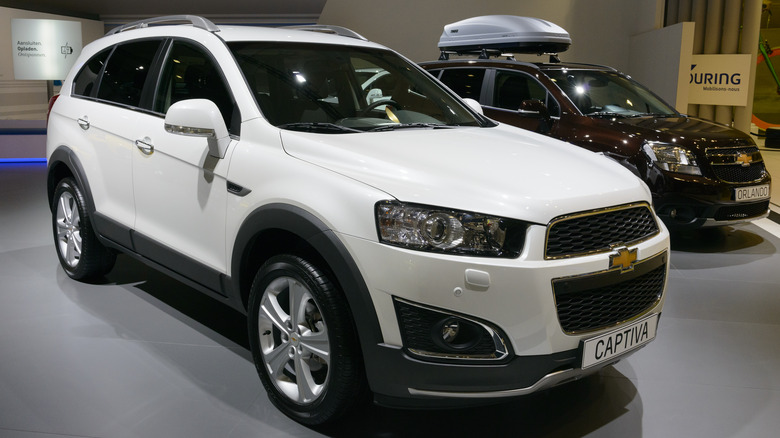
The Chevrolet Captiva was born in 2006 as a rebadged Daewoo Winstorm; it was a seven-seater SUV sold only outside South Korea. It also had a Sport version released in the Americas in 2008 with different design and five seats. Chevrolet killed this version in 2018, then reused the nameplate the same year when rebadging the Baojun 530 SUV for developing countries. The 530 is designed by GM's Chinese branch and is significantly different from both predecessors.
The Chevrolet Spark's first generations were based on the egg-shaped Matiz, developed by then-independent Daewoo, and the 2012 and 2016 ones were GM's own designs. They were all low-cost subcompact hatchbacks with small gas-powered engines. After the last-generation Spark was ended in 2022, Chevrolet released a Spark EUV in 2025 — an electric SUV with boxy design based on the Chinese Baojun Yep Plus and sold in South America.