

Ever Notice That Scoop Under Semi-Trucks? Here's What It's For
The semi-truck was invented in 1898 to transport the earliest American cars, but it has advanced mightily since in both design and performance. Particularly in how to deal with the energy-sapping effect of aerodynamic drag, which is a major issue. In fact, a 1975 study in Automotive Engineering, reported by NASA, found that up to 18 tons of air per mile is displaced by a semi pulling a trailer at highway speeds. Picture something similar to a giant wake a large ship would make, but instead it's air.
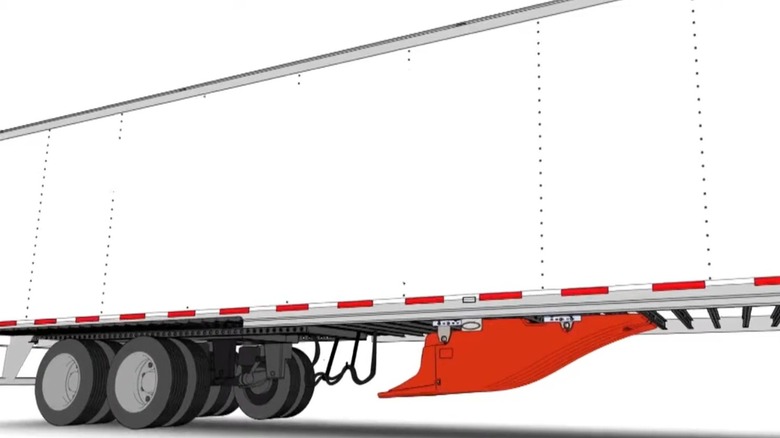
While a big rig may look as aerodynamic as a giant brick on wheels, there are actually several modifications, such as roof fairings and specialized bumpers, working to reduce drag and improve efficiency. One of the more unusual can be seen underneath some trailers, looking like a giant backward scoop. Companies like SmartTruck have designed these products to counteract problem areas of low-pressure air that create drag as a semi travels down the highway.
The big scoop on the UnderTray system funnels air toward the rear of the trailer. The shape of the scoop is deliberate, pointing rushing air down as it travels under the trailer, so that it flows underneath the rear suspension system. Not only does this improve aerodynamic flow under the trailer, the scoop directs it into the low-pressure pocket behind the trailer. The result is a 10% improvement in fuel economy, SmartTruck says.
The UnderTray system isn't the only product addressing drag on the underside of trailers

SmartTruck's UnderTray system isn't the first to tackle the aerondynamic issue posed by the trailer's underside. Side skirts have been used to reduce airflow underneath, blocking additional outside air from getting in and running into the rear wheels, causing additional drag. These long rectangular pieces hang along the trailer's undersides. When using them, "we've found that fleets typically report 4% to 6% improvements [in fuel economy], depending upon their application and driving environment," according to Sean Graham, president of side skirt maker Freight Wing, as reported by Fleet Equipement Mag.
But side skirts don't significantly address the low pocket area directly behind the trailer, which likes to trap air, and is one of the most problematic in reducing a truck's efficiency. In fact, according to Box Wheel, those back doors of the trailer can be responsible for 25% of overall drag. And reduing drag is a key to enhancing fuel economy, which is critical in reducing the cost of transporting goods; it's among the reasons U.S. semi-trucks don't use V8s, but instead inline-6 engines.
It isn't just semi-trucks that struggle overcoming drag; it can affect every vehicle to a certain extent. SUVs offer plenty of advantages in terms of functionality and off-road prowess, but a loaf of bread is more aerodynamic than a Toyota Land Cruiser.