

Here's How Much A 2020 Mazda3 Has Depreciated After 5 Years
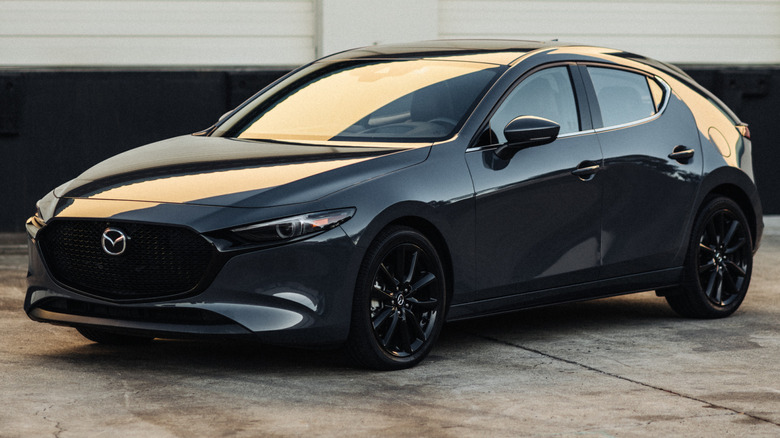
As Mazda's entry-level model and arguably the best car for a new driver, the Mazda3 has long relied on its style, affordable price tag, reasonable running costs, high-end interior, performance, and tidy handling to reel in budget-conscious buyers with high standards. The vehicle is currently in its fourth generation, which debuted for the 2019 model year. Mazda hasn't performed a full facelift or redesign since the 2019 model, but there have been incremental updates to the car, in an effort to keep it fresh and capable of matching strong compact-car rivals like the Honda Civic, Toyota Corolla, and Hyundai Elantra.
Its premium nature, along with its general popularity, gives the 2020 Mazda3 a decent five-year depreciation of 38%, according to CarEdge data. It's worth noting that the figure changes depending on body style, as the hatchback carries a higher depreciation rate of 41%, meaning you could get less of your money back at the time of sale. To add further context, we've compared the Mazda3 to other compact sedans to see how its depreciation compares.
Five-year depreciation for the 2020 Mazda3
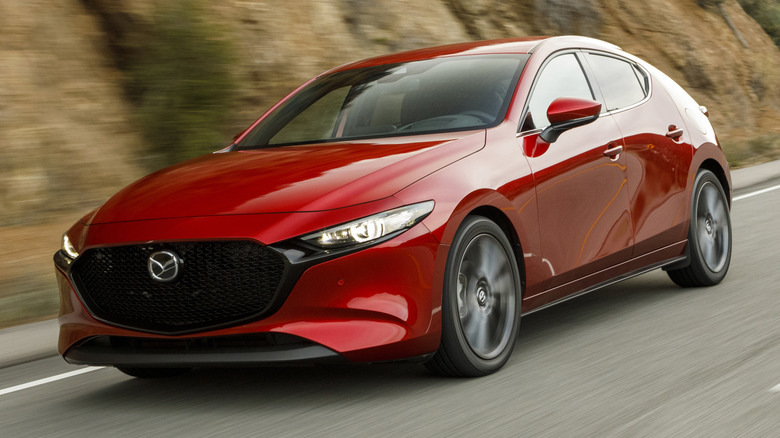
When you look at CarEdge's 38% depreciation forecast for a 2020 Mazda3, and translate it into dollars and cents, it means the compact car will shed over $10,000 of its original value during the first few years of ownership (according to CarEdge, the 2020 Mazda3 sold for an average price of $26,402). This also indicates that around $16,000 will be retained in the value of the car, which CarEdge deems "good" value. Depreciation is not an exact science, though, so it's worth looking at more than one data source when trying to find the value of a 2020 Mazda3. KBB's depreciation analysis is another strong source of data, as it's based on auction sales, private sales, and trade-in prices.
At the end of 2025, KBB put the resale value of an entry-level 2020 Mazda3 sedan at $13,628. The MSRP of the base Mazda3 in 2020 was $22,420 (including $920 destination fee), which puts its five-year depreciation rate at around 39%. The higher-end Preferred Sedan appears to hold its value better than the base-spec models, at around 67%, given its $25,120 price tag and $16,825 resale value. This means it is predicted to lose only 33% of its value after five years of ownership.
The entry-level Mazda3 hatchback, meanwhile, had a starting price of $24,620 and a resale value of $16,104, according to the same KBB data. That translates into a similarly reasonable depreciation rate of about 35%, or 65% value retention after five years. Much like with the sedan, however, there are depreciation rate differences across Mazda3 hatchback models, with the higher-end Premium Hatchback having a heavier depreciation of around 37%. This takes into account its starting price of $29,820 when new and resale value of $18,837 after five years.
2020 Mazda3 depreciation vs major rivals
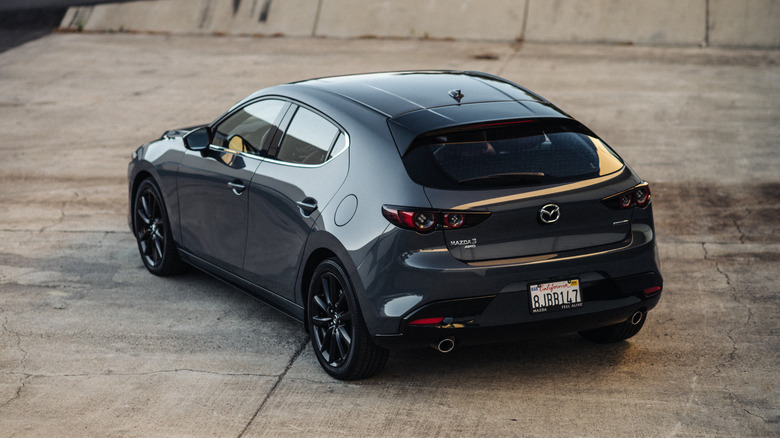
Not all compact cars are created equal. Certain models maintain greater desirability and, accordingly, higher resale value than others. This is demonstrated in the performance of other compact cars from 2020. The Honda Civic is the compact car that holds its value best, with a value retention of about 71% (based on CarEdge's data), meaning it's lost 29% of its value after five years of ownership.
Those expecting the popular Toyota Corolla to follow next might be disappointed to learn that it is bested by the Subaru Impreza, which is estimated to hold onto 69% of its original value after five years. The worthwhile 2020 Toyota Corolla isn't far behind, though, as it's held onto around 67% of its original value. The value-packed Volkswagen Jetta (66%), slick-looking Nissan Sentra (65%), and fuel-efficient Toyota Prius (64%) are the other compact cars from the 2020 model year that retain the most value over five years.
This means all of these models place ahead of the Mazda in terms of five-year depreciation. However, Mazda3's value retention of around 62% helps it find a position ahead of rivals such as the 2020 Kia Forte (61%) and Hyundai Elantra (60%).