

The Pros And Cons Of The Chevy Corvette's Carbon Fiber Wheels
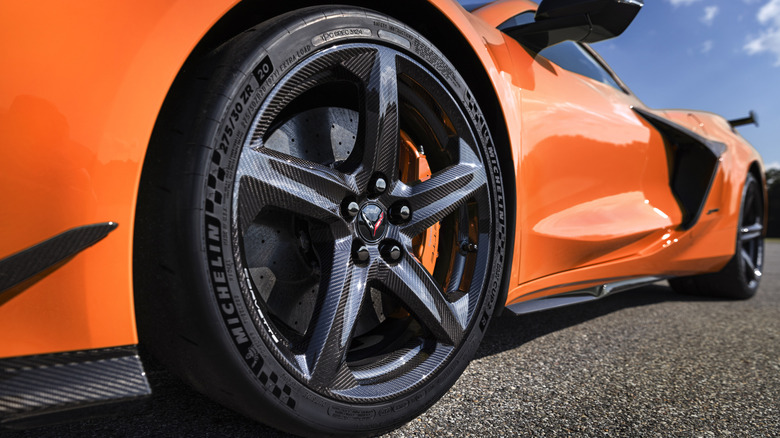
Chevrolet's decision to offer Carbon Revolution wheels on the C8 Corvette lineup, especially on the Z06 and E-Ray, is about physics first and looks second. While it's obvious Chevrolet knows that customers would go crazy over the stylistic aspect of these wheels, the performance gains are where they truly shine. A reduction of 41 pounds of unsprung, rotating mass is no mean feat — that's how much weight a set of Carbon Revolution wheels saves the C8 overall. Corvette's executive chief engineer, Tadge Juechter, has claimed that the swap alone slashes 1 to 1.5 seconds off a two-minute lap time around a track. This is a huge gain, especially given that the engine and aero are left untouched.
Lighter wheels rebound quicker over bumps, stay in better contact with the pavement, and reduce inertia every time you accelerate, brake, or turn. Reviewers who drove Z06 prototypes in Australia summed it up best, with M2's Tim Warren saying the car feels "visceral" and Car Expert's Jim Wong feeling like he was driving a race car. Carbon wheels reshape the Corvette's driving character in a way few bolt-on parts can. And it's not just Chevrolet either, with Ford offering carbon fiber wheels as an option on its iconic Mustang Dark Horse.
The engineering hidden inside each wheel
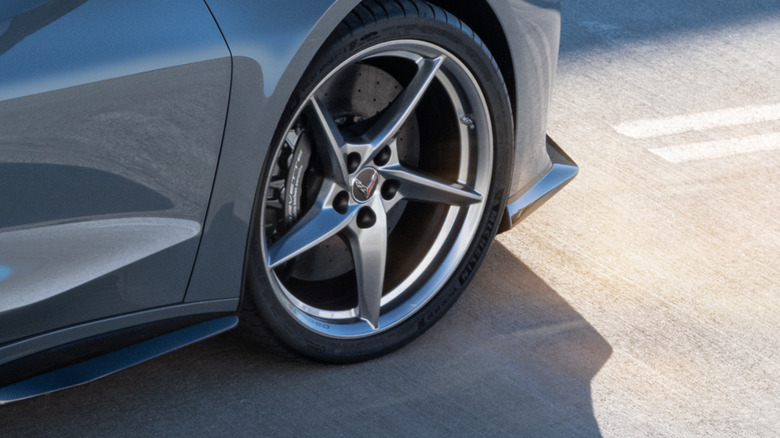
Carbon Revolution spent five years developing the Z06's wheel design with GM, sending more than 100 pre-production wheels through potholes and extended racetrack abuse. GM even created new acceptance standards to push the technology harder, rather than relying solely on existing aluminum wheel standards. A single molded piece of carbon fiber is what makes the skeleton of the wheel, but the finished product is made up of hundreds of individual components. Even the spokes aren't actually hollow, despite being called a "hollow spoke" design. They are actually filled with lightweight foam and chopped fiber.
The two-piece aluminum hub is pressed into the molded carbon, relying on clamping force rather than bolts or adhesives. And because the Z06 generates massive brake heat, the inside of the rim carries a white ceramic plasma-sprayed coating. Its rough, porous texture helps reject heat, and the color reflects radiated heat coming from the Brembo brakes. These details are the difference between a carbon wheel that can survive rapid temperature swings and high-speed impacts, and one that can't.
Where carbon wheels shine, and where they don't

The benefits are clear, with both the Z06 and E-Ray feeling more composed on track and more agile on the road, but for all their strengths, carbon fiber wheels aren't perfect. Even though Carbon Revolution's wheels meet or surpass fatigue benchmarks, there are still concerns regarding durability. Myths stating that they can't handle extreme temperatures and can't be repaired are common and are inflamed even further by early aftermarket designs that have failed under stress. These are wheels made by third parties and are mostly "hybrids", with some components being made of carbon and others made with a metal alloy. They are also not tested to OEM standards, so the quality is a mixed bag. But when it comes to Carbon Revolution's wheels, these concerns seem generally unfounded. And if you know what to look for, there are lots of options for repairing carbon fiber wheels.
One pain point that is absolutely legitimate is cost, driven by the complex manufacturing required to make carbon wheels. Carbon Revolution expects prices to fall on its wheels once production expands and automation is integrated. Hyundai is trying a new approach to keep costs down, which might move the needle, but until that happens, enthusiasts are looking at anywhere from $10,000 to $12,000 for a set of carbon wheels, depending on finish. '
The tradeoff is simple. You get extraordinary performance for a premium price. For drivers who push their Corvette hard or want the sharpest version Chevrolet builds, the pros overwhelmingly outweigh the cons. For everyone else, the forged aluminum wheels remain a strong baseline.