

Most Drivers Ignore This Heater Setting, Even Though It Makes Their Car Warm Up Faster
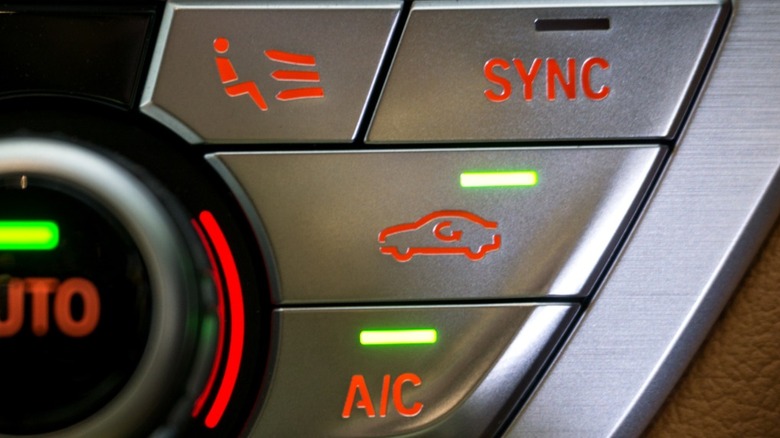
If you live in a particularly cold climate, you know there's no such thing as rushing out to work on a winter morning. Your car needs time to warm up. You tell yourself you're letting the engine warm up, but you're really doing it to let the car warm up for you, as well. We get it. Who wants to drive in sub-zero temperatures? But you could cut down on the time it takes to warm up the car by pushing just one button that lots of drivers overlook.
That button is the recirculate button. This button usually has a little picture of a car on it with a swoopy arrow that kind of curves back in on itself. You've seen it. Everyone has. But maybe you haven't used it, at least not to its full potential. Or maybe you use it all the time, but never turn it off. That's not the optimal way to use it, either.
The truth is, everyone should turn on recirculation when heating up or cooling down their car. The HVAC system won't work as hard to heat the air, resulting in a toasty cabin. The same is true on those hot days when the inside of your car feels like it's been pre-heated for baking muffins. Turn on the recirc button when you turn on the A/C, and that 130° Fahrenheit air will be pushed out a lot faster. You can also use the recirc button to keep wildfire smoke out. Don't leave it on all the time, though. Your air quality might suffer and your windows could fog up faster on cold days.
Why and how this little button works so well

So, why does recirculation help warm your car up faster? Well, let's say it's 20° outside. But you would rather it not be 20° inside your car, as you are not a fan of developing frostbite while you drive to work. A balmy 70° F is more your speed. Your heater may have to start out by heating 20° air. If the recirc button is not on, the heater continuously pulls 20° air from the outside. But if recirculation is turned on, at some point the heater is cycling through air that it has already heated. Each time the air goes through the system, it gets a little warmer until the desired warmth is reached, and the system doesn't have to work so hard.
Of course, the same is true when you're trying to cool your car. Recirculation allows the system to cycle through air that has already been cooled, so the compressor can cycle off. That's one of the advantages of using the recirculation button: components like the compressor and blower motor don't have work as hard or wear out as fast. EVs, in particular, run more efficiently when the recirc button is used, with a 2019 study published in the International Journal of Refrigeration finding it extended a vehicle's range by 11-30%. That's good, since extreme temperatures are hard on EVs. It can help a gas engine run more fuel-efficiently, as well.
Using the recirc button is also great for keeping out pollutants and smells from the outside. As the Mazda 3 owner's manual says, "The recirculate mode should be used when driving through tunnels or while in a traffic jam, or when you would like to shut off outside air for quick cooling of the interior."
The downsides of recirculation and when not to use it

The recirculation button is not a new feature. In fact, recirculation was the only option for the first factory-installed vehicle A/C units in the 1940s. This is because these units were mounted in the trunk, so it would have been very hard to draw in air from the outside. But that became a problem when there were smokers in the car. So nowadays, you have the option to let fresh air into the car, and there are times when you should use it.
We mentioned smokers, but everyone exhales carbon dioxide. With multiple passengers, a lot of CO2 can build up over time, which isn't good for air quality. Leaving the recirc button on full-time can lead to dizziness, drowsiness, and headaches. It can even make it harder for the driver to concentrate or make decisions quickly. Also, keeping out fresh air can cause the windows to fog up more quickly on cold and wet days.
So, use the recirc button for the first few minutes you want to heat or cool your car. If you're driving through an area with lots of pollution or unpleasant odors, that would be a good time to run it, too. If you're driving outside of urban areas and there is no pollution, let the fresh air in. It's also a good idea to let fresh air in regularly to avoid trapping moisture in the A/C. Trapped moisture can cause that dirty sock smell, and who needs that? That little recirc button is an important part of your HVAC system, if you know when to use it.