

How Mercury Marine Went From Building Outboard Motors To Corvette ZR-1 V8s
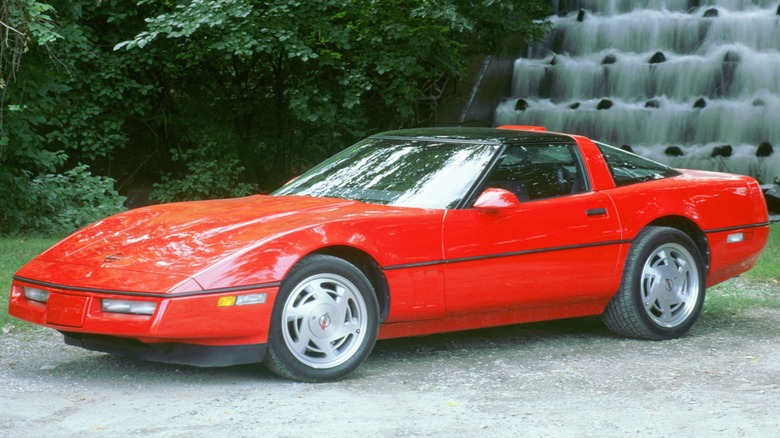
It's likely that all but the most diehard of Corvette fans don't know about Mercury Marine's involvement with the V8 engine powering the C4 Chevrolet Corvette ZR-1. From its introduction in 1984, the C4 Corvette offered features found nowhere else. That spirit of innovation continued with the C4 ZR-1, produced from 1990 through 1995, and the Lotus-designed, MerCruiser-built LT-5 V8 under its hood.
The 1984 C4 Corvettes featured a 205-horsepower L83 V8 that delivered 290 pound-feet of torque. As General Motors' flagship Chevrolet sports car, those numbers have many sports car enthusiasts ranking the C4 among the worst ones ever made. Although the L98 V8 replaced the sluggish L83 in 1985, its 230 hp and 330 lb-ft were deemed insufficient for the upcoming ZR-1 edition of the C4 Corvette.
GM turned to Lotus to adapt the British automaker's four-valve-per-cylinder heads onto the standard small block used in the C4, but the combination wouldn't fit in the Corvette. At that point, GM tasked Lotus with developing a new V8 for the ZR-1, known as the LT-5.
It was soon determined that existing GM engine plants were not the best choice to build the LT-5 due to its complex design and low-volume production. GM ultimately chose Mercury Marine as the LT-5 supplier based on the company's experience with precision low-volume manufacturing.
What is Mercury Marine's background in building engines?
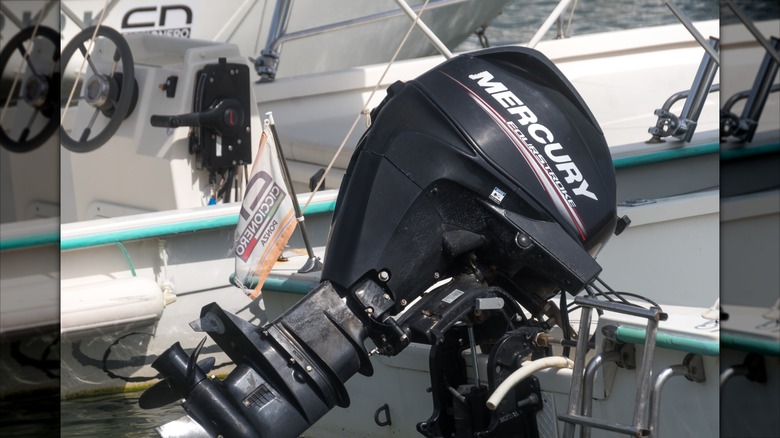
Mercury Marine's story begins with Carl Kiekhaefer, an entrepreneurial engineer from Cedarburg, Wisconsin, who struggled to rebuild his hometown's largest employer during the Great Depression of the 1930s. The failing business was the Thorwald Company, and it had a recurring contract to deliver 500 Thor Outboard boat motors to Montgomery Ward.
Kiekhaefer's only prior experience with boat engines was a three-month stint as a draftsman at Evinrude. Soon after he took over Thor Outboard, Montgomery Ward returned 384 of the 500 previously delivered motors because they didn't work, and canceled its next order. Kiekhaefer redesigned the outboard, reclaimed the Montgomery Ward orders, and by 1939 had established the Mercury Marine brand.
In the late 1950s, Kiekhaefer secured a lease for Lake Conlin, a remote lake surrounded by swamps and forests in Osceola County, Florida, to use as a base for wintertime research and development testing. Lake X, as it became known, was home to "Operation Atlas," an endurance test that saw a Mercury outboard propel a boat around the lake continuously for 25,003 miles, a distance that exceeds Earth's 24,901-mile circumference.
Kiekhaefer's innovative spirit and commitment to quality rescued Thor Outboards and laid the foundation for Mercury Marine. The same spirit continued through the 1960s with the development of the MerCruiser Stern Drive system, which allowed the use of engines with ratings exceeding 300 horsepower.
What makes the Mercury Marine-built ZR-1 engine special?
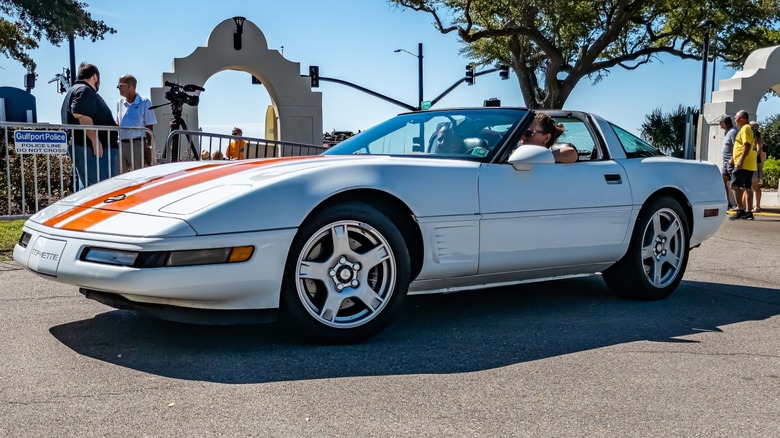
There are aspects of the C4 Corvette ZR-1 LT-5 that make it special other than being designed by Lotus on the other side of the Atlantic and built by Mercury Marine in Stillwater, Oklahoma. Not the least of which was its prodigious power production for a naturally aspirated production engine in the 1990s. Its 375 horsepower, upgraded to 405 before it was discontinued, would rank it among the most powerful Chevy small block engines ever made, if only it were truly a small block Chevy engine.
Put down your pitchforks and pause writing that letter to the editor. It's true. Sure, the 5.7-liter (350-cubic-inch) LT-5 is a small block engine used by Chevrolet, but it isn't really a small block Chevy (SBC) engine. While it has the typical 4.40-inch spacing and 90-degree V-angle between the centers of its cylinder bores, its dual overhead cam design doesn't use the traditional cam-in-block and pushrod architecture, signature features of SBC engines.
The Lotus-designed LT-5 DOHC naturally-aspirated induction system featured 32 valves and 16 fuel injectors to deliver the flow and fuel required to produce peak power. Two intake runners fed each of the eight cylinders, with one injector feeding each runner. According to Hot Rod, the primary injector provided fuel whenever the engine was running, with the secondary intake runner and its injector coming into play when the engine reached about 3,500 rpm.