

Kei Campers Show You Don't Need A Bus To Live Large
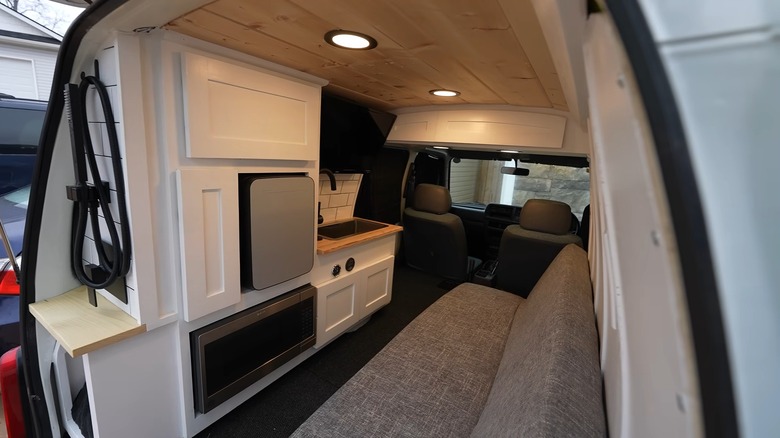
Smaller RVs aren't unusual in the U.S., with over 10,500 class B vans sold in 2024 alone, according to Bish's. This type of recreational vehicle attracts singles and couples looking to hit the open road without all the extra dimensional bulk of a standard motorhome. Often made with premium materials and benefitting from a recent boost in their desirability, prices for some new class B vans have unfortunately risen into six figure territory. Even a van conversion (transforming a traditional work or passenger van into a livable space), can run upwards of $80,000 when you factor in the cost of the vehicle itself and the conversion, per Vanlifers.com.
However, Japan just may have the solution for those who want to travel America's roads without completely obliterating their wallet. Back in the late 1940s, in an effort to spur on domestic automobile sales, Japan drafted a unique light vehicle class called keijidosha. Often shortened today to just kei, these affordable options can't produce more than 64 horsepower, be wider than 4.85 feet, taller than 6.56 feet, or longer than 11.15 feet.
While not new in Japan, taking a kei truck and adding a camper space on the back is gaining attention in the States. Kei trucks are a far cry from some larger American options, such as a 1971 Ford Econoline conversion van turned epic 4x4 camping rig. While kei vehicles aren't sold in the U.S., you can import them (under the 25-year import rule), and with a keen sense of space-saving design, you can make a mini campervan into a cozy home on wheels.
How new Japanese kei campervans maximize space, and what do they cost new?

While massive class A motorhomes and even Sprinter van conversions may be able to afford to sacrifice space here and there, a kei campervan needs to utilize every cubic foot to its fullest. One of the ways Japanese kei campers accomplish this is through multi-functional components. For instance, in some cases, the couch folds out into a bed. This allows for greater functionality without extra furniture. Pop-out extensions can also increase interior space when parked, temporarily raising the roof height and extending the campervan's length. Utilizing any additional space for storage, such as cavities beneath the floor, can also help the interior of these micro-campers feel larger.
One of the most attractive aspects of these premade kei campervans is the cost. Options like the Mystic Mini Pop Bee, with space for up to four and a miniaturized kitchenette, among other features, goes for the Japanese equivalent of around $31,000. Compare that to larger models like the Thor Sequence 20L class B van we have access to in the States, which, even when used, can run north of $73,000. In another example, we found a Ford Transit campervan conversion could cost you almost as much as the purchase price of the van itself. Perhaps Japanese-exclusive models like the Mini Pop Bee could someday sell new in the States, but it's not clear if or when this could happen.
Unfortunately, you can't import any of the new Japanese kei campervans

Due to the U.S. 25-year import rule, if you want a kei campervan, you'll need to source an older model, go through the process of legally importing it, and then complete a conversion, as ready-made Japanese kei campervans can be difficult to find for interested Americans. The 25-year import rule has a complicated history, but it essentially prohibits newer foreign imports due to their supposed inability to pass American safety standards. Just ignore the fuzzy logic of preventing new imports from coming into the country for safety reasons, since vehicles more than 2 decades old are perfectly fine for U.S. roads.
Fortunately for fans, kei light vehicles are now road legal in 30 states. Colorado is the newest to join the growing number of places these unique automobiles are lawfully accepted. Although, the speed at which you can drive them varies, with each state's rules being a bit different. Speed restrictions aren't necessarily a bad thing for kei vehicles, especially the campervan version with added weight, as their small engines may not be as capable on American highway's compared to other vehicles with greater horsepower under the hood. That's likely why kei vehicles can't be driven in Colorado in areas where the speed limit exceeds 55 mph.