

What's The Difference Between 4L60E And 4L65E Transmissions?
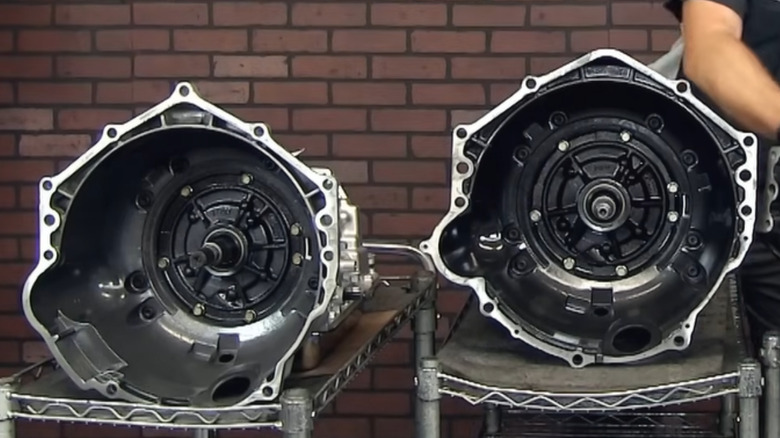
The most significant difference between General Motors' 4L60E and 4L65E four-speed automatic transmissions is their ability to withstand different levels of torque. Before the 4L65E was introduced in 2001, the 4L60E was used in some situations created by LT1 and LS1 engines that exceeded its limitations, causing the 4L60E to acquire a bad reputation in some circles.
While 4L60E and 4L65E transmissions may appear similar on the outside to the untrained eye, there are some visual cues to differentiate the two. Early 4L60E transmissions featured a one-piece case with an integrated bell housing, though they transitioned to a separate bell housing toward the end of their production. The 4L65E is always two pieces, with the bell housing bolted to the case. Perhaps the most notable visual difference between the two is the bolt hole located at the top-center of the 4L65E's bell housing. That bolt hole is missing on both versions of the 4L60E.
There are also internal differences that make transmission swaps more complicated. For starters, the input shafts and torque converters are different between the two transmissions. The 4L65E is made stronger, of course, with upgrades such as a larger shaft, five-pinion gearsets (as opposed to four), heat-treated splines on the stator shaft, and seven friction plates in the clutches instead of six.
General Motors 4L65E lineage
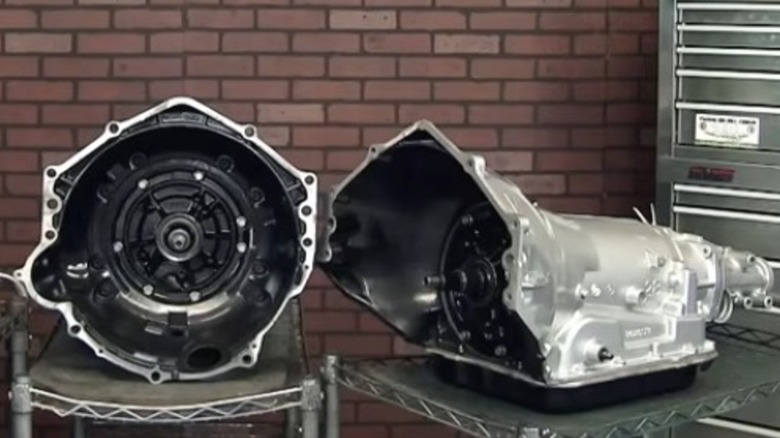
In 1993, the GM 4L60E transmission evolved from, and ultimately replaced, the 700R4 automatic found in GM's lineup, which included the likes of Chevrolet Camaros and Blazers. The new design incorporated provisions for electronic controls in conjunction with the OBD-II system.
While the 4L60E and 4L80E GM automatic transmissions were designed for use in vehicles with different gross vehicle weight ratings, the 2001 4L65E was designed as a replacement for the 4L60E to handle the higher torque loads being generated by the LS V8 introduced in 1997. For reference, the Chevrolet Camaro Z28 from 1993 to 1997 equipped with the 5.7-liter LT1 V8 produced 325 pound-feet of torque. The 5.7-liter LS V8 that followed was able to produce 365 lb-ft of torque.
The evolution of GM transmissions continued rapidly with the six-speed 6L80 automatic coming around in the mid-2000s for use in performance models like the Corvette, Camaro, and Pontiac G8, among others. It was also introduced to GM's trucks, vans, and SUVs as the 4L65E was phased out through the mid- to late-2000s. Progression didn't stop here, though, as an eight-speed transmission would become standard on many vehicles in GM's lineup in 2014.