

The Difference Between Cross-Plane And Flat-Plane Cranks

Engine discussions are not always limited to displacement, cylinder count, and horsepower. Sometimes discussions focus around the crankshaft debate, specifically cross-plane versus flat-plane. Unsurprisingly, there are pros and cons to both designs, but let's kick things off with the most obvious difference: their names.
In a cross-plane setup, the crank pins (where the connecting rods attach) are arranged in two planes that are perpendicular to each other, resembling a cross (or a plus sign). If we're talking cross-plane V8s or inline-4s (like Yamaha's CP4 engine), the first and second pins are 90 degrees apart, as are the third and fourth pins. However, the second and third crank pins are 180 degrees apart from each other. On the other hand, a flat-plane arrangement features all the crank pins resting in a single plane 180 degrees apart.
Flat-plane engines are often seen in expensive European sports cars alongside some American examples like the C8 Corvette Z06, the ZR1, and the now-discontinued Ford Mustang Shelby GT350. Cross-plane cranks are found in just about every other American V8, but some overseas models have used them, as well. Both crank designs are easily recognized through their distinct engine sounds, with flat-plane crank V8s having a screaming high-pitched whine as opposed to the cross-plane's characteristic rumble.
Diving further into flat-plane and cross-plane
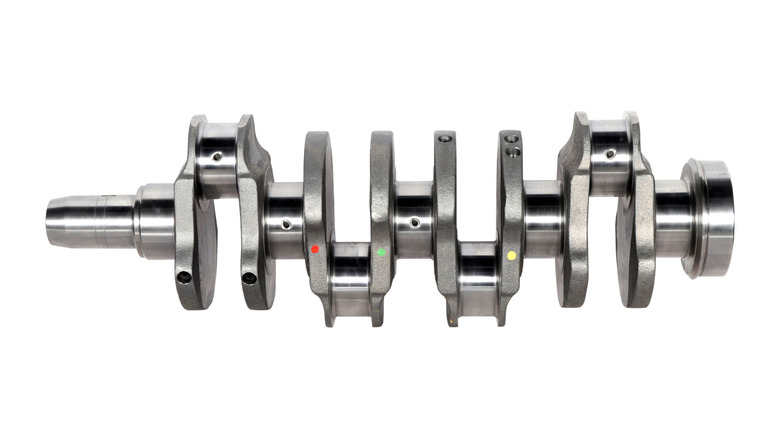
These engines sound different from each other because cross-plane V8s fire two cylinders on the same bank in succession; flat-plane V8s do not. This means the exhaust pulses in a flat-plane V8 have enough time to clear the manifold, while a cross-plane V8 has exhaust pulses from two cylinders crowding the manifold. This kind of firing also brings disadvantages like a relatively complicated exhaust system and increased back pressure. Flat-plane V8s don't have this quirk, which results in increased engine performance due to reduced back pressure.
Something else you might have noticed is how flat-plane V8s are responsive and high-revving, whereas cross-plane V8s are typically not. To explain why, it's important to understand engine balance, particularly with primary and secondary forces. The gist is that primary vibrations are caused by the piston moving up and down, while secondary vibrations are caused by the relative motion of the piston and connecting rod, and are much smaller in magnitude (about 25% of the primary forces) in most engines.
Thanks to its inherent design, a flat-plane V8 cancels out the primary vibrations, but the secondary forces remain relatively intact. The cross-plane crank does a better job of cancelling out the latter, but it's poor on primary balance, creating intense vibration that is only eliminated with the help of massive counterweights. This leads to more inertia, causing the engine to rev more slowly than a flat-plane V8. On the plus side, though, a cross-plane V8 allows for much smoother operation.