

Straight Piping Your Car: Pros, Cons, And Should You Do It?

With lives filled with the sounds of unrestricted race cars, it's no wonder enthusiasts want their daily drivers to sound similar. A sporty exhaust system is one of the quickest ways to make your car stand out or to set it apart from the stock version.
What is straight piping? It's pretty straightforward, but it takes a basic understanding of exhaust systems to grasp the concept. Road-legal cars are restricted by emissions and noise regulations. Part of that process includes using exhaust systems with catalytic converters to reduce pollution and mufflers to reduce noise. A straight pipe deletes or bypasses all emissions and noise-restricting equipment, running a direct set of metal tubes from the engine to the exit, offering an unrestricted exhaust note straight from the engine.
Why do enthusiasts straight pipe their cars? One of the main reasons is easy access to the noise. Straight pipes have a raw mechanical sound that even exotic hypercars often can't match. In some cases, a straight pipe can also contribute to the liberation of a few horsepower. And of course, modifying your car is about individualism, in this case, releasing your engine's unique exhaust signature. What better way to show off your car to the world than letting it be heard from a mile away? So, what are the pros and cons of straight piping your car? And should you do it?
Pros of straight piping your car

There are a few positives to straight piping your car. The most obvious benefit is the aggressive sound it creates. A straight pipe will deliver the most raw, unfiltered exhaust note your car can produce, since there is no restriction to exhaust flow. Automakers do their best to create an evocative exhaust note on performance cars, and some of the best-sounding cars of all time use stock exhaust systems, but straight pipes enhance the noise in a unique way.
Straight pipes can enhance performance as well. Exhaust modification in general does this by removing exhaust back pressure caused by restrictions you'd normally see in a conventional exhaust system. As air flows freely in a straight piped exhaust, you experience better acceleration and a more responsive throttle. You could potentially see horsepower and torque gains from two to five percent. Even more if you have a turbocharged gasoline or a diesel engine.
Removing components like the catalytic converter and muffler also reduces overall vehicle weight, which can supplement your goal towards lightweighting your car. A lighter car should help boost fuel economy and improve handling as well. A well-built straight pipe system is more durable as well. Fewer parts, like catalytic converters and resonators, mean the chances of failure and wear and tear over a prolonged period are reduced. Straight pipes are often constructed using stainless steel and do not rust as often, and as a result, do not need much in terms of maintenance. As with any custom exhaust, the performance and aesthetics of a straight pipe can be tailored according to your wants and needs. Come up with something custom enough, and you may make it look even better than some of the best factory exhaust designs.
Cons of straight piping your car
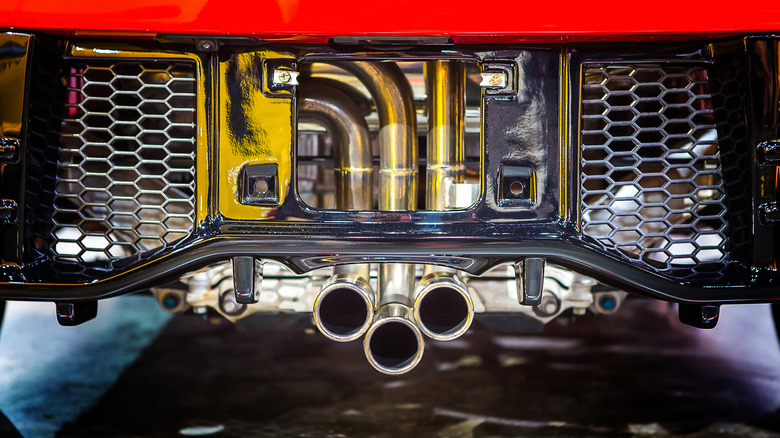
The biggest issue with straight piping your car is its legality. Straight-piping is illegal for any vehicle on public roads anywhere in the United States. A straight pipe system deletes crucial emission-reducing components like the catalytic converter, and as a result, straight-piped cars will fail emission tests. Removing emission-reducing components is a federal offense under the Clean Air Act. In the USA, driving a straight-piped car could result in citations and fines. Another legal issue is the noise a straight-pipe setup creates. The extra noise created by straight pipes is almost certainly going to be louder than permissible limits, which can also lead to citations and hefty fines.
Besides attracting fines and legal penalties, a loud car isn't exactly daily-driver material. Loud exhausts sound good for a short period, but having to listen to it for an extended period, like a road trip, can get tiring. A straight-piped exhaust can potentially improve performance due to its free-flowing characteristics, but a loss of exhaust back pressure can reduce low-end torque, which will be felt while driving at slow speeds. Straight piping your car can also hamper its resale value, limiting prospective buyers to enthusiasts only. The average Joe might not like the idea of an obnoxiously loud car or the legal liabilities associated with it.
Straight pipes are durable and relatively simple, which is part of why they work well on basic muscle cars that lack complicated electronics, but cars with more electronic sensors could cause issues. Straight piping a modern engine can throw up an error code or two and require ECU adjustments for the car to run optimally. An engine that hasn't been tuned for the straight pipe setup may burn more fuel to compensate for the increased exhaust flow, leading to a drop in fuel economy and poor overall performance.
Should you straight pipe your car?
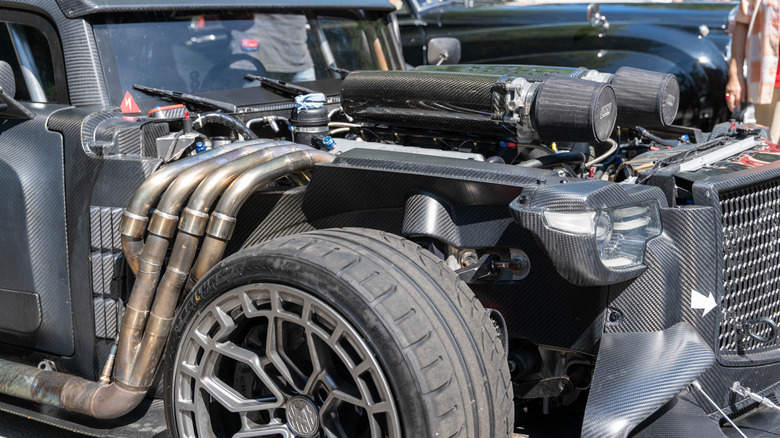
Whether or not you want to straight-pipe your car will ultimately depend on what you are looking to get out of your ride and how much you are willing to spend. A simple straight pipe can be less expensive than some custom setups (especially ones with pricey catalytic converters), but you'll still end up spending anywhere from $200 to $1,300 for it. You usually don't get straight pipes for vehicles out of the box; most have to be fabricated from scratch. By comparison, a cat-back exhaust can cost anywhere from $600 to $3,100 to buy and install. The name cat-back refers to the parts of the exhaust system that are after the catalytic converter in relation to exhaust flow. These systems typically add moderate power gains and moderate performance increases. However, several states like California, Florida, New York, and Virginia have strict laws against loud exhausts, even if they're cat-back systems. So, make sure that your local laws allow exhaust modification of any kind before swapping out the system.
If you are planning a track-only build, straight piping your car is a solution that could net you performance gains in multiple ways. However, like some states, several racetracks have noise limits, so you'll need to check your local circuit's sound restrictions before you slap a straight-pipe onto your build. (Getting black-flagged at your local track day because you blew past the sound limit isn't a fun experience.) Straight piping your daily driver is an even riskier proposition. It's illegal, pollutes the air we all breathe, and it may make your vehicle unsellable. In most cases, you'd be better off spending money on a cat-back exhaust system, even if it is a bit pricier.