

What Are Chassis Ears, And How Can They Help Diagnose Your Car?
You're turning into your driveway, coming from up the block, not down. As you turn in, you hear a pop. Not any pop, that metallic-y pop that means you're going to dedicate a whole weekend to finding and fixing it. The problem? It only seems to happen going into that one driveway, only from that one way, and you can't duplicate it on jack stands. The more you drive, the more you doubt you even heard it in the first place.
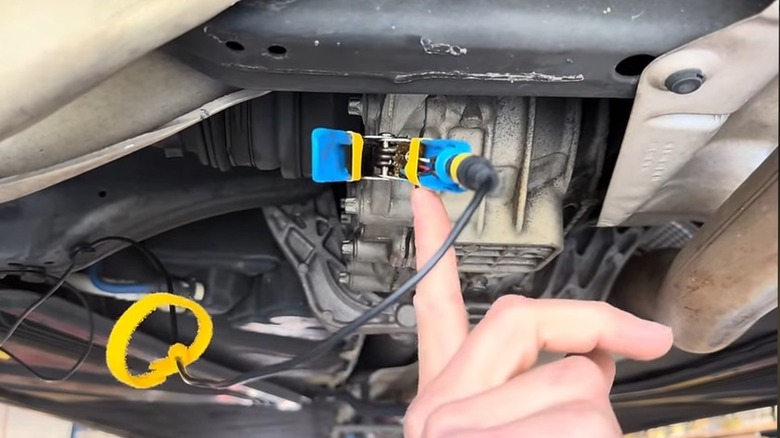
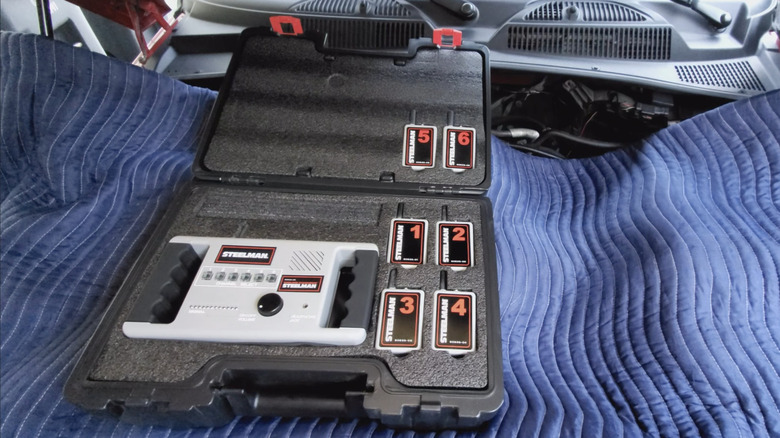
Anyway, this is where Chassis Ears come in. Think of them as an electronic stethoscope radio for your car's rattles. How do they work? You clamp small contact microphones to various parts of your car that you think are the culprit, along with a transmitter. And pro tip, the transmitter packs have a clip, but go ahead and zip-tie them.
These microphones are fed back into a box with a headphone jack for you or your buddy (it's illegal in many states for you to wear headphones while driving) to listen in on. You can then switch between channels, which point to the individual microphones placed around the car, to help pinpoint that pesky noise — all in real time, all while driving in real-world conditions.
Using technology to hunt the noises
In a previous life I ran a body shop. We had accounts with a few dealers, and one day the Nissan dealer brought in a 6th-generation Altima with a strange creak in the rear. This noise had been there awhile, and the dealer was within a week of the customer Lemon Lawing the vehicle. The service manager asked us to check the subframe measurements. Instead, I hooked up the Chassis Ears and found a tiny spot weld had popped in the parcel-shelf area. The metal was sliding and snapping back under flex. We found, fixed, and returned the car in two days — thanks to Chassis Ears.
The reason your mechanic can't find that pop with the car on the lift is dynamic load. When a car is hanging on a lift, its suspension is at full droop. A ball joint might feel tight to a technician with a pry bar, but under the weight of a two-ton sedan hitting that driveway angle just right, that part screams for help. Chassis Ears help solve this by using piezoelectric microphones. These are not traditional microphones that pick up wind noise — they pick up physical vibrations.
You have two main choices here: wired or wireless. Wired systems are the old-school choice. They use long shielded cables you have to zip-tie away from spinny bits. They can be a pain to set up and run, but the shielded wiring can help against interference, especially when working on EVs.
Don't be a parts cannon
There's a keen difference between replacing parts "while you're in there" versus replacing them as a guess. You hear a growl in the front, so you replace the left wheel bearing. The noise is still there. You replace the right one. Still there and now you're out a couple hundred bucks and a weekend or two. Chassis Ears allow for symmetrical comparison. You put one sensor on the left knuckle and one on the right. As you drive, you toggle between the channels. If the left sounds like a smooth hiss and the right sounds like rocks in a blender, you have your answer — or at least a more educated guess on where to start.
These tools aren't just for suspension. You can clamp them to bell housings to listen for a failing input shaft bearing, or to the differential to pinpoint a pinion whine. You can even use them to find interior rattles or loose heat shields under the car.
The setup is simple. Identify your suspects, attach the microphones, and mark your channels so you don't forget which is the sway bar and which is the strut. Whether you're a DIYer who's tired of guessing or a pro who wants to make test-drive time more effective, look into a set of Chassis Ears. Any repair can come down to having the right tool for the job — so let's consider the right tool to figure out what that job even is.