

This Early Oldsmobile Was Powered By A One-Cylinder Engine
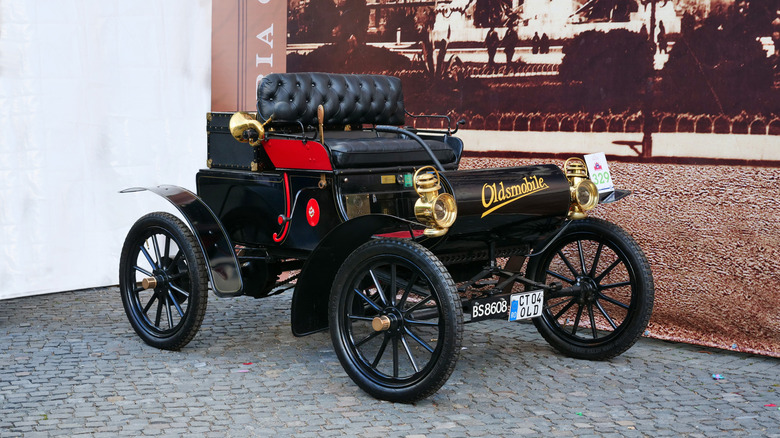
Different automotive eras are often associated with different cylinder counts or engine sizes. For example, classic muscle cars were often synonymous with large V8s, while vehicle trends following the 1973 oil crisis favored smaller engines and greater fuel efficiency. Modern supercars and hypercars bounced back with massive powertrains, going as big as 16-cylinder engines, that are extremely cool, but also pretty rare. However, engine sizes were much smaller at the turn of the 20th century. Take, for instance, the 1901 Curved Dash, a one-cylinder Oldsmobile, so named for its unique footboard design. Although it was hardly the most unusual example around during that time, considering the oldest street-legal car in Germany had two brakes and two horns.
Nevertheless, with a tiny 95.4 cubic inch engine, producing just 4.5 horsepower, the Curved Dash contraption is closer in appearance to a horse-drawn carriage than it is to a modern car. It made a distinct sound as it operated around 500 RPM, described as a singular and intermittent "chug." There was no steering wheel to control the direction. Instead, the Curved Dash used a curved lever extending toward the center of the bench seat. Controlled like a rudder, this tiller steering setup allowed the driver to turn the wheels via direct mechanical connection, albeit with some significant effort required. While the little one-cylinder Oldsmobile became a success, it was by happenstance, rather than by carefully crafted business strategy.
The Olds Motor Works suffers tragedy

Oldsmobile is the original work of founder Ransom Olds, who set up shop in 1897 Detroit, in a facility named the Olds Motor Works. Just a few years after setting up shop, the fledgling automaker had developed nearly a dozen prototype vehicles. At this point, Ransom Olds was at a critical juncture. He needed to move forward with one or more of his company's creations, but he hadn't decided which one to go with yet. Unfortunately, the choice would be taken from him, as a fire destroyed the factory in 1901. Somehow, the Curved Dash survived being consumed by flames, making it the only model left untouched among the company's prototypes.
The fire forced Ransom Olds' hands. His only choice was to put all his efforts into producing the Curved Dash. Automobile sales weren't exactly dominating the market in the early 1900s, with buggies and carriages making up more than 99.5% of the total transportation sales in 1903, but the Curved Dash did pretty well. Between 1902 and 1905, the Curved Dash Runabout became America's top-selling automobile.
The Curved Dash help lay the foundation for the future of automobiles
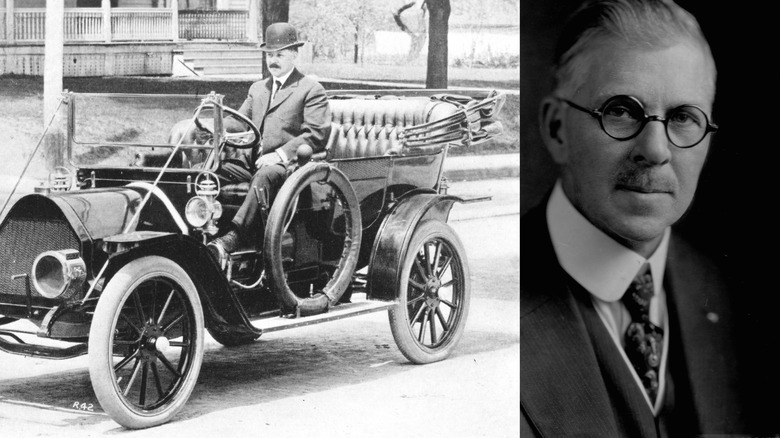
Henry Ford and the early Ford models get a lot of historical automotive acclaim, and with good reason. The genesis of the Ford Motor Company helped build the automotive industry as we know it today. But other highly influential figures like Ransom Olds don't get as much attention. Ford wasn't the only automaker delving into mass-production techniques — Olds produced the Curved Dash using similar production-line methods. In fact, toward the end of the model's run, Oldsmobile was churning out over 5,500 units per year before the Model T was even released.
An interesting factor (which was purely coincidental) in the Curved Dash's success was its price. When they went on sale in 1901, Curved Dash models were priced at $650, which was considered an approachable price point at the time. This encouraged early adopters to take a chance on the automobile, lending to the notion that these vehicles could become a common fixture among American homes. In contrast, the first Model T launched in 1908, starting at $825. Ford's Model T was far more advanced and powerful than the original Curved Dash, but the price increase was still a big pill to swallow for a new mode of transportation. Ford comparisons aside, Ransom Olds started one of the great automobile brands that lasted for more than a century, and we're still not over the death of the iconic brand.