

How The Mazda Miata Got Quicker After Losing Horsepower
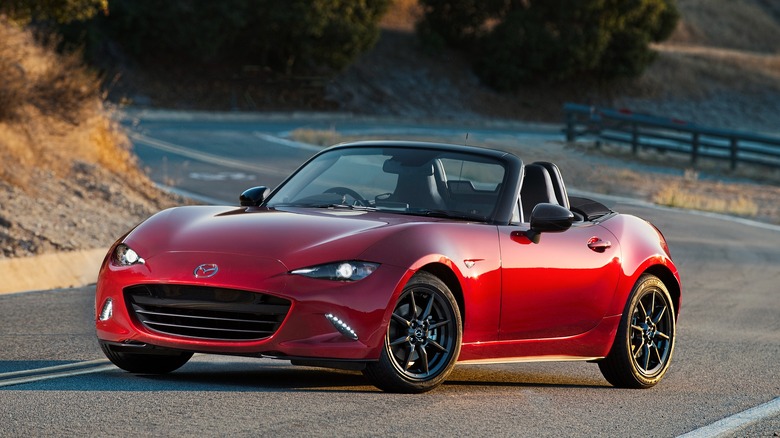
When looking for something sporty, fun, and lightweight, your options are certainly not limited. But if you throw in the caveat the car must also be reasonably affordable, it's hard to argue against the Mazda Miata — although not every iteration has been equally celebrated. In fact, the third-generation (NC) Miata, which ran from 2006 to 2015, seemed to rub the car community the wrong way. It was larger, heavier, and came packed with driving safety systems counter to the original's free spirit.
Fortunately, the automaker heard the complaints, as the 2016 fourth-generation (ND) Miata corrected the missteps and even achieved faster acceleration times than its predecessor, despite losing some horses under the hood. How? The ND Miata lost some unnecessary pounds. The larger NC roadster features a 2.0-liter MZR engine outputting 170 horsepower, while the ND sports a 2.0-liter Skyactiv-G producing 155 horsepower. But on top of the NC being longer at 157.3 inches versus the latter ND Miata at 154.1 inches, it's also nearly 100 pounds heavier.
While this might not sound like much, the differences significantly factor into the car's power-to-weight ratio. Put simply, an engine doesn't have to work as hard to generate movement for a lighter vehicle. This allows both torque and horsepower to be used more efficiently, boosting performance. Case in point, 0-60 mph times went from around 6.7 seconds down to just 5.9. And the upcoming next-gen Mazda MX-5 Miata will be even lighter than the ND and still offer a manual transmission. While weight reduction is a major aspect of the Miata getting quicker, it wasn't the only change that made an impact.
A higher compression ratio and changes around gearing
One way to add both power and efficiency from an engine is to increase its compression ratio. This figure represents the difference in volume when the piston is at the bottom of the cylinder versus the top. The NC Miata features a 10.8:1 compression ratio while the 2016 ND's is 13:1. This results in the latter's engine being more productive, generating an additional 8 pound-feet of torque, which has a direct impact on acceleration capabilities.
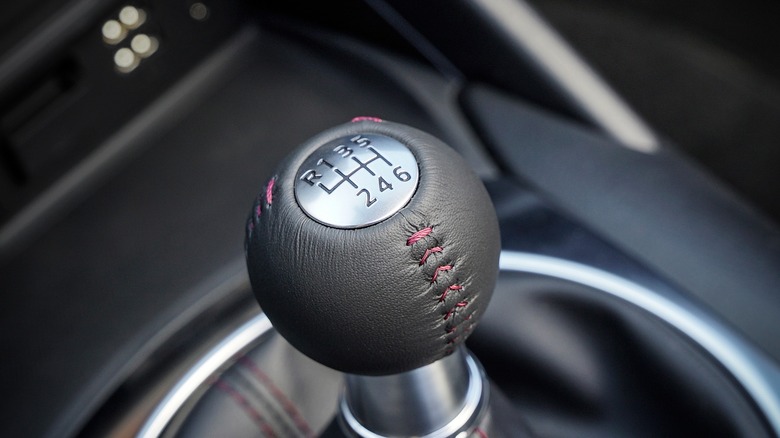
The ND also had some updates to its gearing system, which helped this Miata outperform its predecessor. The gear ratios themselves have been altered, being noticeably higher in every instance over the NC. This favors torque, offering superior acceleration and contributing to the ND outputting more power along the low- and mid-range. In fact, under 6,000 rpm, the older NC can't match the ND in terms of output. It's no wonder we said that the 2016 Mazda Miata would save the sports car, though some would argue the NC Miata is greatly misunderstood.
ND Miatas are part of the nameplate's fourth generation, which is still active today. Over the course of its more than three decades in production, Mazda would also sell over 1.2 million of the roadsters. This allowed it to be recognized by the Guinness Book of World Records, as reported by Forbes. If you ask us, everyone should drive a Miata at least once, as an experience behind the wheel is likely to convert even the most ardent of skeptics.