

This Test Shows The Limits Of Lightweight Wheels (But There Are Still Lessons Worth Learning)
Less weight can be helpful, whether you want to maximize your car's zero-to-60 times and skidpad grip, or fit into an old pair of pants. And vehicle weight saving measures can be fairly dramatic, like removing the rear seats or tearing out sound deadening material, but there are even smaller strategies in place with modern cars that focus on removing heft. Look at Porsche, with straps for door handles on some of their models and decals used instead of emblems in an effort to save mere ounces. A more common weight-saving technique, however, is using lightweight wheels. Lighter wheels reduce overall vehicle weight, which is good, but they also lower rotational inertia. In other words, the engine doesn't have to work as hard to get the wheels spinning. Plus, there's less unsprung weight, which puts less stress on springs and shocks.
But how much of a difference is made when you buy an expensive lightweight wheel? Ignoring the subjective for the moment (we'll get to that), how much time, during acceleration, do you save as wheel weight changes? What about distance while braking? Jonathan Benson, host of the YouTube channel Tyre Reviews, conducted a series of tests to see just how much difference a set of lightweight wheels makes.
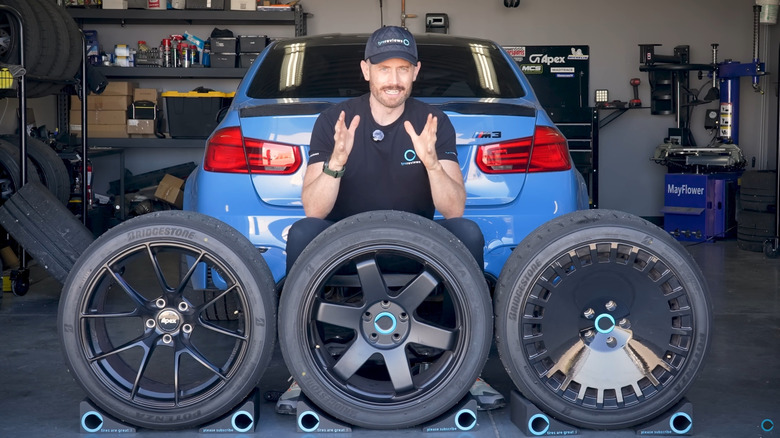
The car he used was an F80-generation BMW M3. Three different sets of wheels were used, each with increasing weight. Respectively, the three wheels weighed 20 pounds, 38 pounds, and 52 pounds each, and were all wrapped in the same sticky Bridgestones. No reason to build suspense: There were differences in performance with all three sets of wheels. There were changes in acceleration, braking, and driver input. The differences weren't insignificant, especially for people chasing lap times, but they were smaller than some might initially think.
Lightweight wheels and hard data
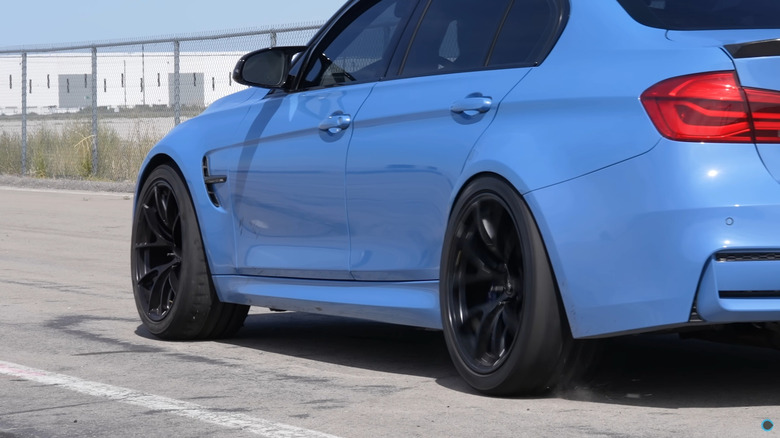
First, let's look at acceleration. The M3 with the 20-pound wheel took 5.76 seconds to accelerate from 31 to 87 mph. With the 38-pound wheel, that time increased to 5.93 seconds. Finally, with the M3 sporting the 52-pound wheel, it took the longest, at 6.07 seconds. Just going by the seat of the pants, that 0.31-second spread was imperceptible. To see the difference static weight makes vs. rotational mass, Benson put the lightest wheels back on and added 130 pounds of ballast to the car, replicating the added weight of the heaviest wheels. The same acceleration run took 5.88 seconds, highlighting just how much of a contributing factor rotational mass is.
According to Benson, his braking test was a bit less scientific because of road surface inconsistencies. The stopping distance differences between each set of wheels (which he doesn't share) were apparently very close. He does crunch some theoretical numbers, however, that show a stopping distance difference between the heaviest and lightest tires of 2 feet.
The track test may be the most interesting portion of his video, especially for racers who want to eke out every last second and stay ahead of the competition. The 20-pound wheels yielded a 99.13-second lap time, the 38-pound wheels slowed the pace to a 99.92-second lap time, and the 52-pound wheels broke out of the 99s to a 100.74-second lap time. Kyle Larson beat Chris Buescher by just 0.001 seconds at the AdventHealth 400 in 2024, NASCAR's closest-ever finish. By comparison, a spread of 1.61 seconds is the racing equivalent of a geologic age. This all suggests that dedicated racers, from weekend warriors in Miatas to sponsored teams with heavy TV coverage, can all benefit from lighter wheels, even if the initial acceleration differences seem small.
How do the wheels make you feel?
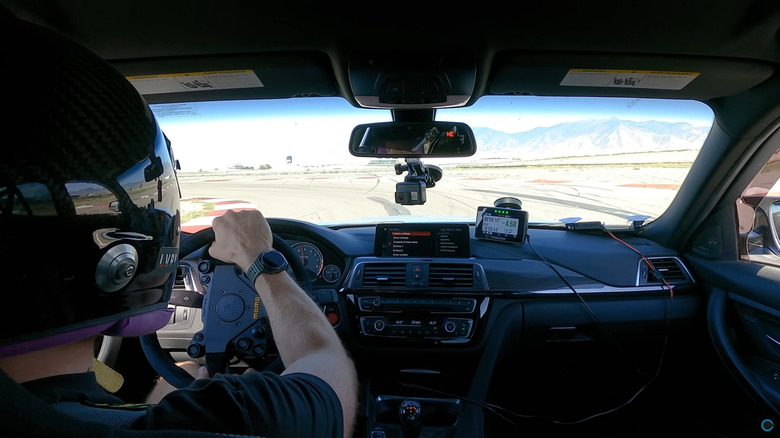
Given that the acceleration times and braking distances are so close, there's an implication that Benson's M3 might've felt fairly similar on different wheels throughout testing. However, the subjective differences were apparently dramatic. Benson said, "On the light wheel, the car wants to dance with you. You get good feedback from the steering wheel. You know what's [going on under] the front axle, which is the most important for feeling confident when driving." But he also notes the reduction in feedback as the wheels get heavier.
The data and Benson's subjective feedback show that bolting on lighter wheels won't make much of a performance difference if you're only driving on the street. If your Dodge Viper keeps losing stoplight drag races against Tesla Model S Plaids, a set of light wheels won't fix that. But not every modification has to satisfy the stopwatch. A change that you can perceive through the wheel, the seat, and the pedals may still be worthwhile.
This extra confidence is great, but it comes at a cost. If you're already wealthy and see the C8 Corvette ZR1's starting price of $183,400 as cheap, then go ahead, spring for the $13,995 clear-coated carbon fiber wheels that reduce rotating, unsprung mass by 42.8 pounds. It's just the price of a used Porsche Boxster S, no big deal. If you work for a racing team that has a budget with no cap, go for the lightest (and strongest) wheels you can buy. But for those of us with wading-pool-shallow budgets, we'll continue to look for car mods that make our cars faster for a bit less money.