

Who Really Invented The Yellow Traffic Light?
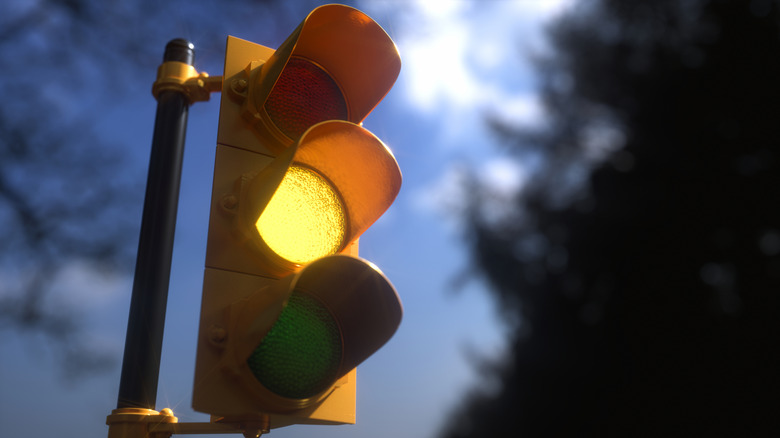
Ah, the yellow light. You know, that signal that is supposed to let you know to slow down as you approach the intersection, but makes you speed up instead? You probably take it for granted, but traffic signals did not always include a yellow light. Traffic signals have been around since before cars, starting in the mid-1800s directing horse carriage traffic in London. The first gas-powered version didn't last long, since it exploded and killed the officer operating it. Electric signals came on the scene in 1914. But they had only two lights: green for go and red for stop, with nothing to warn that the light was about to change. You can imagine how that turned out. Eventually, people had enough of collisions in busy intersections, and multiple inventors started working on solutions.
Along came Garrett Morgan. Morgan was already a successful inventor, having invented a safety hood that would be used by fire departments, as well as accidentally inventing a chemical hair relaxer that became popular with Black men. In the 1920s, Morgan decided to do something about all of these traffic accidents in intersections and invented a traffic signal that would require all traffic to stop in order to clear an intersection before changing to stop or go. He was awarded a patent for it in 1923. Hooray, the caution signal was invented!
Not so fast. A police officer by the name of William Potts brought the three-light traffic signal to Detroit streets in 1920. His traffic lights looked and worked much the way traffic lights do today, with red, yellow, and green lights. While Morgan's traffic signal would influence how traffic would be managed for years to come, Potts was really the inventor of the yellow traffic light as we know it today.
William Potts, the inventor cop
It sounds like a 1980s detective TV show: the inventor who solves crime. We don't know how many crimes William Potts actually solved or if that was even his job. But he was, in fact, a police officer. The police have a special interest in preventing traffic accidents, what with the abundant paperwork and all. Whatever Potts' motives were, it wasn't profit, since municipal employees like him were ineligible to file patents in cases like this.
Potts drew his inspiration from railroad signals, which were already using yellow or amber lights. Railroad signals were similar to traffic signals on the street today. They had three lights: red for stop, green for go, and yellow for "proceed with caution." Potts built something similar, putting his lights in a four-sided box.
The new three-light signal was erected in 1920 at the busy Detroit intersection of Fort Street and Woodward Avenue, which saw more than 20,000 vehicles a day. We didn't even know there were 20,000 vehicles in Detroit in 1920. The city of Detroit would full-on adopt Potts' invention and use it throughout the city. By the 1930s it was being used across the country, and in 1935, the Manual on Uniform Traffic Control Devices declared Potts' design the standard for traffic signals. And they really haven't changed that much a century later (though Japan uses blue lights instead of green for some reason), but we'd like to know what Mr. Potts would have thought about traffic cameras.
Garrett Morgan: not the inventor of the yellow traffic light, but still one interesting dude
Garrett Morgan was already successful by the time he invented his traffic light in the 1920s. So successful, in fact, that he owned an automobile. That was no small feat for most Americans in 1920, but it was even more impressive for a son of a formerly-enslaved person and someone who had only graduated from elementary school. But his inventions enabled Morgan to become the first Black person to own a car in Cleveland.
One of his inventions came about when he was trying to make a chemical solution to keep sewing machine needles from burning cloth. Instead, he accidentally discovered that the solution could make hair lie flat. And so, he launched G.A. Morgan's Hair Refiner, which became pretty popular with Black men. Later, he would invent the safety hood, a forerunner of modern gas masks. In 1916, workers became trapped in a tunnel that was being dug under Lake Erie when they hit a pocket of natural gas. Morgan and his brother put on safety hoods and rescued two of the workers. The U.S. military struck a deal with Morgan to supply them with safety hoods for use in World War I.
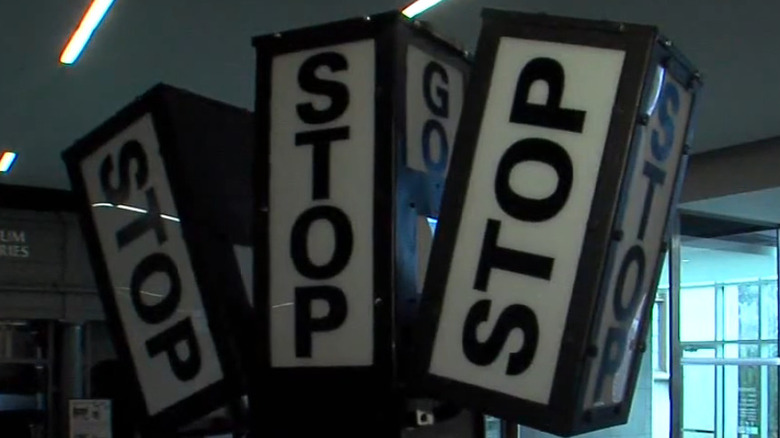
In the 1920s, he created a semaphore-type traffic signal that was cranked manually and would raise signs for stop and go, as well as one for "all-stop," meaning traffic would stop in all directions to let the intersection clear. Unfortunately, this signal wouldn't become the standard. Don't feel sorry for Morgan, though. General Electric would buy the rights to his patent in 1923 for $40,000, which was a stack of bills back in the day. Garrett Morgan didn't invent the yellow light, but he did all right for himself.