

What Is The Difference Between An IIHS Top Safety Pick And Top Safety Pick+?
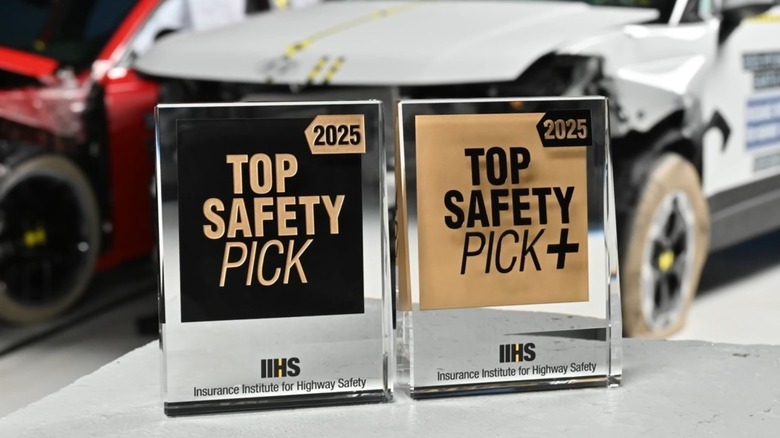
Each year, safety organizations like the National Highway Traffic Safety Administration (NHTSA) and the Insurance Institute for Highway Safety (IIHS) conduct rigorous crash testing on the most popular car models and rate their performance to help consumers see how they performed. The NHTSA uses a five-star rating system, with more stars being better. With IIHS, the scale is a little less straightforward.
Cars tested in IIHS crash test are given ratings of good, acceptable, marginal, or poor. Good is the highest rating, acceptable is the next best, and so on. These ratings are currently applied to three main crash categories: small overlap front, moderate overlap front, and side crash tests (for both the driver and passenger sides of the vehicle). Vehicles are also rated for the effectiveness of their seat belt reminders, headlight performance, ease of child seat installation, and frontal crash prevention in both vehicle and pedestrian scenarios.
The main difference between the IIHS Top Safety Pick and Top Safety Pick+ lies in the updated moderate overlap front test. While the Top Safety Pick+ award requires a good rating in this category, an acceptable rating is usually enough to land the IIHS Top Safety Pick designation. For both designations, a rating of good is needed in the small overlap test and the updated side test. In addition, cars need an acceptable or good rating in the headlight and pedestrian front crash prevention assessments for Top Safety Pick or Top Safety Pick+ award.
What's are the differences between old and updated tests?
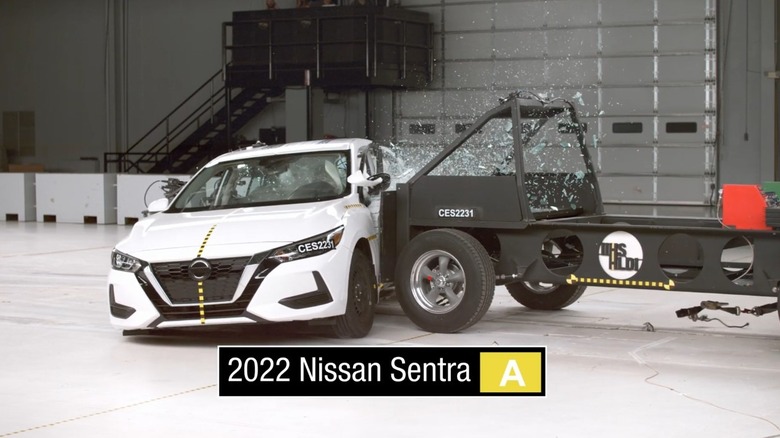
To help minimize casualties, the IIHS rolled out a new side impact test in 2021, aimed at encouraging vehicle manufacturers to strengthen vehicle structures and prevent intrusion into the occupants' space during a crash. The older (or "original") version of the test used a 3,300-pound deformable barrier that measured about the same height as an SUV traveling at 31 mph, to simulate a vehicle being hit from the side. The updated side test, by comparison, uses a more realistically sized 4,200-pound deformable barrier, traveling at a higher speed of 37 mph for greater crash energy.
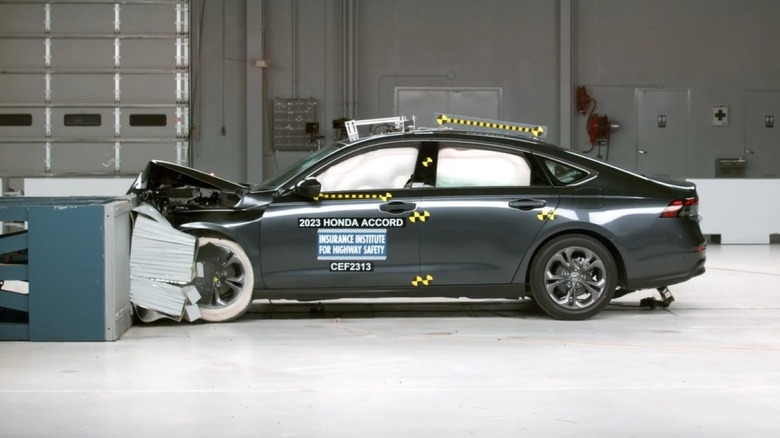
This effort was soon followed up by the introduction of an updated moderate front-overlap test in 2022. As before, the updated assessment judges the impact resulting from a head-on collision in which 40% of the vehicle's front end hits a barrier at 40 mph. Unlike the original moderate front-overlap test, the newest version adds another dummy behind the driver and makes it a point to evaluate rear-passenger safety.
Previously, automakers needed to strengthen vehicle structures and install advanced seat belts and airbag systems in order to achieve success in this test. However, many of those features were primarily designed for front occupants, which led to growing concern about the safety of those in the back seat. Thus, the updated moderate overlap front assessment aims to encourage vehicle designs that use similar advanced tech in the rear seats.
What vehicles made the cut in 2025?
Safety has long been a top priority for drivers who take their well-being seriously, but testing performed by organizations like the IIHS proves that not all cars are built to the same high standards. Depending on the vehicle segment, there may be several top safety rated vehicles to choose from, or none. A total of 53 vehicles across various segments have earned the Top Safety Pick+ award so far in 2025. Winners in the small car segment include the 2025 Kia K4, Honda Civic Hatchback, Hyundai Elantra, Toyota Prius, and Mazda 3 (in both its sedan and hatchback configurations).
Many other segments also performed well. However, the small pickup, large pickup, and large luxury segments appear to be having difficulty achieving top safety ratings. The 2025 Toyota Tundra crew cab pickup is the lone representative in the large pickup segment, while the small pickup and large luxury categories have no winners. Despite applying a slightly less stringent criteria, the Top Safety Pick has fewer winners than the more demanding Top Safety Pick+ designation, as there are only 15 IIHS Top Safety Picks for 2025. Among them is the charming 2025 Subaru Forester, which has since strengthened its appeal with the launch of a hybrid variant.