

The 12-Second Rule That Could Help Prevent A Motorcycle Crash
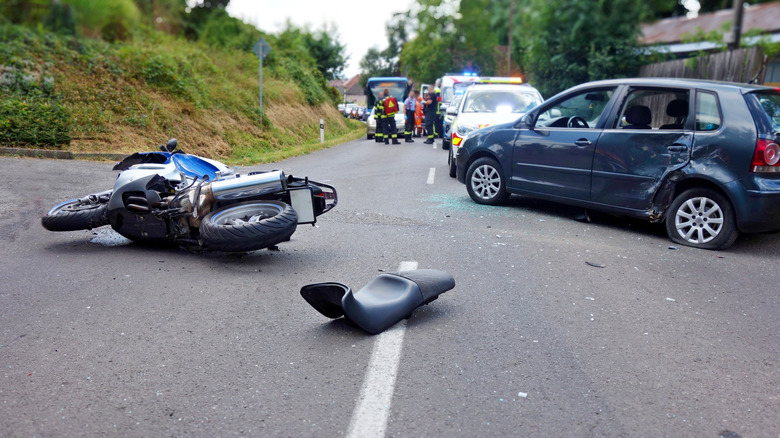
Motorcycle riders don't get crumple zones or airbags as their first line of defense, so motorcycle crashes tend to get really ugly. What motorcyclists need most is extra awareness, and that's where the 12-second rule comes in. It's a core concept taught by the Motorcycle Safety Foundation (MSF) and part of what they call Rider Radar, which is an approach built around understanding your two-second following distance, your four-second immediate path, and your 12-second anticipated path.
According to the MSF, you should always be looking as far ahead as you'll travel in the next 12 seconds. At 30 mph, that's roughly 528 feet. At 45 mph, the distance is around 792 feet. And on the highway at 60 mph, your visual lead stretches out to nearly 1,000 feet, or about two-tenths of a mile. Riders who aren't used to looking that far ahead often worry they'll miss potholes or tar snakes. But the rule doesn't ask riders to ignore anything up close. It simply prioritizes spotting bigger threats early, and that could be anything from a car about to turn left to an erratic driver wandering across the centerline. Twelve seconds of space buys the time needed to recognize a hazard and turn it into a non-issue long before you reach it.
Why the 12-second rule works

The MSF teaches the Search, Evaluate, Execute (SEE) method because it can prevent hazards before they become urgent or unmanageable — this is a core element of the organization's Basic Rider Course. A rider who has already scanned the route ahead has better chances of avoiding the situation by either adjusting their speed or their path. It's akin to giving yourself the same advantage that a wartime general is always on the lookout for, which is getting ahead of the enemy and winning the battle before a single shot is fired.
At 60 mph, you cover 88 feet every second. Spot a threat 1,000 feet ahead, and you get roughly four seconds before you reach it, plus the full twelve-second buffer that allows you to plan instead of panic. Riders sometimes worry they'll miss the small stuff when looking far ahead, but peripheral vision fills those gaps. You may not identify an oil patch instantly, but you'll notice the dark spot and adjust as it approaches. What the 12-second rule truly prevents are the catastrophic scenarios.
Using the 12-second rule to make life-saving decisions
Scanning ahead isn't a distraction but rather a practical tool that gives a rider clarity and helps them make a decision before the distance to the danger closes. Once a potentially dangerous situation is identified, the rider can do one of three things. They can either change speed, change position, or communicate intentions.
Sometimes that means rolling off the throttle to create space. At other times, it means shifting a few feet within the lane to increase visibility or making a clean lane change. In some cases, it might even mean pulling off into a parking lot to wait out a situation that looks like trouble. These are just some of the rules of motorcycle etiquette that separate the newbies from the pros.
On longer rides (especially at highway speeds), this kind of proactive evaluation is what separates uneventful trips from near misses. Ultimately, the 12-second rule is a mindset. And like the MSF stresses in its courses, the more time you give yourself, the better your chances of making it home safely.