

How Reliable Is The New Honda Odyssey? Here's What Consumer Reports Says
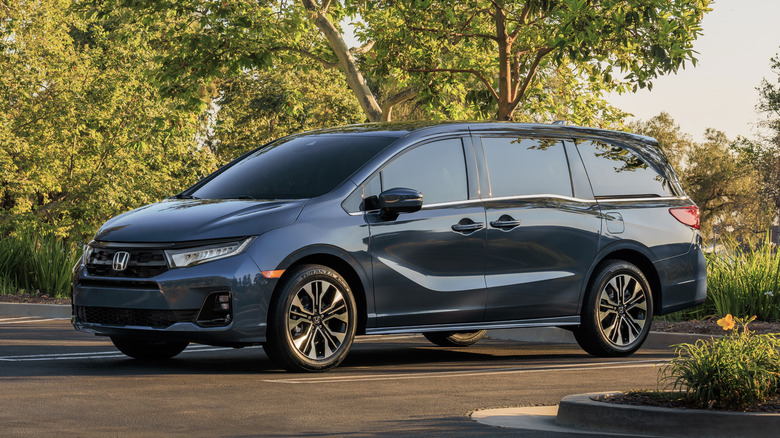
The Honda Odyssey has come a long way since it launched for the 1995 model year as a compact minivan with four-cylinder power and a platform borrowed from the Accord, while lacking sliding side doors. Honda launched the fifth-generation Odyssey for 2018 and brought a mild facelift and new technology for 2021, followed by another facelift in 2025. This edition is almost 20 inches longer than the original. It also has V6 power and sliding doors, which started with the second generation.
A look at Consumer Reports' reviews of the Odyssey shows a reliability roller coaster dating back to the 2001 model year. Over the past quarter of a century, Honda's sliding-door people mover earned an above-average reliability score for only three model years (hint: it's not for the newest versions — 2025 or 2026). These standings contrast with overall car brand rankings from Consumer Reports (CR) for 2026, which place Honda fourth.
The 2025 Odyssey stands out (and not in a good way) with a below-average reliability score, even if it's a superior road trip solution. Meanwhile, the 2026 edition, which didn't receive any noticeable updates, is upgraded to average in the dependability department. Notably, the 2026 version is the first Odyssey model year to receive the organization's "CR Recommended" endorsement, a thumbs-up that started in 2021.
Trouble Spots for the 2025 and 2026 Honda Odyssey
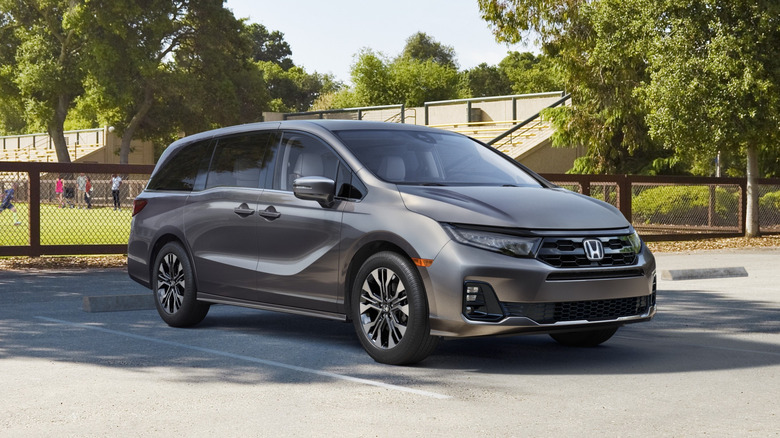
CR highlights two areas of concern for the 2025 Odyssey: suspension/steering and the climate system. These red flags are enough to rank this vehicle last in reliability among six 2025 model-year minivans. Admittedly, the Toyota Sienna, Chrysler Pacifica, and Chrysler Voyager also fall in the below-average category, slightly ahead of the Odyssey. The Kia Carnival reaches average territory, while the Carnival Hybrid climbs into the above-average range. 2025 is the first year for the Carnival Hybrid.
Prospects improve for the 2026 Odyssey, but CR uses a "predicted reliability" scale for the latest model year versus hard data and owner feedback. This ranking is "based on the model's recent history," an average of overall reliability scores from the past 3 years (assuming there are no substantial changes in the new version), according to CR. As a result, there's no breakdown of specific trouble areas.
This number crunching, or "forecasting" as CR calls it, elevates the newest Odyssey. Its now-average ranking puts this Honda in fourth place for predicted reliability out of seven minivans for the 2026 model year. Three Chrysler products anchor the bottom, while the average-ranked Toyota Sienna and Kia Carnival sit higher in the index. The Carnival Hybrid remains top-ranked with an above-average score.
Reliability for the other fifth-generation Honda Odyssey years (2018-2024)
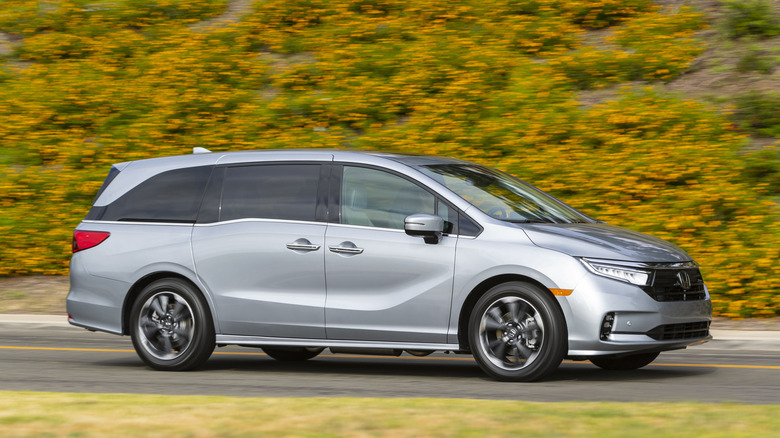
In terms of dependability, the first three years (2018 through 2020) of the current-generation Odyssey earned below-average scores. CR indicates in-car electronics and build quality as notable trouble areas across these years, while the 2018-2019 editions have a history of reported problems with the fuel system/emissions and suspension/steering.
The 2021 Odyssey achieved an average rating, while nagging noise/leaks and in-car electronics issues persist. CR gave the 2022 edition an above-average reliability score, making this the sole fifth-generation Odyssey to achieve this status. Despite this stronger performance, CR still cites build quality issues and noise/leaks as potential problems. Build quality was at the heart of a recall involving mirrors falling off 2020 to 2022 Odysseys. The only other Honda Odysseys from the 21st century to receive above-average reliability ratings were the 2001 and 2002 model years.
The 2023 and 2024 Odysseys dropped to average dependability, with suspension/steering a common trouble area for the 2023 model year. CR flags "minor engine" issues for the 2024 edition, but doesn't get into specifics beyond saying these problems involve the "accessory belts and pulleys, engine computer, engine mounts, engine knock or ping, fuel leaks, [and] oil leaks."