

If You Hear A Fire Truck Honk Three Times, This Is What It Means
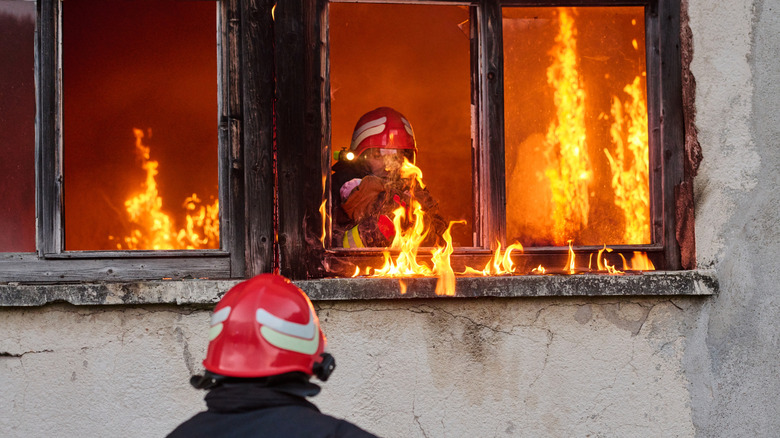
Even for veteran firefighters, being in a burning structure can be a disorienting experience. The smoke makes it hard to see, the roar of the fire makes it hard to hear, and wearing their SCBA (self-contained breathing apparatus) can make it all worse. So, if an order is given to evacuate, it's vital for everyone to hear it — and in many cases, the signal will be three short blasts from an air horn, repeated three times. On the other hand, there is no national guideline for firefighter evacuation signals, and some departments may repeat the horn blasts only twice, or run the siren once for 30 seconds.
With the ability to produce sounds of up to 150 decibels — a level that is considered unsafe for any period of time by the American Speech-Language-Hearing Association (ASHA) — air horns are at least less dangerous than being trapped when a burning building collapses. They work by releasing highly compressed air — 100 to 200 pounds per square inch — which blows against the diaphragm, and that, in turn, vibrates to produce the sound waves. It's basically like the way an audio speaker works. But with the air horn, the sound is further affected by the shape and length of the horn bell. Maybe that's why New York fire trucks sound so unhappy.
The science of sound
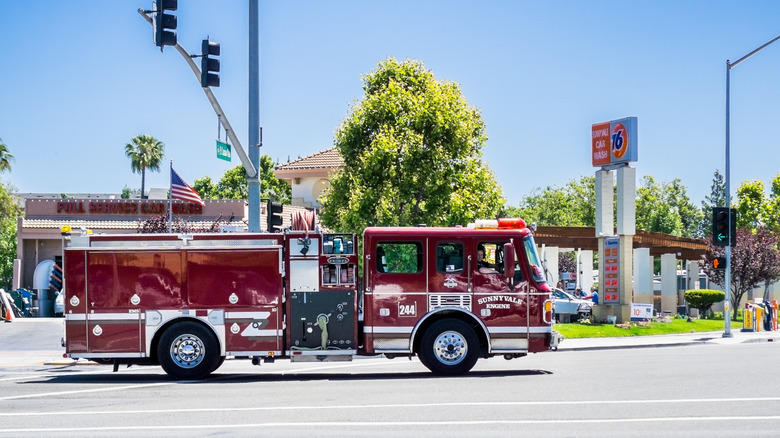
Out in the real world, though, a lot of other factors can also come into play when you're trying to warn folks. For instance, we have to consider the inverse square law: It basically says that a siren's volume falls by 6 dB every time you double your distance from the source. Using some math from Fire Apparatus Magazine, that ends up limiting the effective range of a 110-dB siren to about 80 feet; drivers in cars farther from the siren may not be able to hear it.
Here's how that can play out in one of the more dangerous real-world situations, where a firetruck and another vehicle are each approaching a 90-degree intersection at the same time: The typical driver in a car moving at 45 mph takes roughly 195 feet to come to a stop, which includes the time it takes to recognize the siren sound and then engage the brakes. But if that driver only hears the siren at a distance of 80 feet, stopping before the intersection is going to be virtually impossible.
Nor can you just make the sirens louder. The Occupational Safety and Health Administration (OSHA) has its own rules in place to protect firefighters' hearing. OSHA enforcement isn't always perfect, however. For example, the agency's fines didn't stop Tesla from injuring its workers. And keep in mind there are plenty of agencies and associations getting in on the action when it comes to overseeing firefighters and their equipment.
Siren and horn guidelines
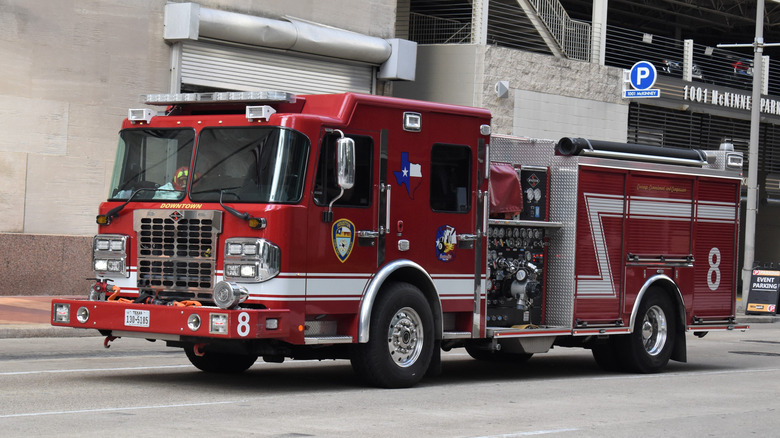
One key source for rules and regulations about sirens is the Standard 1900 for Aircraft Rescue and Firefighting Vehicles, Automotive Fire Apparatus, Wildland Fire Apparatus, and Automotive Ambulances put out by the National Fire Protection Association (NFPA).
The NFPA starts by requiring at least a single siren that's compliant with the J1849 standard for quality and performance from the Society of Automotive Engineers (SAE). It then gets into details like the siren's location on the exterior of the truck, where it needs to be positioned for optimum sound projection in a forward direction — while still remaining protected top and bottom from both foam dripping down off the truck's turret and water thrown up by wet roads. The NFPA also sets some basic guidelines for operator controls, requiring the truck's siren and horn to be operable from a steering-wheel-mounted button. It also requires that the system can work as a PA and produce "wail" and "yelp" sounds.
The high-low wail is the traditional siren sound that goes up and down in tone, and it's typically meant as a long-distance warning. The yelp function provides a series of quick, high-pitched tones that are often used to grab driver attention in crowded traffic. Other common siren sounds include an even more insistent phaser that emits high-speed, high-frequency tones, and a low-frequency rumbler to warn people with hearing difficulties. The bottom line: until the advent of connected cars with emergency vehicle detection, sirens will have their place in road safety.