

These Are The 10 Fastest Motorcycles Of The 1970s
The 1970s saw huge changes in the motorcycle industry. The 1970 Clean Air Act all but killed large capacity two-stroke motorcycles. These engines burned fuel and oil, which didn't play well with the new emission standards. The answer: four-stroke engines. The problem: two-stroke engines have a higher power-to-weight ratio, meaning better overall performance. Accordingly, two-stroke engines were the dominant force in motorcycle racing for a long time.
So, one would think that motorcycle speed decreased in the 1970s. History, however, tells a different story. The fastest 1960s motorcycle, the 1969 Honda CB750, already had a 736cc four-stroke engine and a top speed of 125 mph. However, the 1970s were the true beginning of the liter-bike category and advanced aerodynamics, bringing significantly higher top speeds.
How high? Well, one bike even broke the 150-mph (241 km/h) barrier — a significant increase of the CB750's top speed. Heck, in this piece we listed ten 1970s motorcycles that are faster than Honda's groundbreaking 1969 model. So, from strange, rotary-powered bikes to smooth six-cylinder sports touring masterpieces, here are the 10 fastest motorcycles from the 1970s.
1975 MV Agusta 750S America (130 mph)
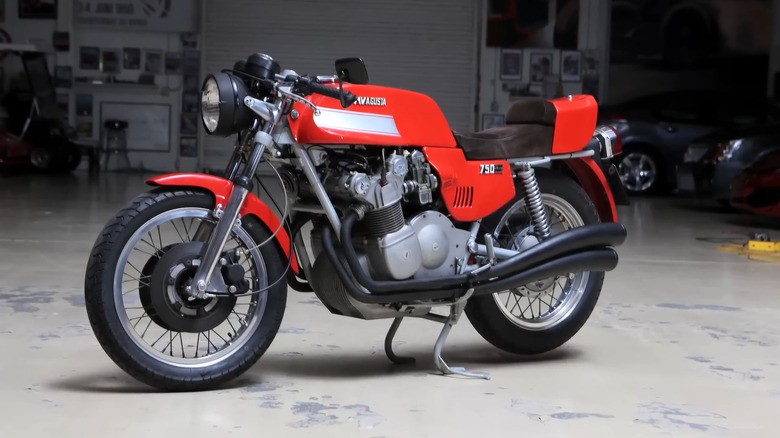
Before we even talk about its era-defining performance, can we just appreciate the MV Agusta 750S America's gorgeous design? This is pure motorcycle art on wheels, with a sculpture-like optional fairing, two organic-looking exhaust pipes on each side, and beautiful details all around.
Nestled in the middle of this 1970s superbike lies a 743cc air-cooled four-cylinder powerhouse with DOHC and four — yes, four 26 mm Dell'Orto carburetors. As a result, it produced 65 hp. Top speed: 129 mph. Interestingly, the Cycle World magazine only measured 114 mph in its review, but it's entirely possible that the model equipped with the full fairing was faster because of better aerodynamics.
Still, MV Agusta wasn't going to rest on its laurels and introduced an even faster, 789cc version called the 750S America in 1975. The improved model produced 75 hp at 8,500 rpm, sent to the rear wheel via a five-speed, transversely mounted gearbox and a relatively heavy shaft drive. MV Agusta claimed a top speed of 130 mph (209 km/h), despite the lack of a full fairing.
Still, the MV Agusta 750 Sport wasn't just a one-trick pony. This bike also had a tubular double-cradle chassis honed in racing; hardly surprising, as MV Agusta won an astonishing 16 titles in the premier motorcycle racing category. A 35-mm Ceriani front fork and dual Marzocchi rear shocks further improved the handling, while two 275-mm front discs ensured good braking performance.
1973 Van Veen OCR 1000 (132 mph)
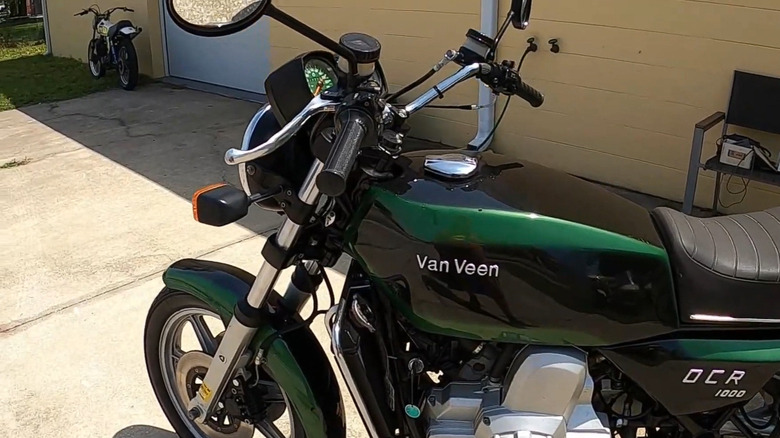
The Van Veen OCR 1000 is a 1970s two-wheel curiosity that has a lot in common with the intense Mazda RX-7 sports car. Yup, you guessed right — it has a twin-rotor Wankel engine! Before you start drooling over this fact, keep in mind that rotary engines weren't uncommon in the 1970s. Fichtel & Sachs pioneered the idea with the Hercules W2000 in 1974, followed soon by the Suzuki RE5.
We really can't blame them — a Wankel engine makes sense in motorcycles, as it's small, light, and energy-dense. And the OCR 1000 was the 'densest' of the bunch — the liquid-cooled 996cc rotary produced an unbelievable 100 hp and 66.5 lb-ft of torque. In 1978, this was enough for a mesmerizing top speed of 132 mph (213 km/h).
However, the Dutch company didn't design the Wankel engine. Henk Van Veen, the company's founder, sourced the engine from Comotor, a joint venture between NSU, the last European automaker to build a rotary car, and Citroën. For the prototype, however, Van Veen used a Mazda rotary engine. The tubular, double-cradle frame was also borrowed from Moto Guzzi, though modified to fit the Wankel engine. Van Veen opted for a four-speed gearbox from Porsche and a shaft drive.
Unfortunately, the exorbitant price of $15k ($110k in today's money) led to poor sales. But it seems like this is a common theme with Wankel motorcycles. Crighton, a British high-end motorcycle company, produces a 690cc twin rotor motorcycle with 220 hp and a dry weight of just 285 pounds (129.5 kg). Called the CR700W, it starts at $195k in the UK. Sheesh.
1977 Yamaha XS1100 (135 mph)
Yamaha had a Wankel-powered motorcycle ready for production in 1972, which featured a 660cc twin-rotor engine with 66 hp. Unfortunately, Yamaha axed the project shortly before production, but it didn't matter, because the Japanese automaker was already working on its first four-stroke, four-cylinder bike — the XS1100.
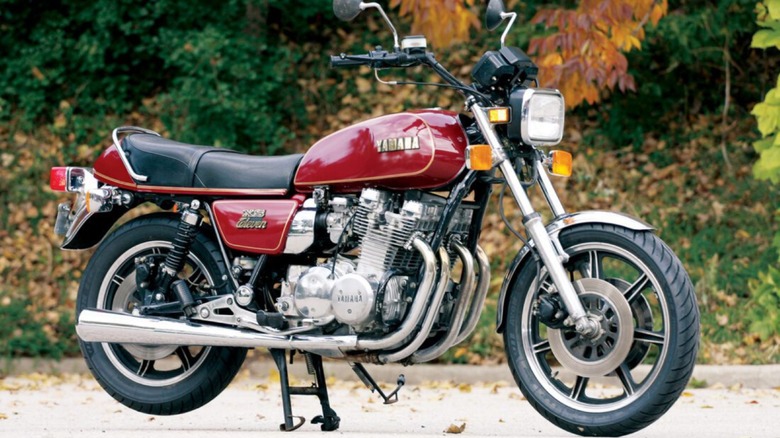
Launched in 1978, the XS1100 took Yamaha's speed game to a whole new level. Of course, it was all thanks to the 1101cc engine, fed by four Mikunis carburetors. It produced 95 hp and 66.5 lb-ft of torque. All that power was sent to the rear wheel via a five-speed transmission and a shaft drive. The four-cylinder powerhouse brought the XS1100 to a top speed of 135 mph (217 km/h) in Cycle World's test, making it one of the fastest bikes of the era. The bike could also run a 11.78-second quarter mile with a trap speed of 114 mph.
The Yamaha XS1100 was a relatively heavy bike at 601 pounds (273 kg) with a half tank of fuel. But Cycle World said it didn't matter — the bike remained controlled in the corners, even at speed, probably thanks to the long wheelbase and stiff chassis. To stop its first four-cylinder beast, Yamaha opted for two discs on the front wheel and one disc on the rear.
Still, the thing that truly set the XS1100 apart was the touring potential. It had a relatively soft suspension, accompanied by the buttery smooth engine and spacious seating for excellent long-distance comfort.
1973 Kawasaki Z1 900 (135 mph)
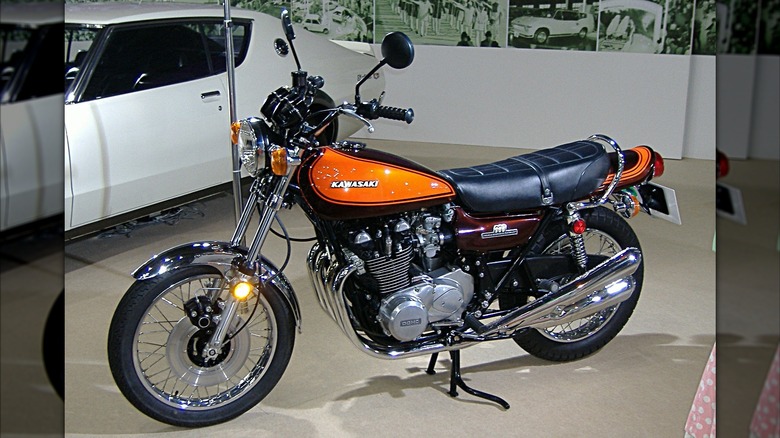
With a 322-hp supercharged 998cc four-cylinder engine and a top speed of 249 mph (400 km/h), the Kawasaki H2R is the world's fastest motorcycle. But the Japanese bikemaker has flirted with speed records long before its supercharged speed machine broke speed records.
Back in 1973, Kawasaki launched the Z1 900, which broke new ground with a manufacturer-claimed top speed of 135 mph (217 km/h). Cycle World said it measured 120 mph in its test, but mainly due to the short runway. The Z1 900 also sprinted to 60 in just 4.8 seconds and covered the quarter mile in 12.61 seconds. To make these figures even more impressive, the Z1 was a relatively heavy, 507-pound (230 kg) roadster motorcycle with long-distance capabilities.
Kawasaki achieved all this using a brand-new 903cc four-stroke, four-cylinder, DOHC powerhouse, mounted transversally. Fed by four 28-mm Mikuni VM28SC carburetors, the engine produced 82 hp and 54.3 lb-ft of torque. Red line: 9,000 rpm. The fact that Kawasaki also needed to comply with the new emission rules made these numbers even more special. For the transmission, Kawasaki went with a five-speed unit, which sent the power to the rear wheel via a chain drive.
In true Japanese motorcycle fashion, the Z1 was also incredibly reliable. In 1972, Kawasaki shattered the 24-hour speed record with the Z1 900, showcasing the bike's incredible durability. Reviewers also praised the handling, courtesy of a stiff double cradle frame, though said that the Z1 would've been better off with a dual braking disc solution upfront.
1975 Ducati 900 Super Sport (135 mph)
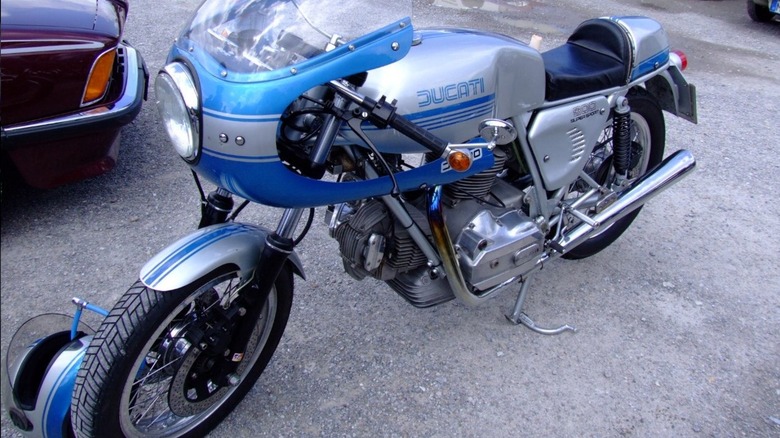
Ducati wasn't going to look from the stands as its Japanese rivals started to take over the industry and in 1975 launched a superbike stunner — the 900 Super Sport. The Bologna-based motorcycle maker was also under the shadow of its big Italian rival — MV Agusta, and the new superbike served as a halo model that showed Ducati was intent on competing with the big boys.
In true Ducati fashion, the 900 SS featured an 864cc V-twin engine, fed by two Dell'Orto PHM 40-mm carburetors. The air-cooled SOHC unit featured Ducati's unique desmodromic positive-valve-closure system which required no springs and could reach high rpm without valve floating. As a result, the relatively small V-twin produced 79 hp at a relatively low 7,000 rpm, meaning it was a torque unit that pulled well from low rpm. And this was not your ordinary V-twin; Ducati developed the engine in racing, winning the 24 Horas de Montjuic endurance race.
The other special sauce was the gorgeous fairing, which looks fantastic to this day. Crucially, it improved aerodynamics. The 900 Super Sport slid through the air, remained stable at speed, and gave the rider excellent wind protection. This was critical, as Ducati's V-twin speeder reached 135 mph (217 km/h).
Oh, and unlike its high-horsepower rivals from the era, the 900 SS weighed just 414 pounds (188 kg), which gave it an agile, playful feel. Ducati also equipped the bike with an adjustable Marzocchi dual rear shocks and front fork, alongside a strong, two-rotor front Brembo braking system.
1978 Suzuki GS1000 (137 mph)
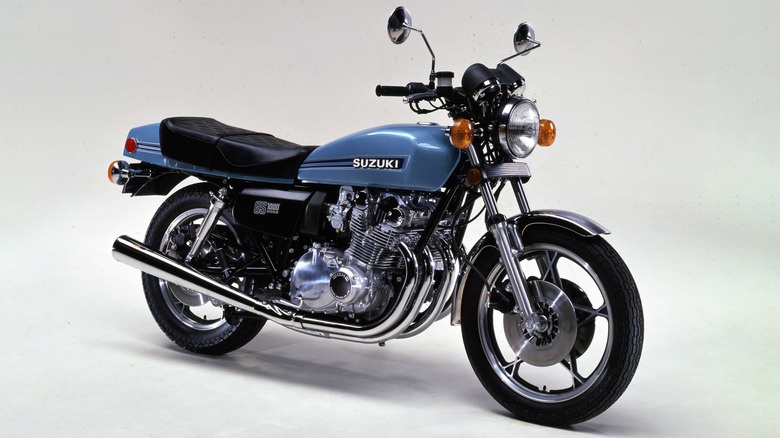
Suzuki's first liter-class motorcycle pushed the brand's GS lineage into the speed record game in 1978. Utilizing the chassis from the GS750, but equipped with a larger 997cc engine, the GS1000 quickly won its first race at the Daytona International Speedway, followed by a win at the Suzuka 8 Hours race.
The race wins showed that Suzuki meant business, and the production bike epitomized that in a street-legal package. The GS1000's air-cooled, four-cylinder, four-stroke engine was an engineering masterstroke. It had a lighter crankshaft than GS750's engine, helical primary drive, and a stronger cam chain. The result: 86 hp at 8,000 rpm and a solid torque figure of 61.5 lb-ft at 6,000 rpm. Power was sent to the rear wheel via a five-speed gearbox and a chain drive. The GS1000 reached a top speed of 137 mph (221 km/h), making it one of the fastest motorcycles of the era. The 11.8-second quarter mile was also impressive for a newcomer in the category.
However, the improvements extended far beyond just the engine. Suzuki also employed weight-saving practices and used a stiff, lightweight frame with large-diameter, thin-walled pipes. Accordingly, the GS1000 weighed in at 516 pounds (234 kg), which wasn't a bad figure for a 1.0-liter bike. The suspension was also very advanced. Telehydraulic front fork. Adjustable rear shocks and a swinging arm fork rear. Consequently, the Suzuki GS1000 was praised for its high-speed stability, which set new standards at the time. It also had strong brakes. Two 295-mm front discs and a single 295-mm rear disc ensured short stopping distances.
1978 Honda CBX1000 (140 mph)
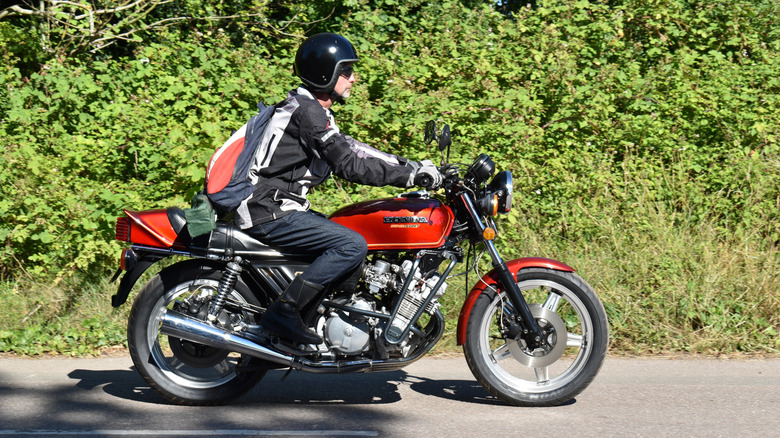
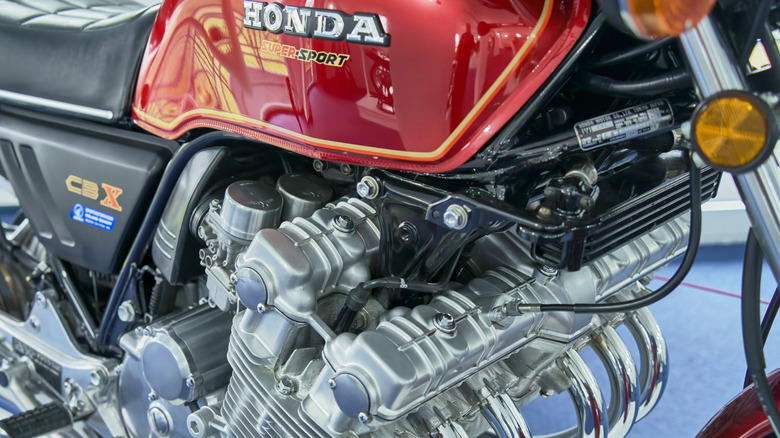
After a handful of bikes overtook the CB750 at the top end, Honda started working on a response nobody expected. The CBX1000 — the world's first hyperbike, arrived in 1978 with a transversally mounted inline-6 engine. Honda couldn't have made a bigger statement, although it wasn't the first to market with such a motorcycle. Italian bikemaker Benelli launched the six-cylinder Sei 750 four years prior, featuring a 747cc engine with 71 hp.
However, Honda's attempt was a whole different beast. The CBX1000 had a larger 1,047cc air-cooled six-cylinder unit that produced 105 hp at screaming 9,000 rpm, setting new standards for a series-production motorcycle. And it's not just the six cylinders that made this engine special. Hell no. Honda also equipped it with DOHC and four valves per cylinder — 24 valves in total, a rarity at the time. There were also six carburetors on this thing. Heck, Honda conducted extensive thermal studies to minimize the bore distances and make the engine as narrow as possible.
On top of all that, the engine was used as a stressed member, a common occurrence in modern motorcycles. This allowed Honda to cut weight from the chassis frame, because weight saving was one of the driving forces during development. To that end, the engine's camshaft was hollow and cast aluminum was used for many CBX1000 parts. In the end, Honda brought the six-cylinder bike to respectable 544.5 pounds (247 kg). As a result, the buttery smooth six-cylinder engine brought the CBX1000 to a world-beating 140-mph (225 km/h) top speed. Quarter mile: 11.36 seconds.
1978 Bimota KB1 (140 mph)
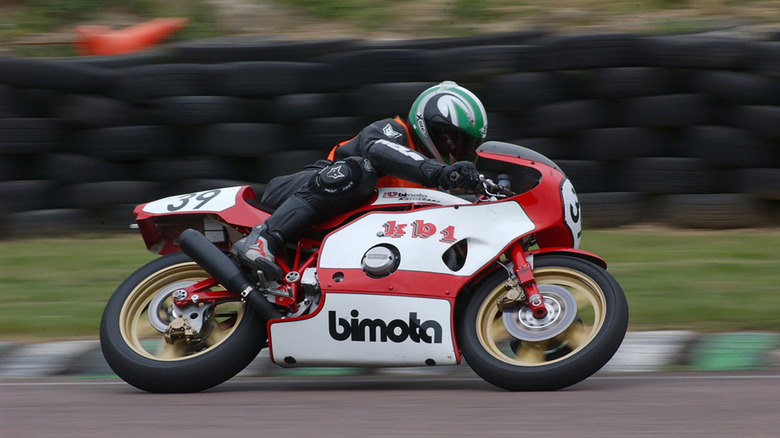
Looking at the Bimota KB1, we won't blame you for thinking it's a much newer bike. But no, the Italian manufacturer launched this stunner in 1978, just five years after launching its first motorcycle, the HB1. To say that Bimota made a thunderous debut, then, would be an understatement. However, there was an elephant in the room — the KB1 utilized the engine from Kawasaki's Z1000. Still, with 84 hp at 7,950 rpm, the 1,015cc engine was certainly no slouch. The air-cooled four-cylinder, DOHC unit featured four 28-mm carburetors and was paired with a five-speed transmission.
Crucially, Bimota did its due diligence and designed a special perimeter tubular frame made from chrome-molybdenum. The Italian brand also equipped the KB1 with an adjustable steering angle and made that amazing bodywork from fiberglass to reduce weight. The KB1 weighed just 425 pounds (193 kg), which, along with the advanced frame and suspension, gave the bike handling that far exceeded other bikes from its era. This was a bike that didn't fight its overly powerful engine, unlike the Honda CBX1000, for example. The twin front and single rear cross-drilled brake discs also made easy work of the lightweight KB1.
Yup, Bimota's superbike was more balanced than most 1970s top-speed demons, but it could also compete in a straight line. Top speed was around 140 mph (225 km/h), though it was limited by the short gearing. In fact, a KB1 tuned by Termignoni reached an astonishing 172.5 mph (278 km/h). Impressed? Good luck finding one, as Bimota only produced 827 units of this amazing motorcycle.
1976 Laverda Jota (140 mph)
Laverda was an Italian company that built some of the craziest motorcycles in the 1970s. Notably, Laverda built a V6-powered racing bike to compete at the 1978 Bol d'Or 24-hour World Endurance event, producing 140 hp at 11,000 rpm from a measly 995cc capacity. Top speed was measured at 177 mph (285 km/h), 20 mph higher than its rivals.
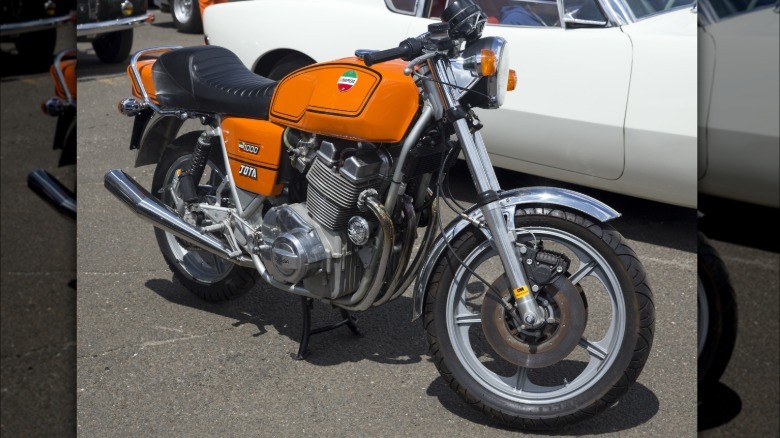
Naturally, Laverda produced the first production motorcycle to break the 140-mph barrier in 1976. Called the Jota, this production bike featured a 981cc three-cylinder air-cooled engine with DOHC. Fed by three Dell'Orto carburetors, it produced 97 hp and 66 lb-ft of torque. Because the three-cylinder engine was narrow, it gave the Jota a sleeker, superbike-like figure. This was amplified by the narrow handlebars for more of a hands-on feel.
Elsewhere, Laverda equipped the Jota with five-way adjustable rear springs with dual shock absorbers, a front telescopic fork, two front and one rear braking disc, and a five-speed transmission. These features provided the Jota with good handling and stability, though it was the meaty engine that gave it a win over its rivals in a 1976 Cycle News high-performance motorcycle comparison test. The competitors: MV Agusta 750 America, Ducati 750 Super Sport, Moto Guzzi 850 LeMans, and another Laverda 1,000cc model.
1979 Dunstall Suzuki GS1000 CS (154 mph)
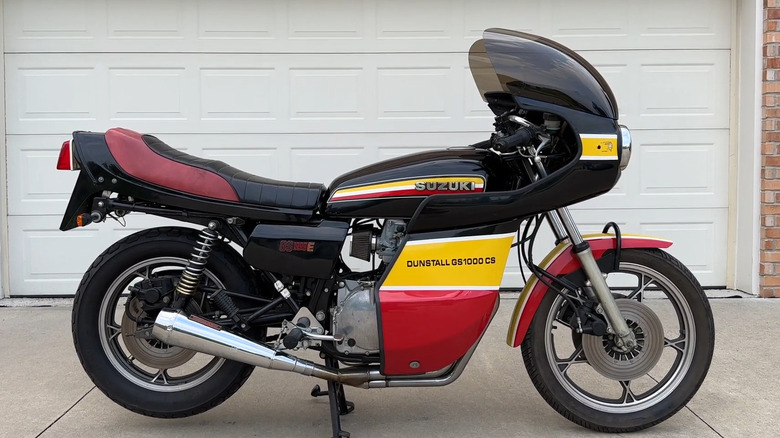
The fastest 1970s motorcycle arrived just before the decade ended. Crucially, it showed that aerodynamics plays a huge role in top speed — not just engine power. See, the Dunstall GS1000 CS was a Suzuki GS1000 underneath, but tuned with some aftermarket parts and then sold at Suzuki dealerships.
The most obvious feature was the wind-cutting Dunstall fairing and bodywork, but the GS1000 CS also had taller gearing. The 987cc four-stroke, four-cylinder engine has also been tuned using high-lift cams, stiffer valve springs, larger 29mm Mikuni smoothbore carburetors, and a gas-flowed head. As a result, the Dunstall GS1000 CS achieved a top speed of 154.2 mph (248 km/h), far higher than any motorcycle at the time. Crucially, it was 17 mph higher than the Suzuki GS1000, which is also in this list.
The record-breaking top speed was such a huge selling point, that Suzuki even slapped a '150 m.p.h.' sticker on the bike. The Dunstall GS1000 CS also covered the quarter mile in 11.2 seconds and handled really well. But that should surprise nobody, because the Suzuki GS1000 was already one of the best high-performance motorcycles of the time. Ultimately, only a few samples of the Dunstall GS1000 CS were produced, making it a very rare classic today.