

Here's How Much A 2020 Nissan Leaf Has Depreciated In 5 Years
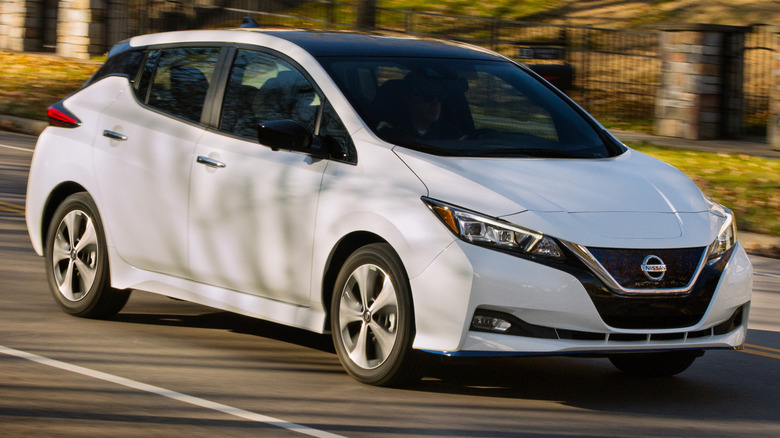
The Nissan Leaf ushered in the industry's first mass market EV, debuting in 2010 with a 107 hp electric motor that was estimated by the EPA to deliver 73 miles of electric-only driving range. The synchronous electric motor uses a 24 kWh battery pack mounted under the vehicle floor. Fast-forward to 2025 and not only has it received a range of updates that have improved its performance, but it is more attractive and much better-equipped than before.
This is especially true with the arrival of the new third-generation model for 2026. Compared to the first-gen model, the Nissan Leaf EV now gets a much larger 75 kWh lithium-ion battery, resulting in a significant power increase to 214 horsepower (though the entry-level S trim features a 52 kWh battery with 174 hp). The 2026 Nissan Leaf also gets 303 miles of range from a full charge, which is a massive improvement over the first-gen Leaf. However, the gap between the current and second-gen models, such as the 2020 Nissan Leaf, is smaller. The latter achieves up to 226 miles — and its 214 hp matches that of the 2026 version.
But there's more than just horsepower to contemplate, and the new model remains a tempting proposition overall. If you currently own a 2020 Nissan Leaf and are considering an upgrade, you might be wondering how much value you have left on your EV. Sadly, according to CarEdge data, this model is one of the worst performing cars for value retention, losing around 66% after five years of typical ownership. If you bought this car new and are looking to sell after five years, you would only get back about 34% of its purchase price.
2020 Nissan Leaf depreciation value
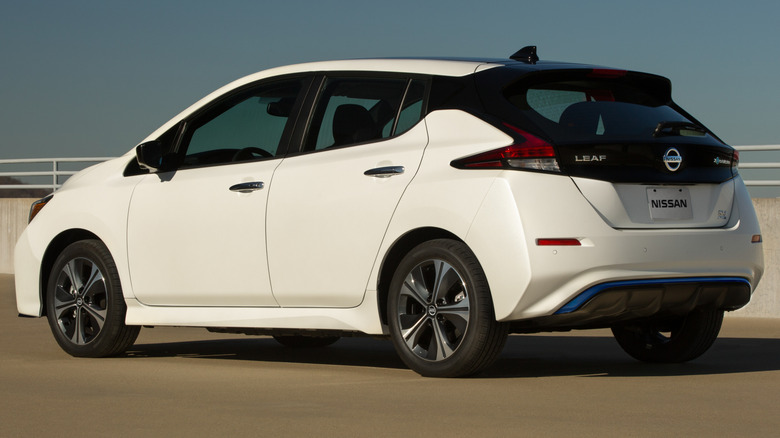
You look forward to getting back around $14,000 for your 2020 Leaf, assuming you bought it new for around $40,000. Kelly Blue Book offers details on each individual trim for the model year, and according to its data, the Leaf's five-year depreciation is even worse at around 71%. This pertains to the base-spec S trim, which had a starting price of $32,550 when new. Now, after five years of use, the car has a resale value of $9,376 left, according to KBB.
Owners of the 2020 Nissan Leaf SV are hit especially hard, with its five-year depreciation set at about 75%. Considering the starting price of $35,140 when new, the car has only managed to keep $8,884 in value after five years of ownership. It doesn't get much better with the range-topping 2020 Nissan Leaf SL Plus, which was priced from $44,850. After five years, it loses 74% of what it was worth, given its current resale value of $11,867. All of this indicates the car's inability to find much demand in its market.
While there was very little wrong with the second-gen Nissan Leaf, there were concerns, especially by those in warmer climates, about its passively air-cooled high-voltage battery. Because the system uses natural airflow to regulate temperature rather than using coolant, some were worried that there could be a risk of significant battery wear somewhere down the line. Range anxiety was also a big problem for some. These aspects, along with its slower charging, meant some would-be customers were a bit hesitant to buy the second-gen Leaf amidst the sea of long-range electric cars available to them. While it's lamentable, it's not hard to see why the Nissan Leaf couldn't keep its value.