

How Old Is Too Old To Drive? When Experts Say You Should Hang Up The Keys
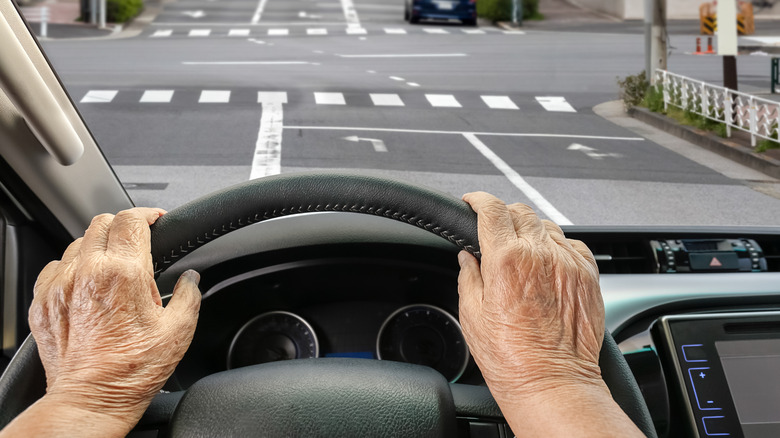
Aging, unfortunately, can come with some negative physical and cognitive changes. Activities and tasks that used to be a breeze, can become more challenging. And what used to be a basic task like driving can become overwhelming. Not everyone needs to stop driving in their golden years, and many do just fine behind the wheel. However, there are real concerns with aging drivers, like the senior citizen who nearly drove off a dirt cliff in California. For concerned families with aging relatives who see that story, it might be time to have a difficult conversation. But at what age should you hand over the car keys for good?
According to several experts, there is no set age when everyone should stop driving. Instead, according to healthcare providers like Kaiser Permanente, there should be a more customized approach to the subject, accounting for individual sensory decline, transportation alternatives, and personal feelings. Though they do note that most people drive seven to 10 years longer than they should, and that people "age 70 and older are more likely to crash than any other age group besides drivers age 25 and younger." Kaiser recommends talking to your doctor about health issues that could impede your driving ability, and keeping an eye out for warning signs. Age 70 sounds like a good time to start that conversation, if not a bit earlier.
Harvard Health Publishing (Harvard Medical School) suggests examining indicators useful in determining competence behind the wheel. For instance, frequent honking from other motorists, friends or family choosing alternatives when offered a ride, or worse, discovering mysterious vehicle body damage. They also point out the IIHS-sourced statistics that show more accidents for drivers 80 and older than almost any other group, which is another clear benchmark to keep an eye on.
At what age do states consider a driver older and what's required?

A survey published by the National Library of Medicine, "At What Age Do You Think You Will Stop Driving? Views Of Older U.S. Adults," found that over 40% of respondents between the ages of 65 and 74 claimed they'd continue driving for an additional 20+ years. But with the available data about accidents, it's not surprising that there are some specific laws regarding older drivers, the same way they do for new/young drivers.
The licensing process is different in every state. Just look at the easiest places to get your license, for example, with one state examiner passing someone simply because they were able to make it successfully to the testing location, and you'll understand the variance. These differences extend to the subject of aging drivers and license renewals, too. Several states don't stipulate a specific age considered an "older driver," like Tennessee, Vermont, and Washington. Other states, like Maryland, take a harder stance. They require vision tests and in-person license renewal at age 40. Florida has the highest stipulated age for senior drivers at 80, at which point a vision test is required for every renewal.
While many states mandate a vision test for aging drivers, some go further, calling for medical evaluations. These can include both physical and mental evaluations of an individual's ability to safely operate a vehicle. In some instances, a medical evaluation requirement can trigger when a driver of a certain age attempts to get a new license, such as when relocating. In Louisiana, for instance, if you're 60 or older and applying for your first license in the state, you'll need evidence in the form of medical reports from both an optometrist and doctor, certifying your level of fitness behind the wheel.
Why this is such a growing problem

In the year 2030, every baby boomer will have reached the age of 65, and as a group, Boomers make up an estimated 73 million people in the United States. This group (Americans over 65) is growing in size at a faster rate than overall population growth. And according to NHTSA, that will translate to over 20% of licensed drivers being over the age of 65. This means more seniors than ever before will be behind the wheel.
Retaining independence is one of the main reasons seniors continue to drive well into their golden years, but staying behind the wheel also happens as a result of limited secondary options like public transportation. In a study, "Public transit use among American older adults: Insights from a nationally representative survey," published on Science Direct, it was noted that nearly 79% of seniors live in car-dependent areas. And of those 65-or-older participants who were surveyed, nearly 58% lived alone, in areas that lacked any public transit. This makes hanging up the keys even more challenging, especially if your friends and family aren't nearby and able to help with transportation.
The internet is filled with fake posts about new, stricter driving laws for seniors, but the reality is, some age-related laws already exist, and with good reason. Making sure drivers at any age can pass a driving test, have the proper eyesight for highway travel, and safely drive a vehicle an important part of public safety. But stricter driving laws aren't a one-size-fits-all solution. With the aging population, access to public transportation is critical, as is support from nearby friends and family.