

Why Porsche Switched From Air-Cooled To Water-Cooled Engines
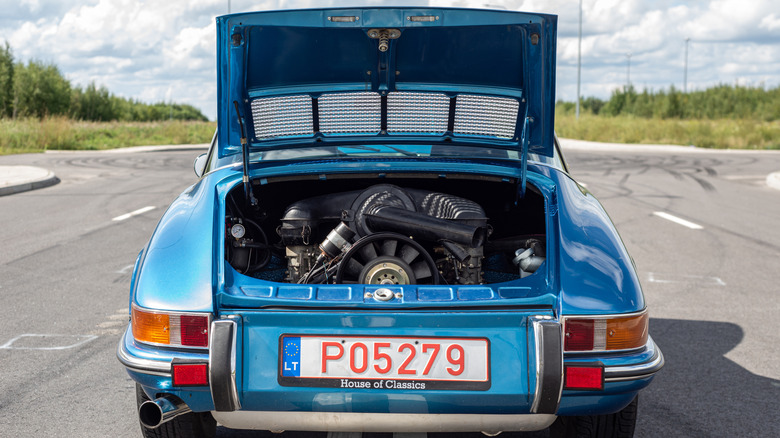
One of the most hotly debated topics among Porsche enthusiasts is which is better: the air-cooled or water-cooled 911. The sports automaker had used an air-cooled engine across multiple generations of its flagship 911, but decided to break with tradition in 1997 and sound the death knell on its tried-and-tested formula — one that had earned many admirers for its old-school charm, the visceral experience it offered, and its relatively uncomplicated mechanicals that made it easy to work on.
So what forced Porsche to change course and switch to a water-cooled engine after using it in the 911 for over three decades? One of the primary reasons for the big switch was the tightening emission regulations that were being put in place worldwide in the '90s. Air-cooled engines take longer to warm up and can't regulate temperatures as precisely as liquid-cooled engines, giving the latter a clear edge in emissions.
Another reason for Porsche to move away from its air-cooled heritage was the growing need for more power. More power generates more heat — especially in turbocharged engines – which in turn demands more effective cooling. Noise regulations may also have influenced the move to water cooling, as water-cooled engines are quieter than air-cooled ones. The 996 — the first water-cooled 911 — was also more efficient and produced lower emissions than its predecessor, the 993. Additionally, the switch to water cooling helped reduce costs by increasing parts sharing with other models in the lineup, such as the Boxster, which debuted just a year before the 996.
Which was the last Porsche model to sport an air-cooled engine?
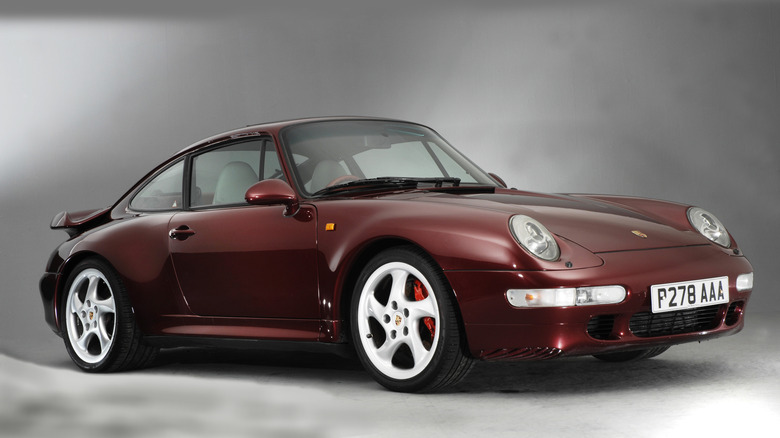
The final hurrah for the air-cooled era of the 911 was the 993, which was, in many ways, the high point of the 3.6-litre boxer flat-six engine. It featured a stiffer crankshaft paired with lighter rods and pistons, larger intake ports, and lighter valves. Launched in 1993, it was the first Porsche 911 to feature a six-speed manual and also the first 911 with a twin-turbocharger, which provided linear power delivery, produced 402 horsepower, and propelled the car to 62 mph in 4.5 seconds.
The 993 was not just about its legendary engine. Porsche engineers also refined its chassis — dubbed LSA (Light, Stable, Agile) – introducing a multi-link rear suspension that improved stability. The 993 was also a visual evolution of its predecessor, the 964, featuring slightly oval headlights instead of the traditional round ones. Its rear haunches were wider due to flared arches, and the overall body was curvier and more aerodynamic than the 964.
The 993 was a fitting way to end the air-cooled era, and many owners still swear by the build quality of the car. The air-cooled Porsche may seem like it's from a bygone time, but it lives on through restomod companies like Singer and RUF.