

Why A Live Rear Axle Is Better For Drag Racing
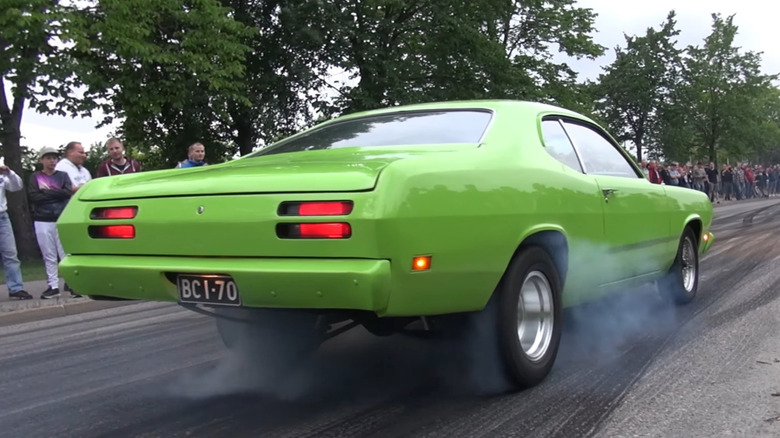
Where do you want G-forces? You can pick from four directions: during forward acceleration, under deceleration, while turning left, or while turning right. Should your car experience sustained vertical Gs, something's gone wrong. The problem is, hardware that improves performance in one direction may harm performance in another, and perhaps this concept is best exemplified by your rear end. I mean, your car's rear end. And no, I'm not talking about styling, like when people hated the Honda Civic's butt so much that they fixed it in Photoshop. I'm talking about solid rear axles and independent rear suspension, or "IRS" if that doesn't trigger thoughts of tax returns.
Dedicated drag cars usually use live rear axles, or solid axles if you prefer, while cars designed to handle twisty road courses generally feature IRS. This makes sense since solid axles have fewer small, delicate parts that can get pretzeled with continent-shifting torque, and independent suspension reduces unsprung weight and allows both rear wheels to respond to bumps without upsetting each other. That said, there are cars that buck these trends. To drag race with IRS, everything needs beefing up to avoid axle hop or snapped half shafts. Motor Trend talked to Corvette IRS drag specialist Rodney Massengale of RPM Transmissions, who said, "It's the whole drivetrain that must be strengthened to support this level of performance. It's like that saying about a chain only being as strong as its weakest link." For proof that IRS can work, look no further than Mark Carlyle and the 6.58-second quarter he ran in his IRS C6 Corvette.
As for solid axle cars that buck trends, Car and Driver thought the 2013 Mustang Boss 302 Laguna Seca handled so well, they had to triple-check to see if the engineers hadn't snuck in an independent setup.
Do me a solid and fight that squat
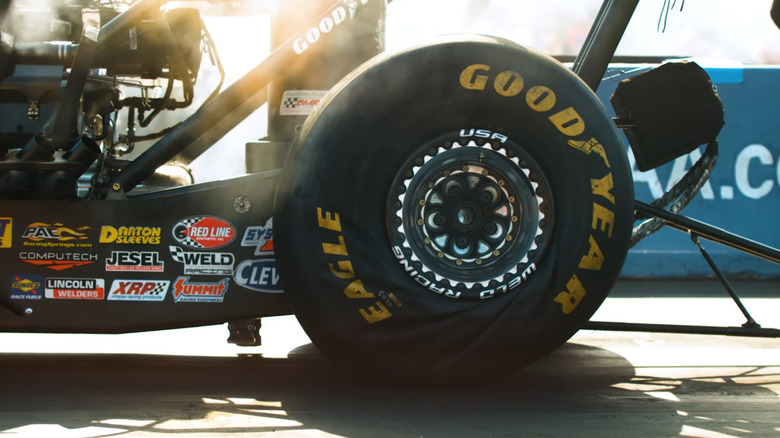
One of the biggest benefits of live axles is their ability to shift a vehicle's weight under acceleration for maximum traction. Grassroots Motorsports asked Cortex Racing's Filip Trojanek about how solid axles and IRS differ in this respect. Filip told Grassroots that in order to get max acceleration, you want the car's weight to transfer as directly as possible, so the less your drag car squats, the better. Also, the less your Cybertruck Carolina squats, the better, but you know that in your soul already. As Filip says, "That weight needs to transfer to the rear tires so they can grip the road during power-down, but it takes time to travel through the springs and shocks –- especially on a front-heavy vehicle. On a high-horsepower car, that time delay shows up as lost traction."
Top Fuel Dragsters have the simplest setups: no suspension at all. Watch a video of a Top Fuel dragster making a run, and you'll see the tires deform, then the car teleports to the other end of the track with zero squatting.
A less simple (but still simple) solid axle suspension uses leaf springs and a pair of shocks. Though leaf springs can twist under power, traction bars can mitigate this. More complex solid axle setups use multiple links, usually three or four, to prevent front-back twisting. Panhard rods keep axles from moving side to side, though triangulated four-link setups work, too. To reduce flexing more, some solid axles use torque-arms, which are basically rods that connect from the middle of the differential to a spot near the transmission. And, as the aforementioned Mustang Boss 302 proves, stiffer springs and bushings, thicker stabilizer bars, and fully adjustable shocks can do wonders to improve handling and mitigate mid-corner jumpiness.
Don't overtax your IRS
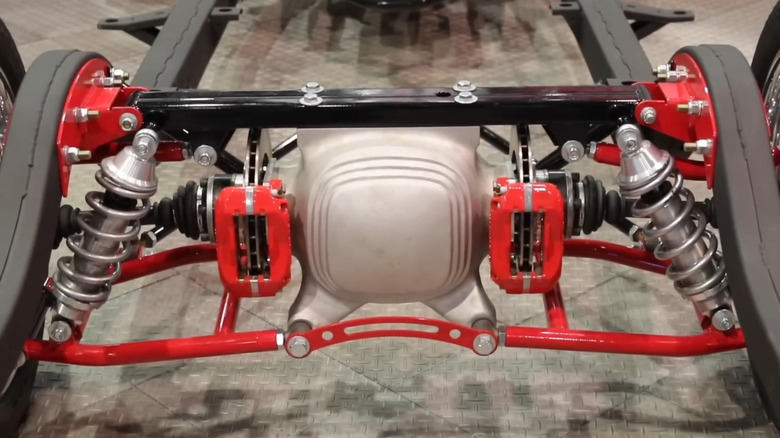
IRS can be set up to prevent squat, but this can negate the benefits of having it in the first place. Let's say you have double wishbone suspension with unequal length control arms in the rear, where the top arm is shorter than the bottom one. This lets the tires stay in better contact with the road around turns because, as the body rolls, the tires stay vertical. But, when squatting under load on a drag strip, the camber will change as the rear end squats, reducing the contact patch.
Eliminating squat with stiffer springs and shocks may help on the straights and with launches, but it will also hamper the suspension's ability to absorb bumps. Plus, the car may feel unstable around turns as a result of the stiff suspension (which is also true of cars with standard equal-length wishbones or struts). In that case, it might just be simpler to use a live axle that always holds the tires perfectly vertical, especially if all you care about is drag strip domination.
IRS has lots of pros and cons but one of the inherent uphill battles with IRS as it relates to drag racing, is that it's prone to axle hop. The tires can alternate between "all the traction" and "no traction" really, really quickly as the differential bushing and suspension subframe bushings deflect. Equal diameter half-shafts can bind and release at the same rate, which makes the hopping worse, which is why the C6 Corvette ZR1 used asymmetrical half shafts (33 mm on the left, 40 mm on the right). During axle hop, there's a twisting and relaxing of suspension components. This oscillation can destroy everything from the ring and pinions to the differential case, and even break control arm welds.