

The Oldest Motorcycle Brand In America Isn't Harley-Davidson Or Indian
Harley-Davidson holds a special place in the history of American motorcycles for a lot of reasons. One of those reasons is certainly the fact that the company is one of the country's oldest motorcycle brands, having been in continuous existence since 1903 — about 2 years after Indian Motorcycles was founded. Yes, Indian is older than Harley, but it also ceased operations for decades after 1953, was revived from 1999 to 2003, and then rebooted again when Polaris purchased the brand in 2011. Harley and Indian have been bitter rivals since the start, even at one time being responsible for a motorcycle war inside a world war.
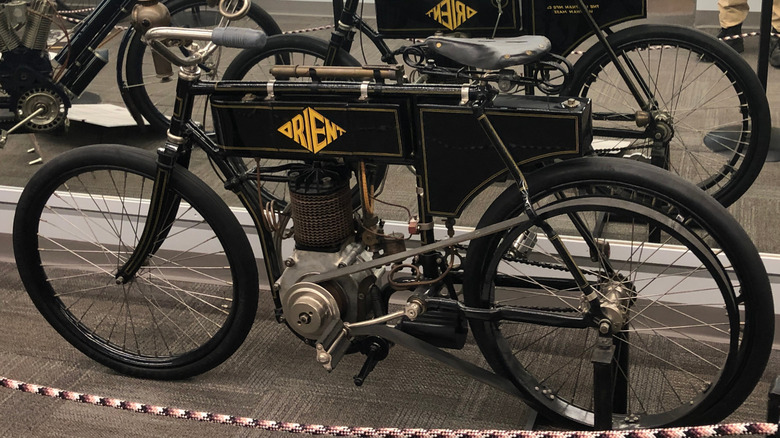
Yet, you'll have to go back a little further than those well-known names to get to the oldest motorcycle brand in America. It was born from the Waltham Manufacturing Company, which, coincidentally, chose a name that's now as fraught with racist overtones as Indian: Orient.
Anyways, the starting point to the Orient venture began in 1893, when Charles H. Metz founded Waltham Manufacturing in Massachusetts to build bicycles. Now, the company also had its own factory bike-racing team at the time, and Metz came up with a unique machine to help. It was a tandem bicycle where the rider in the front handled steering and the rider in back controlled a small gas engine that powered the vehicle. The idea was to use the bike as a simple way to set the pace for the team during training, without needing to find another human to do the pace-bike pedaling. But then Metz had a sudden inspiration.
The story of the Orient-Aster motorcycle
At some point after that, Metz realized that people would be interested in a powered bicycle as a regular means of transportation. With that in mind, he tried mounting gas engines in vehicles with a variety of wheel arrangements before eventually attaching one to a heavy-duty Waltham bicycle. The engine itself was called an Aster, named for the company that built it. That said, the motor was a copy of the DeDion-Bouton unit that was popular at the time.
Metz began advertising the machine in 1899, giving rise to what may be another first. He called the machine a "motor-cycle" in the ad, and some folks believe that was the first ever use of the term. The following year, on July 31, Metz introduced the Orient to the public with winning results — literally. Entered in what's considered the first organized motorcycle speed event in the U.S., held at Boston's Charles River Race Park, the Orient beat all comers to claim victory. Luckily, contestants back then didn't have to worry about lost Teslas driving onto the track during a motorcycle race.
Metz's motorcycle featured a 2-horsepower engine that was able to deliver some 80 mpg, and with its 5-quart fuel tank, it had a range of about 100 miles. Pricing, however, was a bit steep. The Orient-Aster started at $250 at a time when the average manufacturing wage (for adult men) was about $11.16 per week. The stage was thus set for Metz' next motorcycle move.
Whatever happened to Metz and his motorcycle company?
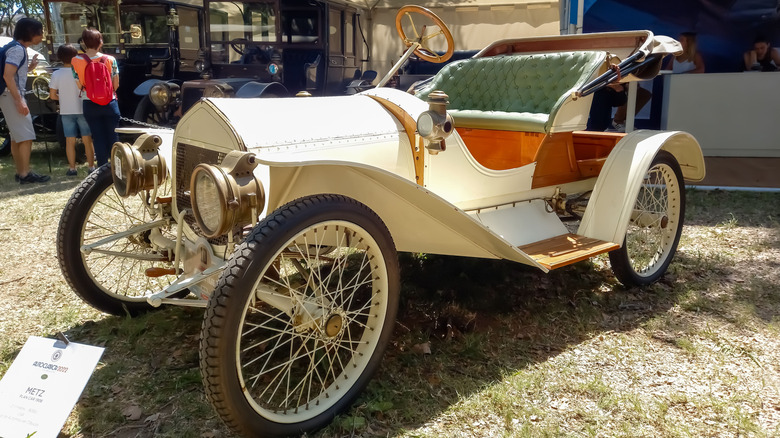
Metz' role at Waltham Manufacturing came to an end in 1902 after arguing with the company's investors. It didn't seem to affect his passion for motorcycles, though, as he went on to build and sell his own bikes before financial issues led him to merge with another small motorcycle manufacturer called Marsh.
Marsh & Metz had its share of success, introducing one of the first V-twin motorcycle engines, but it also had its share of economic difficulties. The records are inconsistent, but the company went bankrupt between 1913 and 1923.
For Metz, though, it was merely an opportunity to change his focus from two wheels to four. It seems that Waltham Manufacturing had continued operating without Metz and had started developing its own cars, but it again faced a problematic economy. That's when the bank holding Waltham's mortgage asked Metz to come back and set things right. He succeeded, temporarily, with another of his genius ideas.
The Waltham plan was to make cars affordable by selling them in a series of 14 separate parts packages that could be purchased one at a time and then put together at home. This not only lowered the final cost of cars, it represented an early way to purchase by installments instead of paying the full price up front. So, in a way, Metz could also be considered the inventor of car payments. On the other hand, today, when 1-In-5 new car buyers have $1,000 monthly payments, folks may not be so thankful.