

Why Did FWD Become The Default For Cheap Cars?
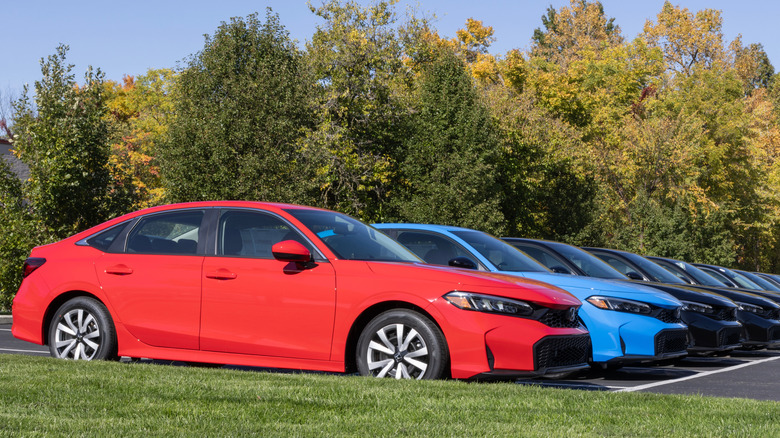
At this point, it shouldn't come as a surprise that run-of-the-mill economy cars still stick to the basics – front-wheel drive, transverse engines, and struts. While it wasn't the case during the 1950s and early '60s, when rear-wheel drive (RWD) was the norm, the turn of the millennium saw things change dramatically. If you've bought a cheap car in the last decade or two, like the 2022 Honda Civic, it probably came with front-wheel drive, otherwise dubbed FWD.
However, apart from gearheads, no one really bothers asking why FWD became so ubiquitous in economy cars. Unsurprisingly, it all comes down to money. Cheap cars are cheap because they don't cost a lot to make, and if you're in the market for a cheap and reliable car, chances are it will come with FWD.
Where a drivetrain sits determines a lot about the vehicle's driving dynamics. For instance, mid-engine cars are often praised for their superior handling, as opposed to front-engine cars. That said, not everyone is picky about handling characteristics, and economic factors often outweigh handling concerns. FWD systems offer manufacturers massive savings, which is crucial if they're targeting entry-level customers who consider a car as simply a means of personal transport. FWD cars are less complicated and easier to build, which is exactly why the bean counters love them.
Blame the malaise era and corporate profiteering

It all started during the 1970s, when the oil crisis fueled the compact car boom. Manufacturers realized that consumer sentiment was shifting from gas-guzzlers to more fuel-efficient alternatives. FWD, although not as popular as it is now, was still part of the automotive mix. Its packaging efficiency was a real selling point, and Oldsmobile and Cadillac featured the layout in the Toronado and Eldorado, respectively.
However, what really got FWD on the map were the economical runabouts from Japan and Europe, like the Honda Civic, Toyota Corolla, and Volkswagen Golf/Rabbit. Because everything is packaged inside a relatively small space, there's less weight to lug around, leading to increased fuel efficiency. In addition to superior gas mileage, another advantage is the potential for better traction in slippery conditions, as the engine's weight sits on the drive wheels. There's also the safety factor — RWD cars tend to fishtail when driven enthusiastically, while FWD vehicles don't typically experience this problem, even if you drive your FWD car extremely fast.
Additionally, FWD cars generally offer more interior space in comparison to RWD cars, as there's no need to house the long transmission and drivetrain components. From an OEM standpoint, fewer materials also means a less complicated assembly process, which brings along added monetary benefits. If you're an automaker building cheap cars, adopting FWD as the default setting is a no brainer. There's a lot to gain and very little to lose. Sure, FWD may not be as dynamic or fun as RWD, but for a daily driver, FWD makes a lot of economic sense, both for consumers and manufacturers.