

What Is Toyota's I-Force Max (And Which Vehicles Use It)?
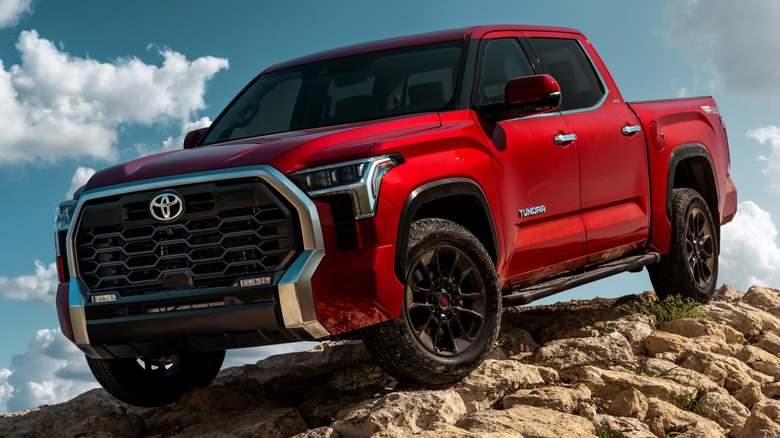
Today, if you want a large Toyota vehicle with a responsive, muscular engine that's capable, efficient, and fully compliant with emissions rules, the brand's i-Force Max engine is by far your best option. It's a hybrid powertrain system that pairs the Japanese automaker's internal combustion engines with an electric motor to provide more power and fuel efficiency than traditional ICE engines.
The i-Force Max hybrid powertrain is specifically designed for use in Toyota trucks and big body-on-frame SUVs that can both tow and head off-road. It's available in two different engine options and two states of tune, depending on the truck or SUV you're looking at. The first is a 3.4-liter twin-turbo V35A-FTS V6 hybrid producing 437 horsepower and 583 pound-feet of torque. If that's too much for your application, there's a 2.4-liter turbocharged T24A-FTS inline-four hybrid setup with 326 horsepower and 465 pound-feet of torque.
Both of these torque-rich powertrains achieve their respective outputs with a bit of help from a 48-horsepower electric motor that is itself motivated by a 1.87-kWh NiMH battery that charges through regenerative braking and by using energy from the engine. In all, there are five Toyota vehicles that are powered by the brand's i-Force Max, not to be confused with the nonhybrid Toyota i-Force engine or the Toyota Hybrid Max system found in the likes of the Toyota Crown and Toyota Grand Highlander. Here's a look at the Toyota models that come with the i-Force Max engine.
Toyota Tundra
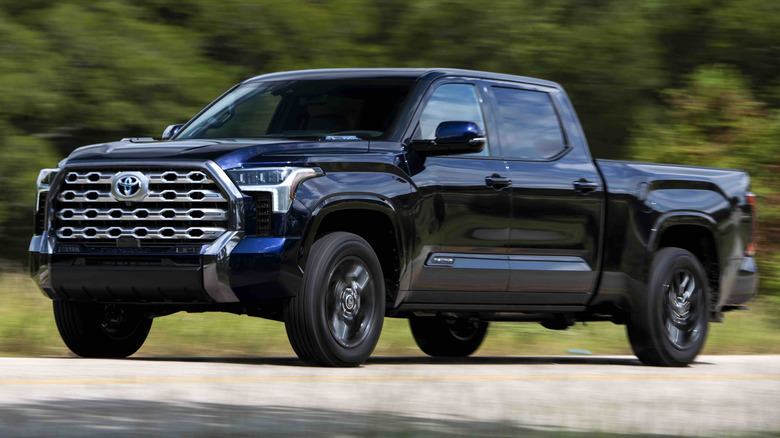
This is where it all began for the i-Force Max. The Tundra became the first Toyota production vehicle to use the i-Force Max when it debuted with the hybrid powertrain as part of the third-generation model introduced for 2022. The setup consists of a 3.4-liter twin-turbo V35A-FTS V6 paired with an electric motor placed between the engine and 10-speed automatic transmission. So equipped, the Tundra generates 437 horses and 583 pound-feet of torque.
It means the third-gen Tundra i-Force Max's peak output is increased by 56 horses and 182 pound-feet of torque compared with the old naturally-aspirated 5.7-liter V8 found in the second-generation model. It's also 48 to 79 horsepower more potent than the i-Force 3.4-liter twin-turbo V6 used in the nonhybrid third-generation Tundra models. If you're interested, there are a multitude of Tundra trim options that can be had with the hybrid powertrain, including the Tundra Limited, Platinum, 1794 Edition, TRD Pro, and Capstone. A Tundra i-Force Max can tow up to 11,450 pounds and averages 22 mpg combined in its most efficient state of tune.
Toyota Sequoia
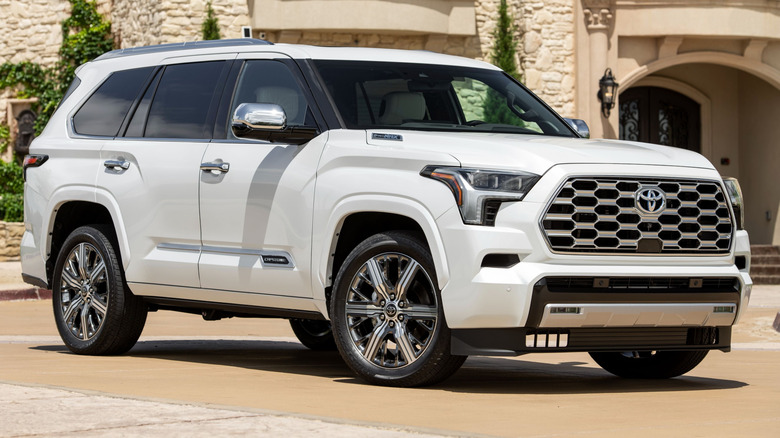
As the Sequoia is built on a GA-F platform it shares with the Tundra, it unsurprisingly uses the same i-Force Max 3.4-liter twin-turbo V6 the truck does. Like the Tundra, the Sequoia i-Force Max makes 437 hp and 583 pound-feet of torque, but unlike the Tundra, there's no nonhybrid i-Force engine here, meaning you get the i-Force Max with the Sequoia as standard no matter which trim level you choose. This has been the case since the third generation of the full-size SUV was introduced in 2022.
All that muscle makes for a capable tow vehicle, as the Sequoia is able to pull a hefty 9,520 pounds. But you'll need the rear-wheel-drive SR5 to unlock that maximum capability. Four-wheel drive SR5 models are good for 9,120 pounds. Opting for the Tundra Platinum or 1794 gets you up to 9,310 pounds of towing capacity, while the Limited trim is tow-rated at 9,300 pounds max. The TRD Pro makes do with 9,020 pounds of towing capacity, whereas the Capstone grade is rated to pull up to 9,280 with the right equipment. EPA estimates suggest the Toyota Sequoia can get up to 22 mpg combined and up to 24 mpg on the highway.
Toyota Tacoma
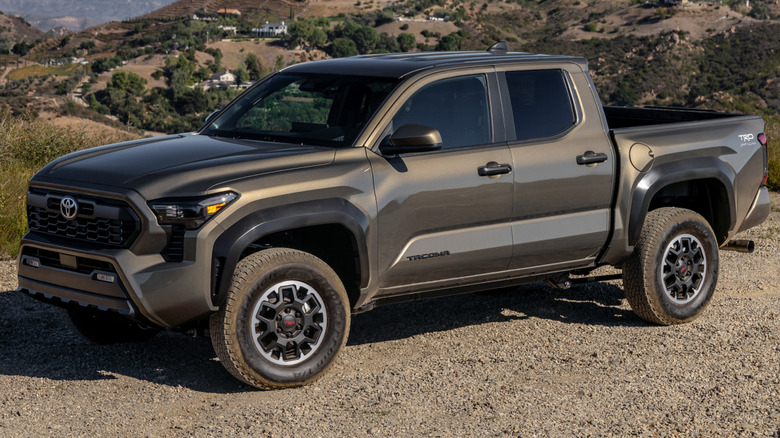
From here on in, it's all i-Force Max 2.4-liter turbocharged T24A-FTS inline-four. The hybrid mill launched with the fourth-generation Tacoma in 2023 and generates a total system output of 326 hp and 465 pound-feet of torque, allowing the Toyota Tacoma Hybrid to blow away every truck in its segment. For context, the outgone 3.5-liter V6 in the third-gen Tacoma made 278 horsepower and 265 pound-feet of torque, while the base 2.7-liter four-cylinder produced a more modest 159 horsepower and 180 pound-feet of torque.
Of course, hybrid assist also means better fuel efficiency than the previous V6, even if the fuel savings involved are negligible. According to EPA tests, Tacomas with the i-Force Max hybrid powertrain average up to 23 mpg combined. That means it delivers an improvement of up to 2 mpg over the most economical 2023 V6 Tacoma models, which see 21 mpg combined on average. More importantly, you won't lose much towing ability with the hybrid engine, as Tacoma models with the i-Force Max engine are rated to tow a maximum of 6,000 pounds and carry a payload of 1,709 pounds. The nonhybrid fourth-generation Tacoma tops out at 6,500 pounds with its payload rated at 1,705 pounds.
Toyota Land Cruiser
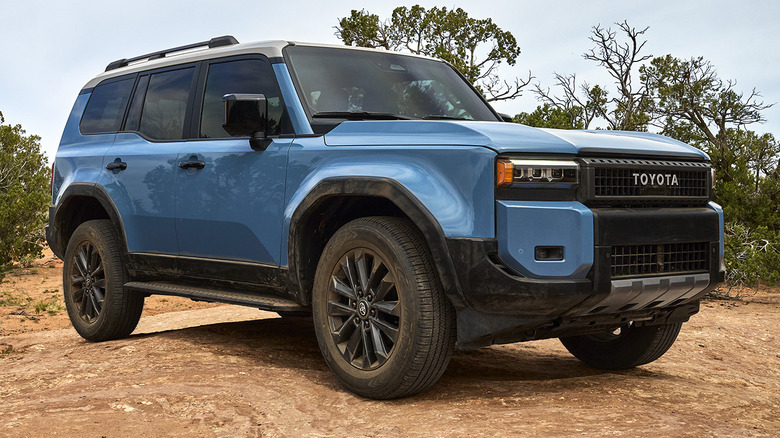
The legendary Land Cruiser has long been the SUV for Toyota aficionados looking for a serious midsize high-rider with true go-anywhere ability. But it has been stung by criticism of its heavy price tag and poor fuel economy. The 381-horsepower 5.7-liter V8 engine in the previous generation car averaged 14 mpg combined, which many regarded as hugely disappointing. To address this, Toyota opted to give the seventh-generation model the i-Force Max 2.4-liter turbocharged T24A-FTS inline-four, lifting its efficiency figure to 23 mpg combined in the process and making the new-gen Land Cruiser the revival of an off-road icon.
At 326 horsepower, it makes 55 horsepower less than the previous generation. However, the Land Cruiser's i-Force Max engine generates 64 more pound-feet of twist than its predecessor, considering it makes 465 pound-feet of torque compared with 401 pound-feet for the discontinued V8 engine. As with the engine, the sole transmission on offer is an eight-speed automatic that funnels power to the standard full-time four-wheel-drive system. The SUV also comes standard with center and rear locking differentials and can tow up to 6,000 pounds with the right equipment.
Toyota 4Runner
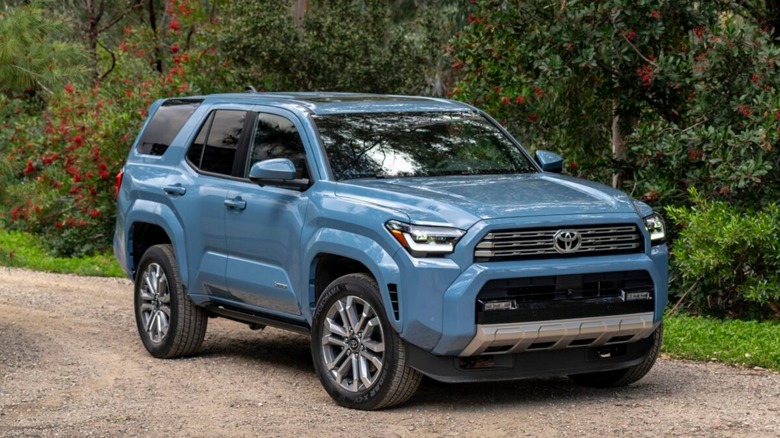
Another Toyota SUV that's powered by the i-Force Max engine is the 4Runner, which began offering the hybrid with the introduction of the fully redesigned 2025 model. As with the models above, the version in the 4Runner makes up to 326 horsepower and 465 pound-feet of torque. Another important note is that it offers the same 23 mpg combined and 6,000 pounds of maximum towing capacity as the current Tacoma and Land Cruiser. In Car and Driver's testing of a 2025 Toyota 4Runner Trailhunter, the i-Force Max engine helped push the SUV to 60 mph in an impressively quick 6.7 seconds.
That's about a second quicker than the four-wheel-drive 2025 Toyota 4Runner Limited with the standard nonhybrid i-Force engine. The downside is that the hybrid advantage does mean starting prices are higher than the nonhybrid models, at $52,790 for the base-spec 4Runner TRD Off-Road i-Force Max and at least $67,900 for the 2026 TRD Pro i-Force Max. In comparison, the nonhybrid 4Runner starts at $41,570 for the SR5 and tops out at $58,200 for the Limited trim. These are the manufacturer's suggested retail prices (MSRP) and, as such, do not include delivery and handling fees.