

Why Drag Races Were Always A Quarter Mile (And When That Changed)
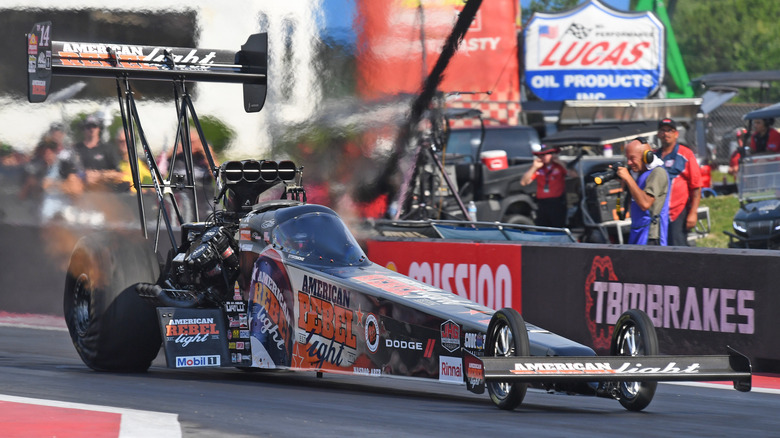
Dom Toretto may live his life a quarter mile at a time, but you know who doesn't? Drivers in the NHRA's Top Fuel and Funny Car classes. Organized drag racing has been around since at least the late 1940s, but advances came fast and furious. By 2008, the speed these vehicles could reach had become a safety issue. Following the death of Scott Kalitta, the NHRA decided to shorten the distance for its most powerful racers to 1,000 feet to help prevent further injuries.
It marked a major change to the sport, which got its start in 1949 when top speeds were just edging into triple-digit territory. About 60 years later, Tony Schumacher drove his NHRA Top Fuel dragster to a then record-setting 337.58 mph in the quarter mile. Brittany Force bested that mark this year when she became the fastest person in NHRA history, thanks to a run of 341.85 mph that allowed her to edge past the previous record of 341.68 mph.
The origin story for the quarter mile itself goes back to the Southern California gearheads who began doing acceleration runs at a small airport in Goleta. The growing buzz of these events attracted the attention of a local journalist, and as he was gathering facts, he naturally asked how long the races were. Truth be told, no one seems to have measured, but Bob Joehnck, an unofficial spokesperson for the group, basically pulled a quarter mile out of thin air. From then on — until 2008 at least — the quarter mile became the drag racing standard.
What happened in 2008?
Many people also raced — illegally and dangerously — right on public streets. In fact, when Wally Parks founded the National Hot Rod Association (NHRA) in 1951, getting drivers off the road and onto a closed track was a top priority. Once that happened, speeds really began to take off.
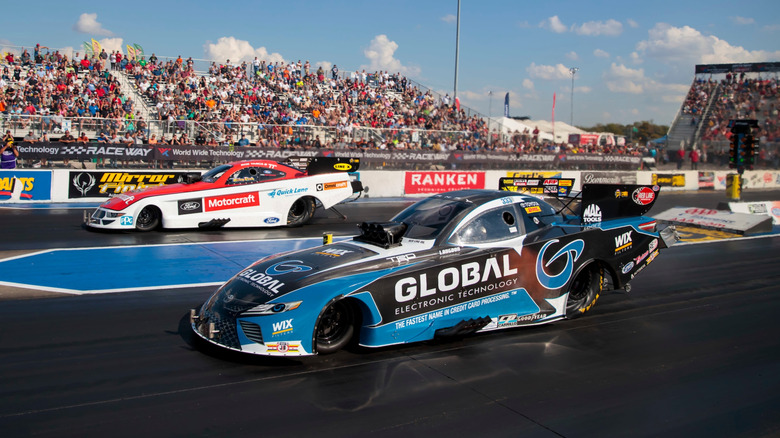
The first NHRA driver to exceed 150 mph in competition was Art Arfons in 1956, although Lloyd Scott broke that barrier in a non-NHRA event in 1955. Big Daddy Don Garlits rocketed past 200 mph in 1965 and 250 mph in 1975. By 1992, Kenny Bernstein was clocking passes north of 300 mph in his Top Fuel dragster. Funny Cars, like this Supra with a hilarious underbite, joined the 300-mph club the following year, courtesy of a 300.40-mph run by Jim Epler.
Soon after, though, tragedy began to catch up with the increasing speeds. Driver Darrell Russell died in 2004 during a Top Fuel race after his engine detonated. In 2007, during testing, Funny Car driver Eric Medlen was killed in a crash. Next, Scott Kalitta — a two-time NHRA champ and son of drag racing legend Connie Kalitta — lost his life after an engine explosion and parachute failure saw him go off the end of the strip, through the run-off area, and into a brick wall. As a result, the NHRA shortened the race distance for Top Fuel and Funny Cars to 1,000 feet to allow more room for the racers to slow down at the end of an event.
Are drag races a quarter mile in Europe?
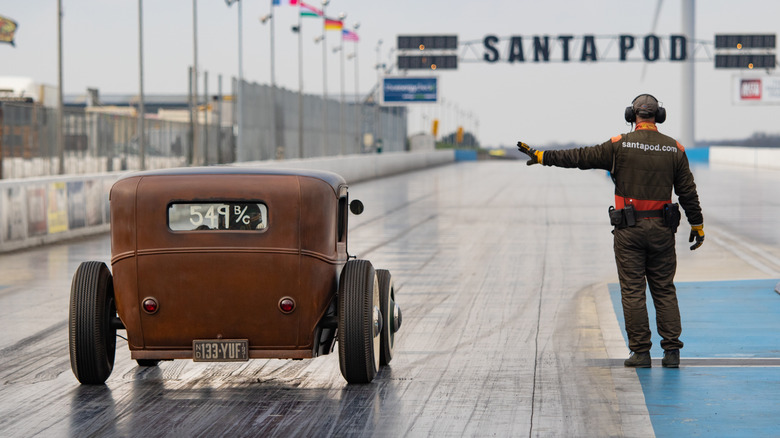
While the good ol' U.S. measures distances in freedom units, most of the rest of the world goes metric. But patriots will be glad to know that the world of European drag racing continues to follow the NHRA's standard of quarter-mile strips for most classes except Top Fuel and Funny Car, where the cars compete over 1,000-foot distances. That's one of the biggest differences between racing In America and Europe, which may bring up another question: There's a world of European drag racing?
Yes, and the organization behind it is none other than the FIA (Fédération Internationale de l'Automobile), which is the same organizing body behind Formula 1, the World Endurance Championship, and the World Rally Championship, among others. The FIA began overseeing the European Drag Racing Championship in 1997, with the current season featuring stops in Great Britain, Sweden, and Germany.
The sport itself grew in popularity in the 1960s, thanks to events like the first British International Drag Festival in 1964. The first permanent drag racing facility in Great Britain launched in 1966 at an old U.S. Air Force base. Still in operation, the Santa Pod Raceway even took its name from the southern California scene, since the "Santa" was taken from West Coast cities like Santa Barbara and Santa Monica. The "Pod" part was a shortening of the name shared by the air base and a nearby village, Podington.