

What Do They Lay Down On Drag Tracks To Make The Surface So Sticky?
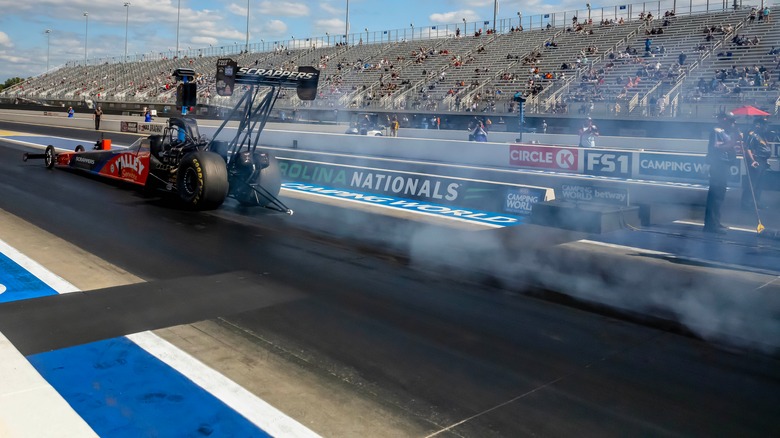
Achieving quick drag times takes more than horsepower and a stripped-down, lightweight body. The key is to put the power down effectively, as even cars with 1,000 hp may struggle to grip the surface if they skitter around. This is where a magic sticky liquid sprayed on the surface comes into play. And like many things in racing — such as aerodynamics — this compound traces its roots back to the aerospace industry.
The resin, PJ1 TrackBite, was developed by Sperex Corporation and first used by NASA as a high-temperature coating for the Space Shuttle before being adopted for drag racing. More recently, it's also been used on some NASCAR tracks (although it wasn't well-received in IndyCar).
PJ1 TrackBite is made from a proprietary resin combined with toluene, ethanol, isopropanol, methylcyclopentane, n-hexane, and hexane. It increases traction by improving the adhesion between the track surface and the tires, helping cars launch harder and maintain a straight, fast run with less wheel spin. The resin isn't sticky when cold, but when warmed, it becomes adhesive and provides excellent grip. Different tracks employ varying thicknesses of surface treatment depending on the temperature, while methanol is typically applied atop the coating to help distribute it more evenly.
The compound is water-resistant, so rain can't wash it away, but it can cause a loss of traction where there's oil on the track. However, it doesn't alter the drag strip's surface, as it's gradually removed along with tire rubber as more is laid down.
What else is needed to make a drag track stickier?
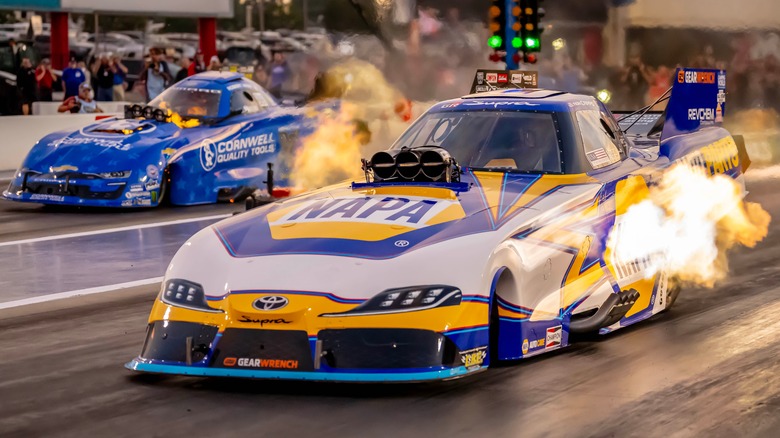
It takes more than just PJ1 TrackBite to make a drag track grippy — there's a certain science to it as well. Some event organizers wash the track with detergent to remove dust and oil, while the pits are cleaned thoroughly to ensure that dust and rocks don't stick to the tires. Scraping the track to remove rubber accumulated from previous events is essential. This is done using a combination of hand scraping, machinery, and blowtorches.
After applying a treatment like PJ1 TrackBite, old tires are pulled over the surface to deposit additional rubber, thereby building up a layer on the track. Some tracks previously used a tire dragger, a specialized bit of machinery with racing slicks attached to a tractor, but there are now specialized tire rotator machines that do the same job. These slicks rotate in the opposite direction of the tractor's movement, effectively laying down additional rubber onto the track surface.
Other factors also affect a track being quick or not, including the temperature — both surface and air — humidity, and moisture. Together, these elements interact to determine how much grip a drag track offers. But PJ1 TrackBite gives it a running start.