

Why The SR-71 Blackbird's Windshield Made It Unique Among Airplanes
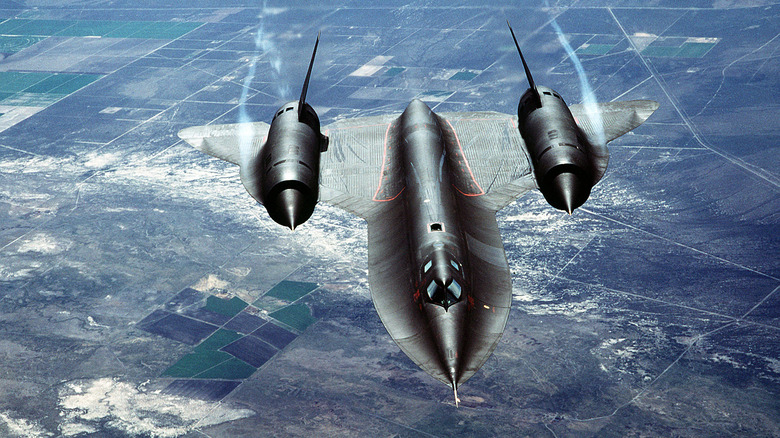
Watch the impressive engineering in this in-depth tour of the SR-71 Blackbird's jet engine and you'll see an extraordinary reconnaissance aircraft that still impresses despite taking its first flight in 1963 and its last in 1999. It looks like something out of science fiction, and beyond its iconic appearance, most remember the Blackbird for its remarkable capabilities, such as achieving speeds up to Mach 3.3, and cruising at altitudes of 85,000 feet.
Its windshield is also a fascinating bit of engineering. While modern military aircraft like the F-22 feature a canopy made from monolithic polycarbonate (a type of plastic), the SR-71 needed quartz glass 1.25 inches thick. The reason was excessive heat, as the Blackbird's 2,500-mph speeds caused the air just outside the cockpit to reach temperatures over 600 degrees. The point at which glass melts depends on its chemical properties, but even borosilicate glass, known for its heat resistance, will melt if the temperature gets high enough. Lockheed's engineers opted for quartz because it was even more heat-resistant and wouldn't distort under high heat like other forms of glass, maintaining clear optics for the pilot and spy cameras.
The SR-71's windshield comprises four sections of glass, rather than one uninterrupted continuous single piece. Again, this has to do with combating the extreme forces this aircraft was under during flights. Smaller solid-quartz sections were less susceptible to potential damage than larger configurations.
The thermal demands of more than 2,500 mph didn't just affect the windshield's design
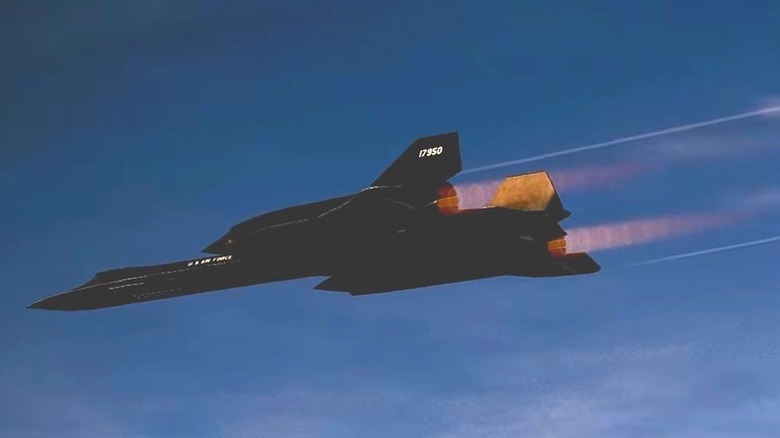
When you learn the story of the SR-71 Blackbird, America's most badass spy plane, you realize what a marvel of engineering it was. Most planes built in the last century have frames built of aluminum, which offers significant strength while being lighter than options like steel. But the Blackbird's 600-degree temperature while cruising would be too much for a traditional frame. In fact, an aluminum frame would have melted, so engineers had to come up with a solution that could stand up to the heat. Titanium was substituted — the first time an aircraft used it.
But building the frame with titanium didn't solve all the issues at hand. Many materials react to changes in temperature, expanding when heated and contracting when cooled. What this meant for the Blackbird was that the exterior aircraft panels swelled at high speeds. To counteract this, these panels were deliberately designed to be undersized. Once exposed to elevated temperatures, the aircraft's skin would expand, filling out to the appropriate size.
The SR-71's exterior color is due to temperature
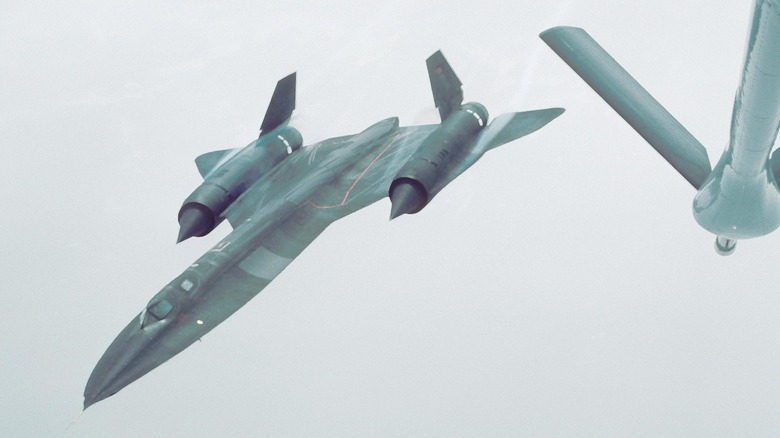
While the SR-71 appears to be black, and even was nicknamed the Blackbird, it's actually painted a very dark blue. This was a response to the temperature increases at supersonic speeds. To put things into perspective, SR-71 is one of the only planes fast enough to outrun the Earth's rotation. So one of the issues facing engineers was how to deal with variations in temperature across the aircraft. While sections of the Blackbird became increasingly hot as it sped up, the ambient temperature at altitude is very cold. For example, if it's 68 degrees at ground level, by the time an aircraft reaches 40,000 feet, it's around minus 71 degrees.
A special paint not only helped reduce the Blackbird's radar profile, but also evenly spread heat across the exterior. The dark shade used both absorbed and radiated heat, so the SR-71 didn't have an extreme disparity between very cold and hot panels during flight.